

Black Shuck: The Demon Hound of East Anglia
Across the marshes, churchyards, coastal roads and lonely lanes of East Anglia moves one of the darkest creatures in English folklore. Black Shuck is the great spectral hound of Norfolk and Suffolk, with traditions extending into the Cambridgeshire Fens and parts of Essex. Similar phantom dogs haunt many other regions of Britain, but they should not all be collapsed into Shuck. The Black Dog of Dartmoor, the Whisht Hounds of Devon and other regional apparitions belong to the wider British tradition of supernatural hounds, while Black Shuck remains above all an East Anglian presence.
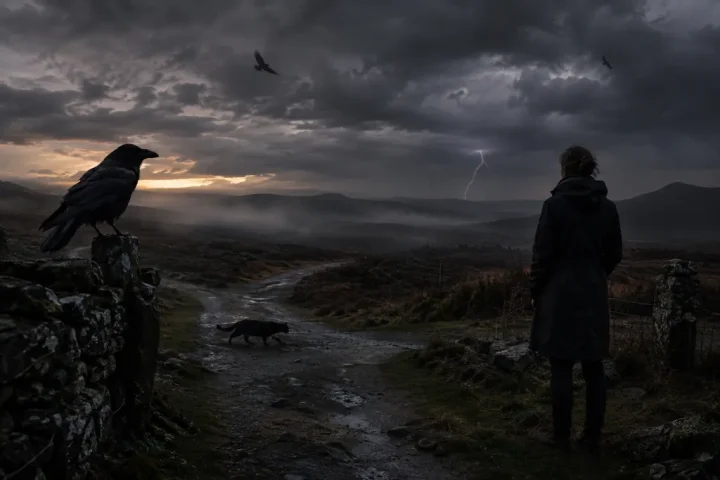
Descriptions vary because Shuck has never possessed one fixed form. He may appear as an enormous black dog, sometimes said to be as large as a calf or even a horse, with shaggy fur and eyes that burn unnaturally in the darkness. Some traditions give him two fiery eyes, while one famous Norfolk description gives him a single blazing eye in the middle of the forehead. Later storytellers have made him headless, surrounded him with mist or added the sound of rattling chains, but the oldest recognisable image is simpler and perhaps more disturbing: an impossibly large black hound encountered where no ordinary dog should be.
To some witnesses he is a harbinger of death. To others he is merely frightening, while still other traditions transform the spectral dog into something strangely protective, an unseen companion of solitary travellers. That ambiguity is essential to understanding Black Shuck. He is not merely Britain’s version of a demonic monster. He belongs to an older and much wider supernatural territory in which dogs guard thresholds, accompany the dead, announce death, protect travellers and move between the human world and whatever lies beyond it.
The Meaning of the Name
Even the name Black Shuck remains uncertain.
One influential explanation connects Shuck with the Old English word scucca, also found in forms such as sceocca, meaning a devil, demon or evil spirit. The Bosworth-Toller Anglo-Saxon Dictionary gives scucca precisely this supernatural meaning, making the connection between Shuck and an older English word for a demonic being highly suggestive.
There is another possibility. In an 1850 issue of Notes and Queries, an East Anglian correspondent described what he called “Shuck the Dog-fiend” and suggested that the name might be connected with the Norfolk dialect word shucky, meaning shaggy. The same account described the phantom as “a black shaggy dog, with fiery eyes, and of immense size” that visited churchyards around midnight. It also noted that a lane at Overstrand was known locally as Shuck’s Lane.
Neither derivation can be treated as absolutely certain. Folklore names frequently mutate through dialect, reinterpretation and centuries of oral transmission. Yet both possibilities are appropriate. Shuck may have been named for his shaggy appearance, for his demonic nature, or through a gradual fusion of words that sounded increasingly appropriate to the creature people believed they were encountering.
The Storm of 1577
The most famous event later associated with Black Shuck occurred on 4 August 1577, when an extraordinary storm struck Suffolk.
At St Mary’s Church in Bungay, people had gathered for worship when the weather became violent. Abraham Fleming published an account later that year under the title A Straunge and Terrible Wunder. He described rain falling with extraordinary force, terrifying thunder and lightning, and darkness so complete within the church that people could see one another only when lightning illuminated the interior.
Then something appeared.
Fleming wrote that the congregation saw a creature in the likeness of a black dog. He described it rushing through the church at extraordinary speed while the terrified worshippers believed that Judgement Day itself might have arrived. Fleming called it a black dog or perhaps “the divel in such a likenesse”, making his own interpretation unmistakably religious.
According to the pamphlet, the creature passed between two people who were kneeling in prayer and both died immediately. Another man was said to have been horribly injured as the apparition passed him, while the church itself was shaken by the storm. Fleming also reported damage to the building and referred to marks remaining in the stone and church door that he compared with the traces of claws or talons.
The episode is one of the great moments in English supernatural folklore, but it must be understood correctly. Fleming did not call the animal Black Shuck. His pamphlet predates the first clear printed use of that name by centuries. He was also writing a religious warning, not conducting a neutral investigation. Storms, strange accidents and unusual natural phenomena were frequently interpreted in sixteenth-century Protestant literature as signs of divine judgement, and Fleming explicitly used the Bungay disaster to urge repentance.
Yet the image he preserved was unforgettable: a black dog moving through a darkened church amid thunder, fire and death.
Later generations recognised Shuck in it.
The Hound at Blythburgh
Fleming claimed that the same supernatural form appeared later that day at Holy Trinity Church in Blythburgh, several miles from Bungay.
His account says that the creature appeared upon a beam inside the church before sweeping down through the congregation. Two men and a boy were said to have died, another person suffered a burned hand, and other worshippers were injured before the apparition departed in what Fleming called a hideous and hellish form.
Holy Trinity still embraces its connection with the legend. The church describes itself today as the home of the Black Shuck legend and welcomes visitors interested in the story.
Marks traditionally identified as Shuck’s claw or scorch marks can still be seen on the church door, although there is no way to prove that a supernatural animal produced them. Storm damage, fire, lightning or later deterioration provide obvious natural possibilities, while folklore offers the far more memorable explanation.
This is where the legend becomes particularly powerful. The story is not built entirely from later oral tradition. There really was a sixteenth-century pamphlet describing a black dog during a catastrophic storm. Real churches are named. Deaths are described. Physical damage is mentioned. What cannot be established is the supernatural interpretation placed upon those events.
The facts and the legend entered the same storm and have never completely separated.
The One-Eyed Hound
By the nineteenth and early twentieth centuries, Black Shuck had acquired many of the features now associated with him.
William A. Dutt, writing in Highways and Byways in East Anglia in 1901, described a huge black dog moving silently along lonely lanes and field paths. Although its howl was terrifying, its feet were said to make no sound. Most strikingly, Dutt recorded a tradition in which the hound possessed only one fiery eye, set in the centre of its head like that of a Cyclops. Meeting this apparition was said to warn the witness that death would come before the end of the year.
This one-eyed Shuck became one of the most visually memorable versions of the legend, but it should not be treated as the creature’s universal form. Other stories give him two enormous glowing eyes, often red, yellow or green. Still others describe nothing more supernatural than a great black dog whose size, silence or sudden disappearance reveals that something is wrong.
Folklore does not behave like zoology. There is no official anatomy of Black Shuck because each encounter reshapes him slightly. What remains constant is the impression of an animal that resembles a dog closely enough to be recognised and differs from one just enough to inspire terror.
The Death Omen
Black Shuck’s association with death is among his most enduring characteristics. In some Norfolk traditions, seeing him means that the witness or someone close to them will die within a year. The apparition does not necessarily need to attack. Merely encountering it may be enough.
This places Shuck among a much wider class of supernatural omens. The frightening power of such beings lies not in what they physically do but in what they know. The death hound may simply appear, look at the witness and continue on its way because the important event has already been determined elsewhere.
Yet East Anglian black dog folklore contains more benevolent traditions as well. Some supernatural dogs accompany people travelling alone or appear to protect vulnerable travellers. Modern folkloric discussion has noted that benign versions became increasingly visible in later accounts, suggesting that the black dog was never completely imprisoned within the role of demonic predator.
Shuck may therefore belong to the old supernatural category of the threshold guardian as much as to the hellhound. A guardian can protect one person and terrify another because its purpose is connected with the boundary it guards, not with simple human ideas of good and evil.
Churchyards, Marshes and Lonely Roads
The traditional landscape of Black Shuck is as important as his physical appearance. He is repeatedly encountered around churchyards, country lanes, coastal paths, marshes and isolated roads, particularly after dark.
These are liminal places. A churchyard marks the meeting place between the living and the dead. A road carries the traveller between settlements. Marshland exists between earth and water, while the East Anglian coast forms the unstable edge where the land disappears into the North Sea. Such locations have attracted supernatural traditions throughout European folklore precisely because they represent passage, uncertainty and transition.
Later occult writing sometimes connected Black Shuck with ley lines and invisible currents of earth energy. That interpretation belongs primarily to twentieth-century occultism and should not be projected backwards as an ancient East Anglian belief. There is no good evidence that the historical Shuck tradition depended upon a prehistoric system of energy lines.
The older mythology needs no such addition. Black Shuck already belongs to thresholds because the places where he appears are thresholds themselves.
Was Black Shuck Brought by the Vikings?
A long-standing theory attempts to trace Shuck back to Scandinavian mythology and the Viking settlement of East Anglia. Dutt was already discussing the idea in 1901, referring to writers who interpreted the legend as a survival of a Scandinavian black hound associated with Odin.
The theory is attractive because Norse mythology contains supernatural wolves, dogs and guardians connected with war and the dead. East Anglia also experienced extensive Scandinavian settlement, making cultural transmission entirely plausible.
What cannot be demonstrated is the existence of one specific black war hound of Odin that later became Black Shuck. Odin’s famous animal companions include the wolves Geri and Freki, but the neat genealogy sometimes presented in paranormal books goes far beyond what the medieval sources support.
A Scandinavian influence therefore remains possible without being proven. Black Shuck may contain Germanic, Scandinavian, Christian and later folkloric elements layered upon one another over many centuries. Folklore rarely preserves a pure original form, especially in regions where cultures repeatedly met, fought, settled and intermarried.
The creature we now call Shuck may therefore be less like a surviving fossil from one ancient religion and more like a shadow cast by several forgotten traditions at once.
Black Shuck and the Devil
Christian interpretation played an enormous role in shaping the sinister reputation of supernatural black dogs.
The association is explicit as early as Fleming’s 1577 pamphlet. The writer did not simply describe an unusual animal. He suggested that the black dog might actually have been the Devil appearing in canine form.
This idea fitted comfortably within early modern European beliefs in which Satan and demons could assume animal shapes. Black animals in particular accumulated sinister associations in witchcraft and demonological literature, while dogs already possessed ancient connections with death, graves and the supernatural world.
It would nevertheless be a mistake to conclude that every spectral black dog was originally demonic. Christianity frequently reinterpreted older supernatural beings through the vocabulary of devils and demons. A guardian of the dead, ancestral hound or territorial spirit could become infernal simply because Christian theology possessed fewer acceptable categories in which to place it.
Black Shuck may therefore be demonic in some traditions without being reducible to Satan in all of them.
Smugglers and the Useful Ghost
Another popular theory gives the legend a much more practical origin.
East Anglia’s long coastline supported centuries of smuggling, and later writers suggested that smugglers could have encouraged frightening stories about spectral dogs to keep local people away from beaches, tracks and secluded roads while contraband was being moved.
The explanation is plausible as an exploitation of existing superstition, but there is little evidence that smugglers actually invented Black Shuck. The tradition is too deeply embedded in East Anglian supernatural culture to be explained so easily.
Criminals did not need to create the ghost.
They only needed people to believe in it.
A rumour that a demonic hound roamed a particular stretch of coast would have been a remarkably cheap form of security on a moonless night.
The Gorleston Sighting of 1972
One of the best-known modern reports occurred at Gorleston-on-Sea on 19 April 1972.
Coastguard officer Graham Grant was reportedly on duty shortly before dawn when he noticed a large black hound running along the beach. The account states that he watched the animal for a minute or two as it ran and occasionally stopped, apparently searching for someone. Then, while he was still watching, the dog disappeared. Later summaries trace the account to a report published in the Eastern Daily Press on 27 April 1972.
The detail that makes the episode memorable is that Grant reportedly did not initially see anything monstrous about the animal. There were no blazing eyes, chains or enormous supernatural proportions. It simply looked like a large black hound until it vanished from open ground where Grant expected it to remain visible.
Later retellings added deaths supposedly connected with the sighting, including the death of a colleague and that of Grant’s father. Those additions are difficult to verify independently and should not be used as evidence that the traditional death omen was fulfilled.
The encounter is stronger without them. A man watching a beach through the quiet hours before dawn sees a dog. He keeps looking at it, and then there is no dog.
That is enough to enter folklore.
Sightings in the Modern Landscape
Reports associated with Shuck did not stop in the twentieth century. Modern paranormal databases continue to collect claimed encounters with strange dogs across Norfolk and neighbouring counties, including a 2006 Gorleston report describing a long-legged dog-like animal that allegedly vanished during a second sighting. These reports are anecdotal and cannot be treated as proof of a supernatural creature, but they demonstrate that the tradition remains active rather than fossilised in Victorian folklore collections.
Academic interest has also moved beyond the simple question of whether witnesses “really” saw a ghost dog. Anthropologist Jonathan Woolley has examined Black Shuck as part of a living Norfolk relationship with landscape, memory, fear and environmental experience. His research treats Shuck as a creature whose significance continues through contemporary encounters and storytelling rather than as an obsolete superstition from a vanished rural England.
This is one reason Black Shuck remains difficult to kill with rational explanation. Even if every individual sighting could be explained as an ordinary dog, darkness, fatigue, mistaken distance or expectation, the cultural creature would remain. Shuck exists not only in alleged encounters but in the way generations have learned to interpret certain roads, coasts and churchyards.
The landscape itself has acquired a memory of the hound.
Black Shuck and The Hound of the Baskervilles
Black Shuck is often credited as the direct inspiration for Sir Arthur Conan Doyle‘s The Hound of the Baskervilles, but the evidence requires a more careful conclusion.
Conan Doyle acknowledged that his friend Bertram Fletcher Robinson gave him the idea through a West Country legend involving a spectral dog connected with an old family on the moors. In a later letter, Conan Doyle explicitly stated that the story grew from Robinson’s remark about such a legend.
This points more strongly towards Devon and Dartmoor black dog traditions than directly towards East Anglia’s Black Shuck. The supernatural hound of the Baskervilles therefore belongs to the same broad British family of ghostly dogs, but it is misleading to claim that Shuck alone inspired Conan Doyle’s novel.
The distinction makes British black dog folklore richer, not poorer. Black Shuck is not one wandering creature whose name changes from county to county. Britain contains numerous regional hounds, each accumulating its own roads, graves, families, warnings and supernatural character.
The Baskerville hound is one literary descendant of that wider darkness.
Black Shuck in the Twenty-First Century
Far from disappearing beneath modern roads, electric lighting and mobile phones, Black Shuck has become one of East Anglia’s most recognisable supernatural symbols.
Bungay now hosts the Black Shuck Festival, founded around the town’s connection with the events of 1577. The 2026 festival takes place from 31 July to 2 August and celebrates folklore, storytelling, art and the supernatural imagination of East Anglia. Its programme even directs visitors back towards Fleming’s original account of the “Straunge and Terrible Wunder”, placing the sixteenth-century source at the centre of the modern celebration.
The creature has also moved far beyond local folklore. Royal Mail included Black Shuck among eight figures in its Myths & Legends stamp collection, alongside Beowulf and Grendel, Blodeuwedd, the Loch Ness Monster, Cornish Piskies, Fionn mac Cumhaill, Grindylow and the Selkie.
There is something wonderfully strange about that transformation. The dog once interpreted as the Devil rushing through a church has become a figure printed upon British postage stamps and celebrated through art and festival culture.
Yet domestication has limits.
A colourful festival representation of Shuck is harmless because everybody knows where the costume ends. The older Shuck survives in another place entirely, waiting for the moment when the road ahead is empty and something black begins moving at the edge of the headlights.
What Is Black Shuck?
Attempts to identify Black Shuck eventually reveal more about the person asking the question than about the creature itself.
For the Christian writer of 1577, a black dog appearing during a violent thunderstorm could be the Devil and a warning of divine judgement. For nineteenth-century antiquarians, Shuck might be a surviving Germanic or Scandinavian tradition. For folklorists, he belongs to the British family of supernatural black dogs. For paranormal researchers, he becomes an apparition or unexplained entity. For cryptozoological enthusiasts, he can be treated almost like an unknown animal. Modern occultists may interpret him as a liminal spirit connected with death, roads and ancient landscape.
None of these interpretations completely contains him.
If Shuck were merely an animal, the death omens and churchyard traditions would make little sense. If he were simply Satan, the benign and protective black dog stories would become difficult to explain. If he were nothing more than an old Norse survival, the Christian and local East Anglian layers would disappear. If he were invented entirely by frightened villagers or smugglers, the extraordinary durability and geographic complexity of Britain’s black dog tradition would remain unanswered.
Black Shuck survives because ambiguity is his natural habitat.
He appears at the edge of categories just as he appears at the edge of places.
The Hound Beyond the Headlights
The endurance of Black Shuck rests partly upon the frightening simplicity of the encounter. There is no ritual required, no haunted mansion to enter and no forbidden book that must first be opened. A person may simply be travelling home at night when a dark shape appears upon the road.
At first there may be nothing supernatural about it. Dogs escape from farms, roam beaches and cross rural lanes. The rational explanation is ready before the witness has even finished looking.
Then something changes. The animal appears much larger than it should. Its eye catches light where there is no light source. Its feet make no sound upon gravel. It keeps pace with a moving vehicle. It crosses into a hedge and cannot be found, or disappears from a stretch of open road while someone is still watching.
At that moment the witness is no longer dealing solely with an animal. Centuries of accumulated folklore enter the encounter.
The black dog becomes Shuck.
That transformation is what keeps the legend alive. In 1577, Abraham Fleming recorded a terrible storm and a black dog moving through a Suffolk church. In 1850, East Anglian witnesses were still being described as encountering an immense shaggy hound with fiery eyes. In 1972, a coastguard officer reportedly watched a black dog vanish from a Norfolk beach. In 2026, Bungay still celebrates the creature and contemporary scholarship still finds Black Shuck moving through people’s understanding of the East Anglian landscape.
Whether there has ever been one supernatural hound behind all these stories may be impossible to answer. Folklore has layered too many centuries, religions, fears and encounters over the original mystery for us to uncover a single clean beginning.
Perhaps that is why Shuck remains one of Britain’s greatest supernatural creatures. He has never needed to prove that he exists. He only needs the road to become dark enough for someone to wonder whether the great black dog ahead of them is going to step aside.
And whether they will still be alive a year after it does.
Enter the Occult World Mystery School
Black Shuck is exactly why serious occult study cannot stop with entertaining monster stories and recycled paranormal trivia. Behind the spectral dog lies death omen lore, demonology, early English religion, witchcraft belief, supernatural animals, sacred landscapes, liminal places and centuries of argument about what can move between the visible and invisible worlds. If you reduce Black Shuck to a spooky dog with glowing eyes, you lose almost everything that makes the tradition worth studying.
The Occult World Mystery School is for people who have had enough of the diluted surface. Enter the deeper study of Ghost Lore, Demonology, Black Magick, Necromancy, Witchcraft, ceremonial magic, ancient grimoires, Hoodoo, Vodou, mythology, divination and spirit traditions, and learn how supernatural beings change across centuries, how death omens operate inside different cultures, why some places become spiritually charged and why serious occult knowledge requires historical understanding as much as fascination with mystery.
Stop collecting fragments while other people decide how deeply you are allowed to understand the occult. Join the Occult World Mystery School and begin studying the systems beneath the stories. There are thousands of spirits, gods, demons, spectral animals, magical systems, grimoires and forgotten traditions waiting beyond the surface, but they reveal very little to people satisfied with simplified explanations and second-hand folklore. The serious student learns where the tradition began, how it changed, what the sources actually say and what later occultists added to it.
Black Shuck has crossed churches, marshes, graveyards, coastlines and centuries without surrendering his mystery. Do not spend your life standing on the safe side of the road watching the darkness from a distance. Enter the Occult World Mystery School, sharpen your knowledge, strengthen your judgement and go far enough into the hidden world to understand why humanity has always feared what walks beside us when the ordinary world falls silent.
SEE ALSO:
FURTHER READING:
- Bunn, Ivan. “Old Shuck at Great Yarmouth.” The Ghost Club Newsletter (Spring 1998): pp. 8–10.
- Canning, John, ed. 50 Great Ghost Stories. New York: Bonanza Books, 1988.
- Folklore, Myths and Legends of Britain. London: Reader’s Digest Assoc., 1977.
- Hole, Christina. Haunted England. London: B. T. Batsford Ltd., 1940.
SOURCE:
The Encyclopedia of Ghosts and Spirits– Written by Rosemary Ellen Guiley – September 1, 2007





Follow