

Caboclos: Indigenous Spirit Guides of Brazil, Forest Wisdom and Ancestral Power
In the Spiritist and Afro-Brazilian traditions of Brazil, Caboclos are powerful spirits associated with indigenous Brazilians, especially the original peoples of the forests, rivers and wild lands. They are honoured as ancestral presences, protectors, healers, warriors, hunters and shamans.
Caboclos are not simply “spirits of the dead” in an ordinary sense. They are elevated ancestral forces. They embody the strength of the land, the wisdom of the forest and the spiritual memory of Brazil itself. In many traditions, they are understood as deified ancestors, not only of individual families, but also of the Brazilian nation and its sacred landscape.
There are male and female Caboclos. Female Caboclos are called Caboclas, and child spirits of this type are sometimes called Caboclinhos. There are countless Caboclo spirits. Some are famous and widely recognised in spiritual houses, while others are known only to the mediums, devotees or individuals with whom they communicate.
Because of this, every person may have a different relationship with a different Caboclo. One may come as a healer. Another may come as a warrior. Another may appear as a hunter, teacher, herbalist, protector or forest guide.
Caboclos in Umbanda and Brazilian Spiritism
Caboclos are especially important in Umbanda, Macumba and other Brazilian Spiritist traditions. They often appear through mediums during ceremonies, where they speak, advise, bless, heal and guide those who seek help.
They are known as active, vigorous and articulate spirits. Their energy is usually direct, strong and full of presence. They may speak with authority, but also with warmth and practical wisdom. A Caboclo does not usually communicate in vague abstractions. These spirits are known for giving clear guidance, spiritual diagnosis and advice that can be applied in daily life.
Caboclos may also communicate directly with individuals through dreams, visions, intuitive impressions and signs. They can appear as forest people, hunters, warriors, elders, shamans or guardians of the wild.
Their presence is often felt as protective, cleansing and empowering. They bring the force of the forest into the ritual space.
The Meaning of the Word Caboclo
Outside spiritual contexts, the word Caboclo can have different meanings in Brazil. In non-mystical or social usage, it may refer to people of mixed African and indigenous ancestry, or people connected with rural or forest regions. Depending on context and tone, the word may sometimes be considered derogatory.
However, in spiritual traditions such as Umbanda and Macumba, Caboclo refers specifically and respectfully to the spirits of Brazilian indigenous ancestors. In this sacred context, the term carries honour, reverence and spiritual authority.
This distinction is important. The Caboclo of Umbanda is not a stereotype or a casual label. He or she is a spiritual force, an ancestral guide and a sacred presence within the ritual world.
Caboclos as Hunters, Warriors and Healers
Caboclos are often described as hunters and warriors. Their connection with bows, arrows, forests, animals and wild landscapes reflects their identity as spirits of strength, survival and direct contact with nature.
As hunters, they know how to track what is hidden. Spiritually, this means they can help uncover the root of a problem, locate spiritual imbalance or reveal what is concealed beneath the surface.
As warriors, they defend, cleanse and protect. They may be called upon to strengthen courage, remove negative influences, guard the home or support someone facing spiritual attack or emotional difficulty.
As healers, they are connected with herbs, roots, smoke, forest medicine and shamanic knowledge. Caboclos are often associated with the wisdom of plants and the healing power of the natural world. They understand the body, the spirit and the land as interconnected.
Caboclos and the Forest
The forest is central to the Caboclo mystery. The Caboclo is not a spirit separated from nature. He or she is deeply rooted in the mato, the wild green world of Brazil.
The forest represents power, danger, medicine, silence and hidden knowledge. It is a place where spirits dwell, where plants speak, where animals guide and where human beings must learn humility.
Caboclos carry this forest force into ritual. Their presence may feel earthy, fresh, strong and alive. They are connected with trees, rivers, herbs, animals, paths, clearings and the unseen intelligence of the natural world.
To honour a Caboclo is also to honour the land.
Jurema: The Realm of the Caboclos
Caboclos are sometimes said to possess their own spiritual realm called Jurema. Jurema is a mythic paradise in the Brazilian jungle, a sacred forest realm presided over by the Cabocla goddess Jurema.
Jurema is both a place and a mystery. It is connected with the enchanted forest, plant wisdom, ancestral power and the hidden world of spirits. In some traditions, Jurema is also associated with sacred plants, trance, healing and spiritual initiation.
The realm of Jurema is not merely imagined as a distant heaven. It is the spiritual essence of the living forest: green, powerful, enchanted and full of ancestral memory.
Aruanda and the Spirit Families of Brazil
Another tradition places the Caboclos in Aruanda, a spiritual realm also associated with the Pretos Velhos, another beloved family of Brazilian spirits. The name Aruanda is linked to Luanda, once a major slaving port in Angola and a place from which many enslaved Africans were forcibly taken to Brazil.
Aruanda became, in spiritual imagination, a realm of healing, ancestral presence and elevated spirit work. In Umbanda, both Caboclos and Pretos Velhos may be seen as compassionate guides who help humanity from this higher spiritual plane.
Where Pretos Velhos often bring patience, humility and ancestral wisdom through suffering, Caboclos bring forest power, protection, directness and active strength.
Together, these spirit families form part of the deep spiritual architecture of Brazil’s Afro-diasporic traditions.
Oxossi and the Caboclos
In Yoruba-oriented traditions, Oxossi is considered chief of the Caboclos. Oxossi is the Orisha of the hunt, the forest, tracking, abundance and precise aim. His connection with the Caboclos is natural, because they too are forest spirits, hunters and guardians of wild knowledge.
Oxossi’s arrow symbolises focus, skill and spiritual direction. The Caboclos, under his influence, may help devotees find the right path, seek what is needed, and cut through confusion.
This connection also reveals how Afro-Brazilian traditions weave together indigenous, African and Spiritist elements. Caboclos reflect indigenous ancestry and Brazilian land spirituality, while their relationship with Oxossi places them within a broader sacred system of Orishas, spirits and ancestral forces.
How Caboclos Communicate
Caboclos communicate through mediums in ritual settings, but they may also appear outside formal ceremonies. They can come in dreams, visions, intuitive flashes, sudden inner knowing or repeated signs connected with forests, arrows, animals, herbs or indigenous imagery.
When incorporated by mediums, Caboclos are often known for strong posture, clear speech, decisive gestures and a commanding spiritual presence. They may offer advice, prescribe spiritual cleansing, recommend herbs, bless individuals or give warnings.
Their guidance is often practical. They may speak about health, relationships, spiritual protection, discipline, courage, emotional strength or the need to reconnect with nature.
Caboclos are not passive spirits. They move, speak and act.
The Spiritual Lessons of the Caboclos
The Caboclos teach strength, simplicity, courage and connection to the land. They remind us that spiritual wisdom is not only found in books, temples or elaborate rituals. It is also found in the forest, the body, the breath, the herb, the river and the instinctive knowledge of survival.
They teach us to stand firmly. To speak clearly. To protect what is sacred. To listen to nature. To honour the ancestors of the land.
They also remind us that healing is not always soft. Sometimes healing comes through strength. Sometimes protection requires courage. Sometimes guidance must be direct.
The Caboclo does not flatter weakness. The Caboclo awakens power.
Caboclas and Caboclinhos
Female Caboclos, known as Caboclas, carry their own spiritual force. They may appear as healers, warriors, forest mothers, herbalists, protectors or guardians of hidden knowledge. Their presence can be fierce, nurturing, commanding or deeply compassionate.
Caboclinhos, the child spirits connected with this family, may bring innocence, movement, joy, playfulness and spiritual freshness. Like all child spirits, they should be treated with respect rather than sentimentality. In the spirit world, youth does not mean weakness.
Together, Caboclos, Caboclas and Caboclinhos show that this spirit family is vast and diverse. They cannot be reduced to one image or one role.
Caboclos and Modern Occult Study
For occult students, Caboclos are deeply important because they show how living spiritual traditions preserve ancestral memory. They are not abstract symbols. They are active presences within Afro-Brazilian religion and Spiritist practice.
To study them is to study mediumship, ancestral elevation, nature spirits, indigenous memory, spiritual healing, possession trance, sacred geography and the blending of African, indigenous and Catholic influences in Brazil.
This kind of study requires respect. Caboclos belong to living traditions, and their names, rituals and ways of working should not be treated casually. They should be approached with cultural awareness, spiritual humility and sincere interest.
Go Deeper Inside the Occult World Mystery School
If Caboclos fascinate you, this is only one doorway into the powerful world of Afro-Brazilian and Afro-diasporic spirituality.
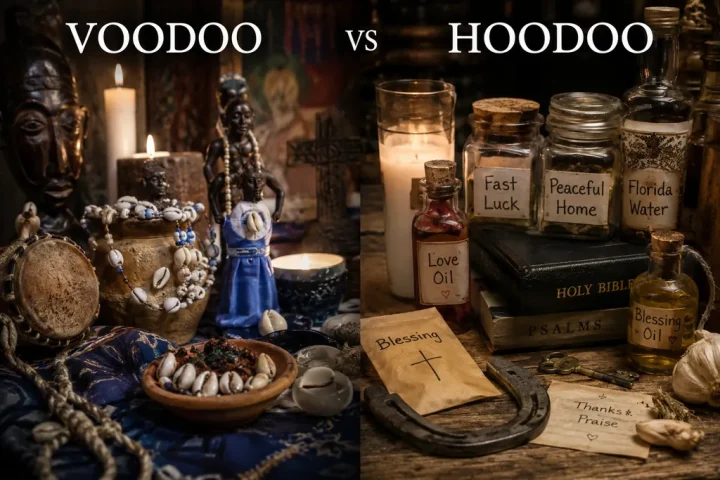
Inside the Occult World Mystery School, you can explore Voodoo, Hoodoo, Orishas, spirit work, folk magic, Witchcraft, ancestral traditions, ritual practice and the hidden world of spirits with more depth and structure.
This is not just a place to read articles. It is a living occult community where you can learn, ask questions, share insights and meet fellow occultists who are also drawn to magic, spirits, ancestors and the mysteries of the unseen world.
Whether you are interested in Caboclos, Oxossi, Obatala, Oxalá, the Lwa, ancestral guides, folk magic or spirit communication, the Occult World Mystery School gives you a place to continue your journey.
Join us inside the Occult World Mystery School and walk deeper into the living mysteries of magic, spirit wisdom and ancestral power.
Altars:
If at all possible, offerings are given outdoors, ideally near trees or even hung from trees. If this is not possible, create an indoor forest for them via houseplants. Place food offerings on mats set on the floor so that they can sit and eat.
Sacred animals:
Amazonian animals in general, but especially snakes
OFFERINGS:
Roast corn; plantains; pineapples; melons; tobacco, especially cigars
SEE ALSO:
SOURCE:
Encyclopedia of Spirits: The Ultimate Guide to the Magic of Fairies, Genies, Demons, Ghosts, Gods & Goddesses– Written by Judika Illes Copyright © 2009 by Judika Illes.



Follow