

Furcas: The Demonic Knight of Logic, Philosophy, and Divination
Furcas is a Fallen Angel and the 50th of the 72 Spirits of Solomon. In the grimoires, he is described as a knight of Hell who commands 20 legions of demons. Unlike many spirits who appear as kings, dukes, presidents, or princes, Furcas bears the rank of knight, a title that suggests discipline, combat-readiness, service, and directness of purpose.
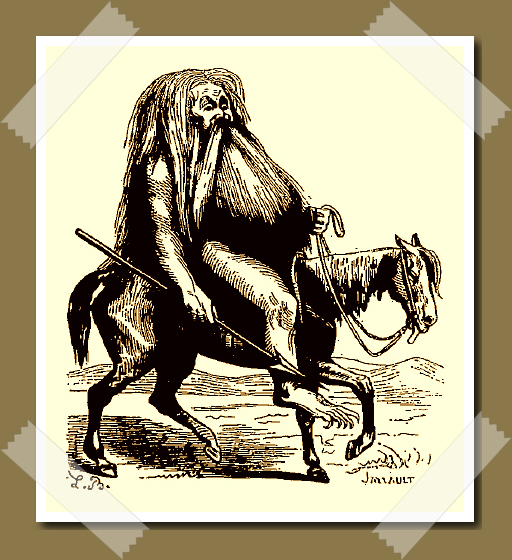
He appears as a cruel or severe-looking man with a long beard and a wild, hairy head. He rides upon a pale horse and carries a sharp weapon, usually interpreted as a lance, sword, or spear-like instrument. His image is stark, martial, and unsettling: an aged but powerful rider, armed, watchful, and prepared to pierce illusion with the force of knowledge.
Furcas is not primarily associated with wealth, seduction, or political power. His domain is knowledge — especially the kind of knowledge that sharpens the mind, strengthens argument, and reveals hidden patterns. He teaches rhetoric, philosophy, logic, astronomy, chiromancy, and pyromancy. In this sense, Furcas is a spirit of disciplined thought, intellectual force, and occult perception.
Furcas in the Goetic Tradition
As the 50th spirit of the Ars Goetia, Furcas belongs to the famous catalogue of the 72 Spirits of Solomon. These spirits are presented as powerful beings who can be conjured, commanded, questioned, and directed by the magician through ritual authority.
Furcas’ title as knight makes him distinctive. In medieval and grimoire symbolism, a knight is not merely a warrior. A knight represents service, strategy, honour, combat, and specialised ability. Furcas’ weapon may therefore be read not only as a tool of violence, but as a symbol of precision. He cuts through confusion. He pierces weak reasoning. He forces the mind to become sharper, more disciplined, and more exact.
His pale horse adds another layer of meaning. Pale horses often carry associations with death, spiritual severity, liminality, and the crossing of thresholds. Furcas is not a comforting teacher. He is the kind of spirit who may bring clarity through confrontation, severity, and intellectual pressure.
The Teachings of Furcas
Furcas is said to teach rhetoric, the art of powerful speech and persuasion. Rhetoric is not merely decoration of language. It is the ability to shape argument, influence minds, speak with force, and understand how words move people. In occult terms, speech is power. Words can bless, curse, command, reveal, conceal, bind, and liberate.
He also teaches philosophy, the disciplined investigation of truth, reality, existence, ethics, and knowledge. Philosophy asks the great questions: What is real? What is the soul? What is power? What is the good life? What is the hidden structure behind appearances? A spirit who teaches philosophy is not simply providing abstract ideas. He is pushing the practitioner toward deeper thought.
Furcas also teaches logic, the art of correct reasoning. Logic is essential in occult work, even though many beginners overlook it. Without logic, the magician becomes vulnerable to fantasy, delusion, fear, and self-deception. Logic protects the mind. It helps distinguish symbol from fact, intuition from projection, and genuine insight from emotional distortion.
His teaching of astronomy connects him to the celestial order. In older occult systems, astronomy and astrology were closely linked. To understand the heavens was to understand time, fate, cycles, planetary influence, and the relationship between the macrocosm and the microcosm.
Chiromancy and Pyromancy
Furcas also teaches chiromancy, the divination of the hands. Chiromancy, often called palmistry, studies the lines, mounts, shapes, and markings of the hand as signs of character, fate, temperament, and life direction. The hand is a living map of action, will, instinct, and possibility. A spirit who teaches chiromancy teaches the reading of embodied destiny.
He also teaches pyromancy, divination through fire. Fire has long been used as a medium of vision. Flames shift, flicker, consume, reveal, and transform. In pyromancy, the practitioner may observe the movement of flame, sparks, smoke, colour, heat, and pattern to receive omens or impressions.
Fire is especially appropriate for Furcas because his teachings are not soft. Fire purifies, destroys, illuminates, and tests. Like logic, it burns away what cannot endure.
The Occult Meaning of Furcas
Furcas may be understood as a spirit of hard knowledge. He does not represent gentle inspiration, but mental discipline. His presence suggests study, intellectual courage, the sharpening of perception, and the willingness to examine truth without sentimentality.
For the occult student, Furcas symbolises the need to strengthen the mind before entering deeper forms of magical practice. Rhetoric teaches how to speak. Logic teaches how to think. Philosophy teaches how to question. Astronomy teaches how to observe the heavens. Chiromancy teaches how to read the body’s signs. Pyromancy teaches how to interpret the living language of fire.
Together, these arts form a path of disciplined occult intelligence.
Furcas reminds the practitioner that magic is not only emotion, desire, and ritual. It is also study, structure, memory, interpretation, and mental precision. Without these qualities, the magician may be ruled by the very forces they seek to command.
Working Symbolically with Furcas
In a symbolic or meditative sense, Furcas can be approached as an archetype of severe wisdom. His pale horse may represent passage into hidden knowledge. His weapon may represent the cutting edge of reason. His long beard and aged appearance suggest old knowledge, accumulated experience, and the authority of a difficult teacher.
He is not a spirit of easy comfort. He is a figure of challenge. He asks whether the seeker is willing to think clearly, speak truthfully, study deeply, and confront ignorance within the self.
Those who are drawn to Furcas may be drawn to occult scholarship, divination, philosophy, magical logic, ceremonial tradition, or the disciplined study of grimoires. His current is especially relevant for those who want their occult practice to be more than fascination — who want it to become knowledge.
Go Deeper into Furcas, the Goetia, and Demonic Wisdom
Furcas is one of the 72 Spirits of Solomon, but he is also a reminder that demonology is not only about fear, power, or darkness. It is also about knowledge, discipline, divination, rhetoric, logic, and the hidden sciences that sharpen the occult mind.
Inside the Occult World Mystery School, you can explore Furcas and the other Spirits of Solomon in greater depth, alongside demonology, Black Magick, ancient grimoires, spirit work, protection, divination, ritual structure, and the serious study of occult practice. You will also meet fellow occultists who are not satisfied with shallow explanations, but want to understand the deeper meaning behind spirits, symbols, and magical systems.
If Furcas, the Goetia, demonic intelligence, chiromancy, pyromancy, and the hidden sciences call to you, then do not remain at the edge of the grimoire. Step inside the Occult World Mystery School and continue your study with others who are walking the path of knowledge, power, and occult transformation.
Furcas as the Blade of the Mind
Furcas stands as the blade of the mind. He is the sharp weapon carried by reason, the pale horse of occult discipline, and the old knight who teaches that wisdom is not always gentle. Sometimes wisdom cuts. Sometimes it burns. Sometimes it demands that the seeker abandon illusion and think clearly.
He teaches that the occult path requires more than desire. It requires intelligence. It requires study. It requires the courage to question, the strength to reason, and the discipline to master both word and symbol.
Furcas is the demonic knight of hard knowledge — severe, learned, and armed with the power of the sharpened mind.
From “The Goetia: The Lesser Key of Solomon the King” (1904) Written by S.L. MacGregor Mathers
FURCAS. – The Fiftieth Spirit is Furcas. He is a Knight, and appeareth in the Form of a Cruel Old Man with a long Beard and a hoary Head, riding upon a pale-coloured Horse, with a Sharp Weapon in his hand. His Office is to teachthe Arts of Philosophy, Astrology, Rhetoric, Logic, Cheiromancy, and Pyromancy, in all their parts, and perfectly. He hath under his Power 20Legions of Spirits. His Seal, or Mark, is thus made, etc.
From the “Pseudomonarchia Daemonum” ( 1583 )written by Johann Weyer (Johann Wier)
Furcas is a knight and commeth foorth in the similitude of a cruell man, with a long beard and a hoarie head, he sitteth on a pale horsse, carrieng in his hand a sharpe weapon, he perfectlie teacheth practike philosophie, rhetorike, logike, astronomie, chiromancie, pyromancie, and their parts: there obeie him twentie legions.
From the “Dictionnaire Infernal” (edition of 1863 ) Written by Jacques Auguste Simon Collin de Plancy
Forcas/ Forras/ Furcas is a knight and high president of hell controlling 29 legions of Demons. He appears as a man with a long beard and white hair, rides a horse, and carries a pointed dart. He teaches the virtues of herbs and precious stones, logic, esthetics, chiromancy, pyromancy, and rhetoric. He can make one invisible, ingenious, and articulate. He also can find lost things and discover treasures.
Original Text : Forcas, Forras ou Furcas, chevalier, grand-président des enfers ; il apparaît sous la forme d’un homme vigoureux, avec une longue barbe et des cheveux blancs ; il est monté sur un grand cheval et tient un dard aigu. Il connaît les vertus des herbes et des pierres précieuses; il enseigna la logique, l’esthétique, la chiromancie, la pyromancie et la rhétorique. Il rend l’homme invisible,ingénieux et beau parleur. Il fait retrouver les choses perdues ; il découvre les trésors, et il a sous ses ordres vingt-neuf légions de démons.











Follow