

Elementals: Spirits of Earth, Air, Fire and Water
Elementals are supernatural beings associated with the fundamental forces of nature and, within Western occult philosophy, they are understood as living expressions of earth, air, fire and water. The term has also been used more broadly for nature spirits believed to inhabit or protect the natural world, including animals, birds, insects, plants, stones, forests, rivers and other features of the landscape. Within magical traditions, elementals may therefore be approached not simply as symbolic representations of nature but as intelligences belonging to realms that coexist with the human world.
The system most familiar to modern occultists associates gnomes with earth, salamanders with fire, undines or nymphs with water, and sylphs with air. These classifications became especially influential through the writings of the sixteenth-century physician, alchemist and occult philosopher Paracelsus, who developed one of the most elaborate theories concerning elemental beings. His descriptions helped establish the idea that every element contains its own form of life and that these beings possess characteristics determined by the element from which they arise.
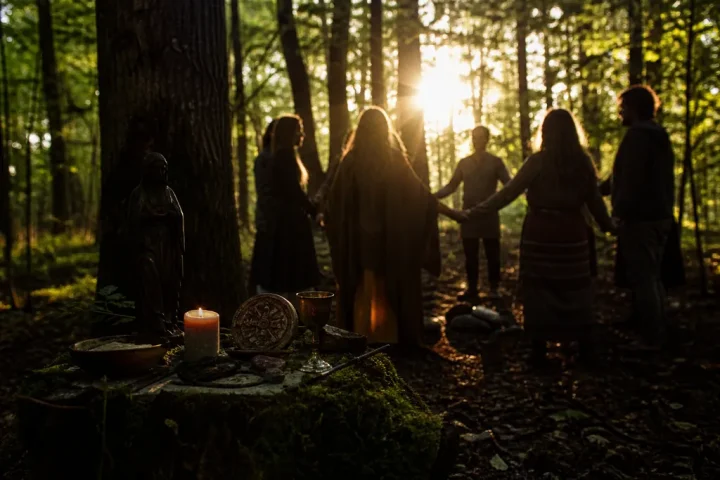
In magical practice, elementals may be invoked when working with the forces of nature. Those who accept the possibility of clairvoyant perception maintain that elementals may occasionally become visible to people who are particularly sensitive to the natural world. Modern Pagan communities have also preserved stories of such encounters. Circle Sanctuary near Mount Horeb, Wisconsin, has been associated with accounts of elemental sightings, while the Findhorn community in northern Scotland became famous for claims that cooperation with nature intelligences contributed to extraordinary gardening results.
Such stories continue a much older occult belief that nature is not spiritually empty. Within this worldview, a forest is more than a collection of trees and a river is more than moving water, because both may contain forms of consciousness that normally remain beyond ordinary human perception.
Paracelsus and the Elemental Kingdoms
Paracelsus did not describe elementals simply as ghosts or incorporeal spirits. In his cosmology they possessed bodies appropriate to their own realms and could interact with human beings, although they belonged to a different order of creation. He maintained that they were not descendants of Adam and Eve and therefore did not share humanity’s spiritual ancestry.
According to Paracelsus, elementals possessed something resembling human form, with bodies sufficiently substantial for them to exist within their own environments. At the same time, they occupied a position between the material and spiritual worlds, giving them capacities beyond those of ordinary humans.
Their mortality was one of the strangest elements of his doctrine. Paracelsus believed that elementals could die but did not possess immortal souls in the same manner as human beings. Consequently, he did not attribute to them precisely the same moral or theological condition assigned to humanity. Their behaviour arose from their own nature, instincts and intelligence rather than from the Christian concept of salvation.
This did not prevent them from forming relationships with people.
Traditions surrounding unions between humans and elemental beings appear repeatedly in European folklore, especially in stories concerning water spirits, nymphs and beings later associated with fairies. Paracelsus believed that such unions could produce offspring whose condition would belong more closely to humanity than to the elemental parent.
He also included beings such as giants and dwarfs within his wider vision of the hidden inhabitants of nature, suggesting that the invisible world was considerably more populated than the familiar fourfold classification alone would imply.
The Elemental Realms
The four principal classes of elementals remain inseparable from the elements in which they exist. Gnomes belong to earth and are traditionally associated with the hidden places beneath the ground, where minerals, stones and buried treasures lie concealed. Their nature reflects the solidity, endurance and secrecy attributed to the terrestrial element.
Undines belong to water and are frequently described as the elemental beings most capable of developing close relationships with human beings. Stories of supernatural women emerging from lakes, rivers and springs preserve echoes of this older concept, in which the fluidity and beauty of water are personified through beings who may appear alluring, generous or dangerous.
Sylphs belong to air and embody its movement, lightness and invisibility. Paracelsus considered them more accessible to humanity than some other elemental classes, although their nature remained fundamentally different from ours.
Salamanders belong to fire and were described as among the most elusive of the elementals. Their name was borrowed from the salamander of folklore, an animal once popularly believed capable of surviving within flames. In occult tradition, however, the salamander became something far greater than an unusual animal and came to represent the living intelligence hidden within fire itself.
Paracelsus maintained that gnomes and salamanders could possess prophetic gifts, although both were less inclined toward human interaction than undines or sylphs. Each elemental remained connected to its own world, and the different classes did not ordinarily intermingle with one another in the manner that they might interact with humans.
Their societies were imagined as possessing organisation, leaders, customs and laws. They were not depicted merely as isolated supernatural creatures wandering randomly through nature, but as inhabitants of coherent realms existing alongside the human world.
Humans, however, were believed to face an important limitation. Elementals could cross into our realm, but ordinary human beings could not simply enter theirs because the physical human body was considered too coarse to survive within an elemental environment.
Helpful and Dangerous Elementals
Elementals have never been regarded as uniformly benevolent.
Some traditions describe them as generous beings capable of assisting humans, helping with work or revealing hidden treasures. Others portray them as unpredictable, mischievous or actively dangerous. Certain nature spirits were believed capable of misleading travellers, arranging accidents or retaliating violently against people who disturbed them.
This ambiguity reflects something fundamental about the occult conception of nature. The natural world provides nourishment and beauty, yet it can also kill without hesitation. Water sustains life while remaining capable of drowning the careless traveller, while fire offers warmth even as it destroys everything placed within it.
Elemental beings mirror this instability.
Modern Wiccan traditions have generally emphasised respectful interaction with benevolent elemental forces, especially when elemental powers are incorporated into ritual and nature-based magic. Rather than approaching every elemental as something to dominate, many practitioners attempt to establish a relationship based upon harmony with the natural forces represented by the spirit.
Older ceremonial magic, however, often took a considerably more commanding approach.
Elementals in the Grimoires
Grimoires contain descriptions of spirits connected with natural forces and provide ritual methods by which such beings might be invoked, constrained or commanded. Their appearances frequently reflect the elements from which they originate, so that the manifestation of the spirit becomes an outward revelation of its essential nature.
The Key of Solomon gives this description of the elemental spirits:
Some are created from Water.
Others from the Wind, unto which they are like.
Some from Earth.
Some from Clouds.
Others from Solar Vapors.
Others from the keenness and strength of Fire; and when they are invoked or summoned, they come always with great noise, and with the terrible nature of fire.When the Spirits which are created of Water are invoked, they come with great rains, thunder, hail, lightning, thunderbolts, and the like.
When the spirits which are created of Clouds are invoked, they come with great deformity, in a horrible form, to strike fear into the Invocator, and with an exceeding great noise.
Others which are formed from the wind appear like thereunto and with exceeding swift motion, and whensoever those which are created from Beauty appear, they will show themselves in a fair and agreeable form; moreover, whensoever thou shalt call the Spirits created from Air, they will come with a kind of gentle breeze.
When the spirits which are created from the Vapors of the Sun are invoked, they come under a very beautiful and excellent form, but filled with pride, vanity and conceit. They are clever. . . . They show great ostentation and vainglory in their dress, and they rejoice in many ornamentations and decorations. Thou shalt only invoke them in serene, mild, and pleasant weather.
This description demonstrates that elemental spirits were understood through the phenomena accompanying them. Their environment, behaviour and appearance were inseparable from the forces that produced them, meaning that the magician encountered not merely an individual entity but the power of an element given supernatural form.
Mastering the Elements
Western ceremonial magic repeatedly stresses that anyone attempting to command elemental beings must first achieve a degree of mastery over themselves. Arthur Edward Waite argued that the magician needed to overcome ordinary weaknesses and be strengthened by the influence of a superior spiritual world before attempting to impose authority upon elemental forces.
The underlying principle is that magical authority cannot be separated from inner discipline. A magician ruled by uncontrolled impulses would be attempting to dominate outside forces while remaining incapable of governing those within.
According to Eliphas Levi in The Doctrine and Ritual of High Magic:
To overcome and subjugate the elementary spirits, we must never yield to their characteristic defects. . . . In a word, we must overcome them in their strength without ever being overcome by their weaknesses.
Lévi’s statement transforms elemental magic into something deeper than spirit summoning. The magician’s encounter with the element becomes a confrontation with qualities that also exist within consciousness. Magical mastery therefore involves learning to engage with those forces without allowing them to dominate the practitioner.
Artificial Elementals
Occult literature also uses the expression artificial elemental for an entity deliberately created through concentrated will rather than encountered as an independent nature spirit. In this sense, the term overlaps with the concept of a thought-form.
The magician is believed to construct such an entity upon the mental plane and give it the qualities required for a particular purpose. Some systems describe the magician as providing part of their own mental energy or consciousness to give the creation sufficient independence to complete its assigned work.
An artificial elemental is therefore not intended to become an unrestricted autonomous being. Its purpose is determined during its creation, together with the conditions governing its existence and eventual dissolution. It may also be given a name so that the magician can summon, direct or terminate it.
The crucial distinction is that a traditional elemental is believed to exist independently within nature, whereas an artificial elemental originates through magical creation.
The two ideas are frequently confused, but they belong to very different occult theories.
Jack Parsons and the Elemental Woman
The concept of elemental manifestation also appears within twentieth-century occult history through the controversial magical experiments of Jack Parsons, the American rocket engineer and disciple of Aleister Crowley.
Parsons undertook ritual operations intended to attract or manifest a particular feminine magical force. A woman subsequently entered his life under circumstances that Parsons interpreted through the framework of his magical work, and later accounts sometimes described her as an elemental manifestation.
Whether this episode is understood literally, psychologically or symbolically, it demonstrates how dramatically the meaning of the word elemental had expanded. The concept was no longer restricted to the nature spirits described by Paracelsus but could encompass entities believed to have been deliberately summoned or attracted through ritual magic.
The Hidden Intelligence of Nature
The enduring fascination of elementals arises from the occult idea that nature possesses consciousness.
Within this worldview, the four elements are not merely physical substances. They represent fundamental powers underlying existence, while elemental spirits give those powers personality, intelligence and form.
The magician who works with elementals is therefore attempting to establish contact with forces larger than individual human consciousness.
Whether gnomes, sylphs, salamanders and undines are regarded as literal supernatural beings, visionary forms perceived through altered consciousness or symbolic personifications of natural forces, they have occupied an important position within Western esotericism for centuries. Their presence can be found in alchemy, ceremonial magic, witchcraft, occult philosophy and modern Pagan spirituality, where they continue to express the ancient conviction that the world surrounding humanity is far more alive than ordinary perception suggests.
For the serious student of occultism, elementals therefore represent much more than four colourful categories of nature spirits. They lead directly into some of the central mysteries of magical philosophy, because studying them raises questions about consciousness, spirit manifestation, the hidden structure of nature and the possibility that intelligence may exist in forms radically different from our own.
Enter the Occult World Mystery School
If you genuinely want to become an occultist, then knowing that a gnome belongs to earth or a salamander belongs to fire is nowhere near enough. Anyone can memorise occult terminology, repeat the names found in grimoires and spend years collecting fragments of esoteric information without ever understanding how the traditions connect.
The Occult World Mystery School exists for those who are finished with that superficial approach and want to study the occult as a serious body of knowledge. Go beyond definitions and begin understanding the magical principles behind spirits, elemental forces, ceremonial traditions, grimoires and the hidden philosophies that generations of magicians spent their lives attempting to master.
If these subjects fascinate you, then stop remaining a spectator of the occult and start becoming a student of it.
Join the Occult World Mystery School now and begin the serious study of the Mysteries, because reading about magic can satisfy curiosity, but only disciplined study can take you deeper into the world the old magicians were actually trying to understand.
FURTHER READING:
- Bardon, Franz. Questions and Answers. Salt Lake City: Merkur Publishing, 1998.
- Butler, E. M. Ritual Magic. Cambridge: Cambridge University Press, 1949.
- Hall, Manly P. Paracelsus: His Mystical and Medical Philosophy. Los Angeles: The Philosophic Research Society, 1964.
- Waite, Arthur Edward. The Book of Black Magic and of Pacts. 1899. Reprint, York Beach, Maine: Samuel Weiser, 1972.
SOURCE:
The Encyclopedia of Magic and Alchemy Written byRosemary Ellen Guiley Copyright © 2006 by Visionary Living, Inc.


Follow