
Eloise Psychiatric Hospital: The Haunted Legacy of Michigan’s Lost Institution
For more than a century, the sprawling institution known as Eloise stood west of Detroit as one of the largest public healthcare complexes in the United States. What began as a modest county poorhouse grew into an enormous community of hospitals, farms, workshops, wards and service buildings spread across hundreds of acres. Thousands of people lived and worked there, thousands more died under its care, and more than seven thousand were ultimately buried in a nearby cemetery, many beneath simple numbered markers rather than conventional named headstones. Long after most of the buildings disappeared, Eloise acquired another identity, becoming one of Michigan’s most persistent haunted locations and a place where visitors, employees and paranormal investigators continue to report shadow figures, unexplained voices, footsteps, physical sensations and apparitions.
The history of Eloise is far more complicated than the horror stories that later surrounded it. It was never simply an asylum filled exclusively with psychiatric patients, nor was every form of treatment practiced there unusually cruel by the standards of its time. Eloise was simultaneously a poorhouse, infirmary, psychiatric hospital, general hospital, tuberculosis facility and enormous county institution. It became capable of impressive medical innovation while also suffering through periods of overcrowding, neglect and treatments that modern observers may find deeply disturbing.
That contradiction is essential to understanding the place. Eloise was not created as a haunted institution. It became one through almost a century and a half of poverty, illness, institutionalisation, medicine, death and human memory.
From Poorhouse to Eloise
The institutional history that eventually produced Eloise began in 1832, when Wayne County established a poorhouse closer to Detroit for residents who could no longer support themselves. In 1839, thirty-five residents were transferred to a new rural property in what was then Nankin Township, on land associated with the former Black Horse Tavern. This move marks the beginning of Eloise at the location now associated with Westland, Michigan.
The early institution was not a psychiatric hospital in the modern sense. County poorhouses absorbed a broad range of people who had nowhere else to go, including the elderly, disabled, chronically ill, homeless and impoverished, alongside people suffering from psychiatric disorders. As the population increased, the county gradually developed separate medical and psychiatric divisions.
The name Eloise came later. A post office established on the grounds in 1894 was named after Eloise Dickerson, the young daughter of Freeman B. Dickerson, who was connected with the administration of the county institution. The name gradually became associated with the entire complex, and in 1911 the psychiatric division became formally known as Eloise Hospital for Mental Illness.
By then, the institution was already developing into something vastly larger than the original rural poorhouse.
A City Behind Hospital Walls
At its height, Eloise occupied approximately 902 acres and contained around seventy-five buildings. By the late 1920s, roughly 10,000 patients and residents could be housed there, supported by approximately 2,000 employees. The place functioned almost as a city in its own right.
There were kitchens capable of producing enormous numbers of meals, a bakery, farm, cannery, power facilities, employee accommodation and transportation connections. Eloise maintained its own police and fire departments, while railway and trolley services linked the institution with the surrounding region. The grounds contained medical wards, psychiatric buildings, service structures and agricultural areas designed to help sustain the population.
This enormous scale is one reason Eloise later became so difficult to remember accurately. Different generations encountered entirely different versions of the institution. A person admitted to the poorhouse in the nineteenth century experienced a different Eloise from a psychiatric patient in the 1940s or a general-hospital patient in the 1970s.
The institution changed continuously.
Its ghosts, if one accepts the paranormal interpretation, would therefore come from many different worlds.
Tuberculosis at Eloise
Tuberculosis was one of the major medical threats confronting American institutions during the late nineteenth and early twentieth centuries. Before antibiotics transformed treatment, physicians frequently relied upon isolation, rest, fresh air and exposure to sunlight.
Eloise began separating tuberculosis patients during the early twentieth century, initially using tent facilities before developing a dedicated tuberculosis sanatorium around 1910–1911. Open-air treatment was considered medically appropriate at the time, and the institution became part of the broader campaign to isolate contagious patients and control the spread of the disease.
The dedicated tuberculosis operation did not continue throughout Eloise’s entire history. As specialised facilities became available elsewhere in Michigan and Detroit, the programme was gradually reduced and eventually discontinued in 1923.
Tuberculosis nevertheless added another layer of serious illness and death to an institution already responsible for thousands of vulnerable people.
Treatment, Innovation and Controversy
Modern descriptions of Eloise frequently portray it as a place defined entirely by brutality. The historical reality is more difficult.
There were unquestionably periods in which patients endured harsh conditions. Overcrowding became severe at times, funding was inadequate, and historical accounts describe sanitation problems, restraints and accusations of mistreatment. During one period, approximately 3,800 psychiatric patients were housed in facilities intended for roughly 2,500.
Psychiatric medicine itself was undergoing dramatic experimentation during the twentieth century. Eloise used treatments that included electroconvulsive therapy, insulin shock therapy and hydrotherapy. Lobotomies were also performed there. These procedures belonged to a period when physicians were attempting to treat serious psychiatric illness with techniques that were sometimes invasive, dangerous or poorly understood by later standards.
The story should nevertheless not be simplified into one of constant torture. Electroconvulsive therapy, for example, remains a recognised modern psychiatric treatment when administered under controlled medical conditions. Other procedures once regarded as progressive were later abandoned as medicine developed.
Eloise also achieved genuine medical innovations. It was associated with early diagnostic X-ray use, radium treatment, occupational and recreational therapy, music therapy and what has been described as Michigan’s first kidney dialysis unit.
The institution therefore embodied both sides of twentieth-century medicine: remarkable ambition and serious limitation.
That tension may be more unsettling than the exaggerated horror stories. The people working at Eloise were not necessarily villains, and the patients were not merely helpless figures in a gothic nightmare. They were human beings living inside an enormous healthcare system that reflected both the knowledge and the failures of its era.
The Cemetery of Eloise
Few parts of the Eloise story carry greater emotional weight than its cemetery.
More than 7,100 people were buried there, many because relatives could not or would not claim their bodies. The dead included psychiatric patients, poorhouse residents, tuberculosis patients and people who died within other parts of the medical complex.
Many graves were marked not with names but with small numbered blocks.
The numbers corresponded to institutional records, yet over time identifying individual burials became increasingly difficult. Researchers, genealogists and local historians have spent years attempting to reconnect numbers with names, reconstructing the lives of people whose identities had effectively disappeared beneath the grass.
These were not anonymous people while they were alive.
They had families, occupations, illnesses, friendships and personal histories. Yet many eventually became little more than numbers in a burial ground associated with an institution the outside world increasingly preferred to forget.
The cemetery naturally became part of Eloise’s paranormal reputation. Whether or not one believes the dead remain attached to their graves, the existence of thousands of burials beside the former hospital gives the haunting tradition a very real historical foundation.
No invented ghost story is required to make that landscape disturbing.
The Tunnels Beneath Eloise
An underground system of tunnels once connected portions of the Eloise complex. Some carried steam and utilities, while others facilitated movement between buildings, including the transportation of patients and staff during severe weather.
The tunnels later became one of the most atmospheric elements in paranormal stories about Eloise. Their darkness, confinement and separation from the outside world made them natural settings for claims of voices, footsteps, shadows and unseen presences.
Some modern retellings claim that patients regularly used the tunnels to escape or hide from hospital staff. This detail has not been supported convincingly by the stronger historical record and should be treated as later folklore rather than fact.
The real tunnels require no such embellishment. Beneath a medical institution housing thousands of people, a network of underground passages would inevitably carry strong associations with secrecy and confinement once the hospital was abandoned.
Many access points were eventually sealed.
The tunnels nevertheless remain part of the psychological geography of Eloise, representing the hidden infrastructure beneath an already immense institution.
The Woman in White
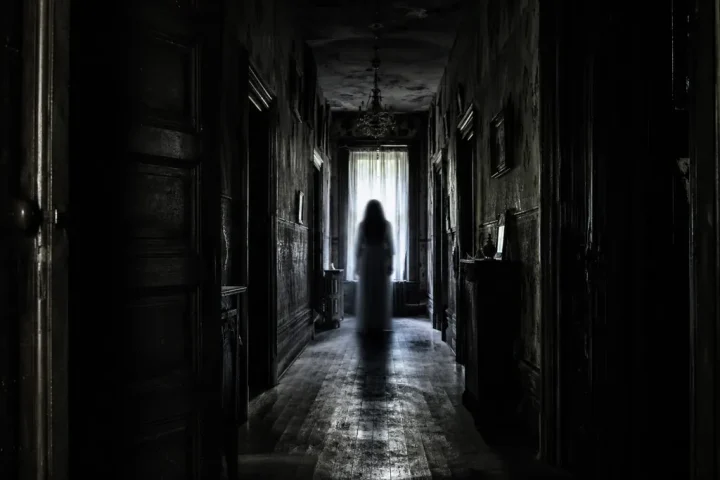
Among the recurring apparitions associated with Eloise is a woman dressed in white.
Paranormal investigators and local reports have described a female figure appearing on upper levels of surviving buildings and occasionally near the roof. The identity of the woman has never been established, and attempts to label her as a particular patient or nurse remain speculative.
This is important because haunted-location folklore frequently attaches anonymous apparitions to convenient historical personalities without evidence. Eloise housed and employed tens of thousands of people over generations. A female apparition, if genuinely encountered, could theoretically correspond to any number of residents or staff members.
The safest conclusion is simply that a woman in white has become part of the Eloise haunting tradition.
Her persistence across separate accounts makes her one of the location’s more recognisable supernatural figures, although no surviving evidence can establish who or what witnesses believed they were seeing.
Shadow Figures
Dark human-shaped forms are among the most commonly reported phenomena at Eloise.
Investigators and visitors describe fleeting shadows moving through hallways, crossing doorways or appearing where no person should be standing. Some accounts involve indistinct movement, while others describe apparently full-bodied silhouettes.
One owner associated with the present Eloise attraction has claimed to have seen a shadow-like form moving along a ceiling. Paranormal investigator Ryan Sherwin has described encountering what appeared to be a full-bodied shadow figure, while other visitors report the familiar sensation of being watched before seeing movement disappear at the edge of their vision.
Shadow figures occupy an ambiguous position within paranormal investigation. Low light, fatigue, peripheral vision, expectation and irregular architectural spaces can all generate convincing misperceptions.
Eloise supplies almost ideal conditions for such experiences.
Yet the frequency with which shadows appear in the location’s testimony has made them one of the defining elements of its haunted reputation.
Voices, Screams and Footsteps
Eloise is equally famous for sound.
Visitors and investigators have reported whispers, moaning, footsteps and distant screams emerging from apparently empty areas. Former employees and later explorers have described sounds that seemed to follow them or originate behind closed doors.
Retired law-enforcement officer Richard Brooks has recounted hearing footsteps that could not be located even with the assistance of his police dog, while later investigators have described whispers apparently occurring close to them when nobody else was nearby.
An employee interviewed during an investigation published by The Guardian also discussed unexplained sounds and shadows associated with the former complex. The same report described children visiting the property who claimed to see a man seated on a staircase where accompanying adults saw nobody.
Such testimony does not constitute scientific proof, but it demonstrates that Eloise’s paranormal reputation existed independently of the current commercial haunted attraction.
Reports of voices and footsteps had circulated long before the modern property began marketing organised ghost investigations.
Cold Spots and Physical Contact
Sudden changes in temperature are frequently reported during modern paranormal investigations at Eloise. Visitors describe areas becoming unexpectedly cold or experiencing a chill accompanied by the impression that someone else has entered the room.
Other witnesses have gone further.
Current owners and investigators have reported touches, hair pulling and other physical sensations occurring when no visible person was close enough to cause them. Detroit PBS historian Adam Hachey has described personal experiences involving shadow figures, whispers, equipment movement and unexplained touching while exploring the site.
These accounts remain subjective.
Temperature changes inside large ageing structures may arise from air movement, ventilation, drafts and differences between enclosed spaces. Physical sensations can likewise have numerous explanations.
Their paranormal significance depends entirely upon interpretation.
What can be established is that reports of touch and cold have become part of contemporary Eloise testimony and continue to attract investigators who believe the remaining buildings may still contain something unexplained.
Electronic Voice Phenomena
Like many heavily investigated haunted locations, Eloise has generated numerous claims involving electronic voice phenomena, or EVP.
One frequently repeated account concerns a recording interpreted as saying “help me”. The phrase has appeared in several paranormal publications and discussions surrounding Eloise, but the original recording and complete chain of documentation are difficult to establish.
That means the claim should be treated cautiously.
The alleged voice may form part of Eloise paranormal tradition, but it cannot responsibly be presented as objectively verified evidence of communication with a dead patient.
Another phrase sometimes attributed to Eloise recordings is “I’m lost”. That claim is even weaker. No reliable original investigation or recording has been identified that establishes it securely.
The distinction is important because EVP interpretation is inherently subjective. Sounds that resemble words to one listener may be heard very differently by another, particularly when the expected phrase has already been suggested.
Eloise has produced many supposed voices.
What those sounds actually represent remains unresolved.
The Children’s-Ward Stories
Later paranormal accounts sometimes describe a former children’s ward as an especially active location where laughter, voices and the sound of toys can supposedly be heard after the rooms have emptied.
Children did live and receive care at Eloise during portions of its history, and the institution had paediatric facilities and educational provisions.
What cannot currently be established is that a particular children’s ward was historically recognised as the central paranormal hotspot described in modern ghost stories.
Reports of moving toys and recurring child voices are repeated by paranormal sources, but the documentation is considerably weaker than for the broader shadow, voice and footsteps traditions.
For that reason, the children’s-ward material is best understood as unverified Eloise folklore rather than documented haunting history.
Its popularity may reflect the emotional power of childhood associated with abandoned institutions. A child’s laughter in an empty hospital is almost universally unsettling, which makes such stories particularly likely to survive and spread.
Whether anything more lies behind them remains unknown.
The Legend of the Suicide Room
One of the darkest modern claims involves a supposed chamber called the “Suicide Room”.
According to paranormal retellings, numerous patients allegedly killed themselves there, leaving an emotional residue so powerful that visitors experience despair, nausea or panic upon entering. Stories sometimes add unexplained bangs, shadow figures, electromagnetic-field fluctuations and sensations of invisible hands touching or grabbing people.
The problem is that the historical existence of such a room has not been verified.
No reliable institutional record has been located identifying a particular Eloise room as the site of repeated suicides. No strong historical source confirms the concentration of deaths described in the legend, and the dramatic claims surrounding the room are difficult to trace beyond later paranormal material.
That does not prove that no patient ever died by suicide at Eloise. An institution of its size and duration inevitably witnessed many forms of tragedy.
What it means is that the specific “Suicide Room” should be treated as an unverified paranormal tradition, not as a documented historical location.
This is an important example of the way haunting folklore grows around abandoned institutions. A room develops a reputation, later visitors arrive expecting to feel something unusual, emotional responses reinforce the legend, and eventually the story is repeated as historical fact even when no original documentation can be found.
Eloise’s genuine history contains enough suffering without turning uncertain traditions into false certainty.
Paranormal Television and Modern Investigations
Eloise has attracted national attention from paranormal television programmes.
Destination Fear investigated the property in 2019, presenting reports of screams, slamming doors and possible poltergeist activity. Discovery’s Expedition X returned to Eloise for a two-part investigation in 2023, during which investigators attempted to document anomalous activity and communicate with whatever they believed might be present.
Television programmes inevitably favour dramatic presentation, and claims made during investigations should not automatically be treated as historical evidence. One story associated with televised Eloise investigations involves a ten-year-old girl supposedly dying during a freezing hydrotherapy treatment. Historical verification for that specific death has not been established, so the story should remain in the category of paranormal legend unless stronger evidence emerges.
The programmes are nevertheless significant because they demonstrate how far Eloise’s haunted reputation has spread.
The institution that once housed thousands of people on the outskirts of Detroit has become known nationally as a place associated with the supernatural.
Eloise After Closure
Eloise did not close in a single moment.
Psychiatric operations ended in 1979, while Wayne County General Hospital continued functioning until 1984. As the immense institution contracted, buildings were emptied, abandoned or demolished.
Most of the sprawling complex eventually disappeared.
For decades the remaining structures became symbols of institutional decay, attracting urban explorers, historians and paranormal investigators. Photographs of empty corridors and deteriorating wards strengthened the popular impression that Eloise was a completely abandoned asylum frozen in time.
That description is no longer accurate.
The principal surviving Kay Beard Building at 30712 Michigan Avenue has been developed as Eloise Asylum, a commercial attraction offering historical tours, paranormal investigations, escape-room experiences and seasonal haunted entertainment. Some investigations extend into areas including the attic, firehouse and sub-basement.
Visitors therefore need to distinguish between the genuine history of Eloise and deliberately theatrical horror environments created for modern audiences.
A location can possess a paranormal tradition and still operate as a commercial haunted attraction. The existence of one neither proves nor automatically invalidates the other.
Why Eloise Became Haunted
The supernatural reputation of Eloise did not emerge from a single murder, catastrophe or spectacular tragedy.
It arose from scale.
For nearly a century and a half, thousands of people entered the institution because they were poor, ill, disabled, elderly, mentally unwell or otherwise dependent upon public care. Thousands worked there as doctors, nurses, attendants, cooks, labourers, police officers and administrators.
Many recovered and left.
Others never did.
The cemetery alone preserves evidence of more than seven thousand deaths associated with the institution. Some people buried there are now identified only through surviving records and numbers cut into small stones.
Such history creates fertile ground for haunting legends because the emotional reality does not need to be invented. Isolation, illness, institutionalisation and death genuinely belonged to Eloise.
Yet reducing every ghost story to the supposed spirit of a tortured psychiatric patient would be equally misleading.
Eloise contained many kinds of people.
If witnesses genuinely encounter something unexplained in its surviving buildings, there is no reliable method for deciding whether the source is a patient, nurse, doctor, tuberculosis sufferer, poorhouse resident, child, worker or something else entirely.
The ghosts have inherited the same problem as the history.
There are simply too many lives.
What Haunts Eloise?
Perhaps nothing supernatural remains at Eloise.
Old buildings produce strange sounds. Shadows move unpredictably through rooms illuminated by flashlights. Drafts generate cold spots. Expectation alters perception, and paranormal investigators entering one of America’s most famous haunted institutions are already prepared to interpret uncertainty as presence.
That possibility must remain part of any serious examination.
Yet something equally important remains true.
Witnesses continue to report figures, footsteps, whispers, physical contact and unexplained activity. Some accounts come from paranormal investigators, others from employees, police officers, journalists and visitors. The reports stretch across decades and predate the modern haunted attraction.
Whether they represent spirits cannot be demonstrated.
Their persistence can.
Eloise has therefore become haunted in two senses. It is haunted in folklore by apparitions and voices, and it is haunted historically by the enormous number of lives once contained within a single institutional system.
The second haunting is undeniable.
Perhaps that is why the first refuses to disappear.
Go beyond haunted asylum stories
Abandoned hospitals attract easy horror because locked wards, forgotten graves and empty corridors already contain everything needed for a frightening story. Occult study begins when you stop accepting that atmosphere as an explanation and start asking what traditions actually say about death, spirit attachment, apparitions, psychic residue and communication with the dead.
Join the Occult World Mystery School and move beyond the recycled stories that reduce the supernatural to entertainment. There are thousands of spirits, gods, demons, magical systems, grimoires and forgotten traditions waiting beyond it, together with centuries of teachings on necromancy, mediumship, spirit contact and the unseen forces occultists have deliberately attempted to understand. If you are satisfied with ghost hunters walking through dark corridors, remain a spectator. If you want to understand the systems behind the mysteries, enter the Mystery School and begin studying what lies beyond the surface.






Follow