
Evocation: Calling Forth Spirits, Ghosts, and Hidden Powers
Evocation is the ritual calling forth of a spirit, entity, deity, ghost, or supernatural intelligence. In ancient Greece, evocation was closely connected with necromancy: the summoning of the souls of the dead for prophecy, guidance, or the resolution of unfinished spiritual business.
The spirits called through evocation may be understood in different ways. In classical necromancy, they were often regarded as the souls of the dead. In ceremonial magic, they may be angels, demons, planetary intelligences, elemental beings, or other spiritual forces. In some psychological interpretations of magic, the evoked entity may represent an externalised force from within the magician’s own consciousness.
This ambiguity has always surrounded evocation. Is the spirit truly external? Is it a power hidden within the practitioner? Is it a psychic projection, a discarnate being, or a symbolic intelligence? The answer depends on the tradition, the operator, and the worldview through which the rite is understood.
Evocation in the Ancient World
In the ancient Greek world, evocation was often performed to consult the dead. Those who practised it were sometimes called psuchagogoi, meaning “soul-drawers.” These evocators were believed to possess the power to summon ghosts and also to lay, dismiss, or exorcise them.
They occupied an uneasy place in ancient society. They were not ordinary priests, yet they were not always dismissed as frauds either. They were associated with necromancy, witchcraft, prophecy, and chthonic ritual. Thessalian witches, in particular, were famous for their powers of evocation and ghost-calling.
The purpose of evocation was usually practical. The dead were believed to know things hidden from the living. They could reveal the future, explain omens, identify causes of misfortune, or give guidance in crisis. To call a ghost was to seek knowledge from beyond ordinary human perception.
Evocation for Prophecy
The earliest descriptions of evocation rites appear in Homer’s Odyssey, where Odysseus seeks the ghost of Tiresias, the blind Theban prophet. The goddess Circe sends him to the realm of Hades and Persephone so that he may receive prophetic knowledge from the dead.
In these ancient accounts, evocation took place at night and involved chthonic offerings to the underworld gods. The setting was liminal: a pit, a fire, the darkness, and the nearness of the underworld. The dead were not casually invited; they had to be released temporarily from the realm below.
In Homer’s account, the summoned ghosts gather around the blood pit, longing to drink. Odysseus must hold them back with his sword until Tiresias arrives. Only after Tiresias drinks is he able to speak fully and deliver prophecy.
This image is one of the foundational scenes of Western necromantic literature: the living hero, the blood pit, the restless dead, the drawn sword, and the prophet who speaks from beyond death.
The Ghost as Oracle
Later writers also described the dead as oracular beings. The ghost did not always appear clearly. It might be dim, uncertain, difficult to perceive, and yet capable of speech.
According to Maximus:
“A man wanting an oracle would come to them, pray, sacrifice an animal, pour full libations, and call up the soul of any of his ancestors or friends. Then the ghost would confront him. It would be hard to see, and one could doubt that one was seeing it, but it would have the power of speech, and could deliver prophecies. After discussing what was asked of it, it would depart.”
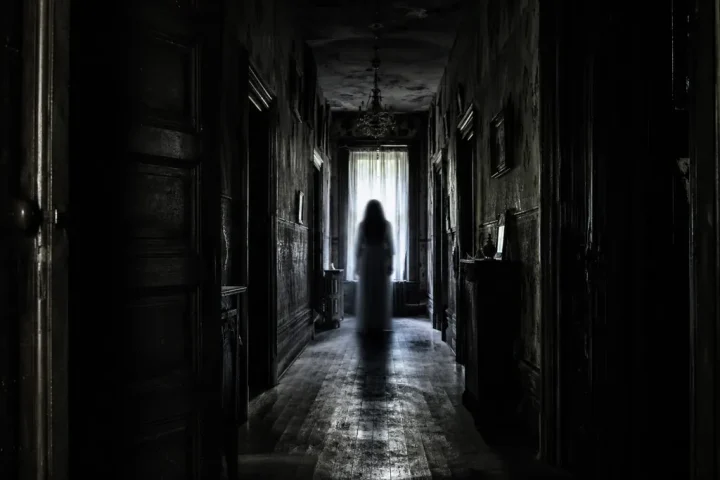
This passage captures the strange uncertainty of evocation. The ghost is present, but not fully visible. The witness may doubt what is seen, yet the spirit speaks. It exists at the threshold of perception, neither fully material nor purely imagined.
Aeschylus and the Necromantic Lake
Aeschylus also preserves important material on evocation. In his fragmentary work Psuchagogoi, he retells the necromantic summoning from the Odyssey. In this version, the rite is placed beside an unnamed lake, often thought to be Lake Avernus, a flooded volcanic crater near Cumae in Italy.
Lake Avernus was strongly associated with the underworld and with necromantic rites. To the Greeks, it was linked with Odysseus’s descent to consult the dead. Its dark volcanic landscape, still waters, and chthonic associations made it a natural setting for ghost-calling.
Aeschylus places the rites at the side of an unnamed lake:
“Slash the gullet of the neck, and let the blood of this sacrifi cial victim fl ow into the murky depths of the reeds as a drink for the lifeless. Call upon primeval Earth and chthonic Hermes, escort of the dead, and ask chthonic Zeus to send up the swarm of night-wanderers from the mouths of the river, from which this melancholy off-fl ow water, unfit for washing hands, is sent up by the Stygian springs.”
The language is dark, solemn, and deeply chthonic. Earth, Hermes, Zeus below, the reeds, the river, the blood, and the night-wandering dead all belong to the underworld atmosphere of ancient evocation.
Libations to Soothe the Dead
Not all ancient evocation relied on blood sacrifice. In Aeschylus’s Persians, Atossa, widow of King Darius and mother of Xerxes, seeks to call up the ghost of her dead husband. Troubled by dreams, she comes with offerings intended to soothe the dead.
Atossa arrives with “full libations” which “soothe the dead”:
“…white milk, good to drink, from an unyoked cow, the secretion of the flower-processing bee, gleaming honey, offerings of water from a virgin spring, and an unmixed drink from its mother in the field, this restorative from an ancient vine. The fragrant fruit of the light olive tree, which always luxuriates in leaves, is here, too, as are woven garlands of flowers, children of the Earth that bears everything. But, my friends, sing hymns in support of these libations to the dead below, and call up the Demon Darius, while I give these honours to the gods below into the thirsty Earth.”
Here the dead are not violently compelled. They are honoured, nourished, and invited through offerings of milk, honey, spring water, wine, olive fruit, and garlands. The atmosphere is still chthonic, but more devotional than coercive.
The ghost of Darius appears and prophesies disaster for Xerxes’ campaign against Greece. Once again, the dead are called because they possess knowledge beyond the reach of the living.
Evocation and the Geography of the Underworld
Ancient evocation was often associated with places that seemed close to the realm of the dead: caves, lakes, volcanic regions, river mouths, pits, tombs, and sanctuaries of chthonic gods.
Such places were not chosen randomly. They were thresholds. A cave leads into the earth. A lake reflects the sky but hides depth below. A pit opens downward. A tomb marks the boundary between the living and the dead. These landscapes allowed the ancient imagination to locate the underworld not merely as a mythic realm, but as a place that could be approached through sacred geography.
The evocator worked at these thresholds, calling upward what belonged below.
Evocation Through Dreams
Evocation was not always performed in waking ritual. The dead were also believed to visit the living in dreams.
A person who wished to consult a particular ghost might make offerings, prayers, or invocations before sleep. The hope was that the spirit would appear in a dream and deliver the desired message. This form of evocation belongs to the wider practice of dream incubation.
Dreams were understood as places of contact. The sleeper crossed a boundary, and the dead could come near. The dream world, like the necromantic pit or sacred cave, became a threshold between realms.
Evocation for Ghost-Laying
Evocation was not only used for prophecy. It could also be used to appease, dismiss, or lay a troublesome ghost.
Restless dead were believed to cause disturbances when they had unfinished business, improper burial, unavenged wrongs, or unresolved anger. If the identity of the ghost was known, the living could attempt to address its grievance. If the identity was unknown, methods might be used to locate the responsible grave or corpse.
In ancient accounts, the ghost was not merely banished without concern. It had to be heard. It might speak its anger, reveal the cause of its unrest, or demand proper observances. The living then had to take appropriate action.
This is a crucial idea in ghost-laying: a spirit may not need to be conquered. It may need to be recognised, appeased, reburied, honoured, or avenged.
Pausania and the Ghost of Cleonice
Classical literature contains many stories of evocation used to appease or lay the dead. One example concerns Pausania, the Spartan regent who defeated the Persians.
According to Plutarch, Pausania summoned Cleonice, the virgin daughter of prominent citizens of Byzantium, intending to rape and disgrace her. In the darkness, she accidentally overturned a lamp stand. Pausania woke suddenly and, thinking an enemy had entered, stabbed her to death.
Afterwards, Cleonice’s ghost came to him in dreams and gave him no peace. Pausania fled Byzantium, but the ghost continued to pursue him. Desperate for relief, he consulted an oracle of the dead at Heracleia and called up Cleonice’s spirit.
She told him that all would be well when he returned to Sparta. Pausania did not realise that the ghost was foretelling his death. Later, he was starved to death in the temple of Athene of the Bronze House. Thus, Cleonice’s ghost was finally avenged.
The story shows that evocation could reveal not only prophecy, but moral consequence. The dead remembered. The dead pursued. The dead demanded justice.
The Ghost of Pausania
After Pausania’s death, his own ghost became troublesome. It haunted the temple where he died and frightened people away.
The Spartans consulted an oracle and learned that his ghost had to be propitiated. Evocators were summoned from Thessaly to lay the spirit. They declared that the Spartans had created pollution in the temple and that the matter had to be corrected.
Two bronze statues of Pausania were erected at the altar, and the ghost was appeased.
This account reveals another dimension of ancient evocation: the relationship between the dead, sacred space, pollution, and ritual repair. A ghost was not simply a wandering spirit. It could be a sign that moral or ritual order had been broken.
Nero and the Ghost of Agrippina
Roman tradition also preserves accounts of haunting and ghost-laying. Emperor Nero was said to be haunted by the ghost of his mother, Agrippina, whom he had ordered killed.
Agrippina had been politically ambitious and deeply involved in the power struggles of imperial Rome. Nero first tried to have her drowned in a collapsible boat near Baiae, close to Lake Avernus, but she survived. He then arranged her death in such a way that it appeared to be suicide.
Afterwards, Nero was reportedly overcome with horror and guilt. Agrippina’s ghost haunted him, and he said that the Furies pursued him with whips and burning torches.
Nero consulted evocators to lay her ghost, apparently gaining relief for a time. Yet later, while travelling in Greece, he avoided initiation into the Eleusinian Mysteries because the rites involved a symbolic journey into the underworld. He feared that this might stir up Agrippina’s anger, as well as that of the Furies.
In these stories, evocation is bound to guilt, bloodshed, and the fear that the dead cannot be silenced forever.
Evocation in Ritual Magic
In later ritual magic, evocation became the formal calling forth of a spirit, entity, intelligence, or deity. The purpose might be knowledge, assistance, command, protection, revelation, or magical operation.
In ceremonial magic, the evoked spirit is typically called to appear outside the magician’s protective circle, often within a magic triangle. The circle protects the magician; the triangle contains or focuses the manifestation of the spirit.
This form of evocation is not the same as invocation. In invocation, the practitioner calls a deity or spirit inward, seeking union, inspiration, possession, or indwelling presence. In evocation, the spirit is called outward, made present before the magician, and addressed as an external force.
Evocation and the Magician’s Preparation
Ceremonial evocation is traditionally considered one of the most demanding forms of magic. The magician must know precisely what is being sought and which spirit is appropriate for the operation.
The ritual must be studied carefully. The magician must prepare through purification, prayer, fasting, consecration of tools, and the proper arrangement of ritual space. Names, sigils, perfumes, gestures, words, and symbols all matter.
The magician must also possess clarity of intention. To evoke a spirit without purpose, discipline, or knowledge is considered foolish in most magical traditions. The operator is expected to understand the being called, the reason for calling it, and the method by which it will be dismissed.
This is why evocation has always carried warnings. It is not casual spiritual experimentation. It is structured contact with forces considered powerful, unpredictable, or dangerous.
Francis Barrett and the Inner Nature of Spirits
Not all occult writers have understood evoked spirits as purely external beings. Francis Barrett, author of The Magus, suggested that spirits and hierarchies may also be understood as aspects of consciousness.
According to Francis Barrett:
“gods and hierarchies of spirits may be reasonably supposed to be but previously unknown facets of our own consciousness.”
This view does not necessarily deny the reality of spiritual contact. Rather, it complicates it. The spirit may be outside the magician, inside the magician, or somehow both. Evocation may bring into form a power that exists in the subtle world, the unconscious mind, or the mysterious borderland between them.
This interpretation connects ritual magic with psychology, mysticism, and inner transformation.
Franz Bardon and Magical Evocation
Franz Bardon considered evocation one of the most difficult branches of magic to understand. In The Practice of Magical Evocation, he gave one of the first detailed public descriptions of evocation in the Western esoteric tradition.
Bardon argued that the magician must develop astral sight and hearing, the psychic senses of clairvoyance and clairaudience, in order to perceive evoked spirits properly. For him, the outer ritual was not enough. The magician’s consciousness had to be trained to operate in the subtle atmosphere of the spirit.
He taught that the place of manifestation could vary. A spirit might be evoked into a triangle, mirror, fluid condenser, or another prepared magical focus. What mattered was that the magician created an atmosphere corresponding to the nature of the spirit and projected consciousness into that atmosphere so the spirit could perceive and respond.
In Bardon’s system, evocation is therefore both ritual and inner skill. The magician must command the space, but also transform consciousness.
The Difference Between Ancient Necromancy and Ceremonial Evocation
Ancient necromantic evocation and later ceremonial magic share the basic act of calling forth unseen beings, but they differ in tone, purpose, and structure.
Ancient Greek evocation often focused on the dead. It sought prophecy, justice, appeasement, or the settlement of unfinished business. Its atmosphere was chthonic, nocturnal, and tied to underworld deities, graves, pits, caves, and sacred waters.
Ceremonial evocation, especially in grimoire traditions, may involve a wider range of beings, including angels, demons, planetary spirits, elemental intelligences, and named hierarchies. Its structure is often more formalised, with circles, triangles, sigils, divine names, perfumes, prayers, and commands.
Both forms, however, share a central assumption: the unseen can be addressed. The dead, the spirits, or the hidden powers may answer when properly called.
Study Evocation, Necromancy, and Spirit Work Inside Occult World Academy
Evocation is one of the most important and misunderstood subjects in occult history. It connects ancient necromancy, ghost lore, ceremonial magic, spirit communication, demonology, witchcraft, grimoires, and the deep question of whether unseen beings can be summoned into contact with the living.
Inside the Occult World Academy on Skool, we explore these mysteries in depth. You can study demonology, ancient grimoires, necromancy, spirit communication, witchcraft, divination, Kabbalah, angels, and the ritual traditions that shaped Western occultism.
This is not a place for shallow curiosity. It is a growing community for serious occultists, witches, seekers, and practitioners who want to understand the history, symbolism, dangers, ethics, and deeper meaning of magical practice.
Join the Occult World Academy on Skool and go beyond short articles. Step into a living occult community where you can study evocation, spirits, demons, ghosts, magical rites, and the hidden architecture of the unseen world with fellow occultists.
The Mystery of Evocation
Evocation remains one of the most powerful images in the history of magic: the living calling to the dead, the magician standing within the circle, the ghost rising at the threshold, the spirit speaking from beyond ordinary sight.
In ancient Greece, evocation belonged to the realm of the underworld. It was a way to seek prophecy, appease restless ghosts, or confront the consequences of violence and unfinished business.
In ceremonial magic, evocation became a highly structured ritual art in which spirits were called forth, addressed, commanded, questioned, and dismissed.
Across both worlds, evocation reveals a central occult truth: the invisible is not silent. It may speak through dreams, omens, apparitions, ritual forms, inner voices, or terrifying manifestations at the edge of perception.
To evoke is to call across a boundary.
And once the boundary answers, the magician must be prepared to listen.
FURTHER READING:
- Coffta, David J. “Nero (54–68 C.E.)” Available online. URL: https://www.roman-emperors.org/nero.htm. Downloaded February 17, 2006.
- Hurley, Donna. “Agrippina (the Younger): Wife of Claudius.” Available online. URL: https://www.roman-emperors.org/ aggieii.htm. Downloaded February 17, 2006.
- Ogden, Daniel. Magic, Witchcraft, and Ghosts in the Greek and Roman Worlds: A Sourcebook. Oxford: Oxford University Press, 2002.
SOURCES:
- The Encyclopedia of Ghosts and Spirits – Written by Rosemary Ellen Guiley – September 1, 2007
- The Encyclopedia of Magic and Alchemy Written by Rosemary Ellen Guiley Copyright © 2006 by Visionary Living, Inc.




Follow