
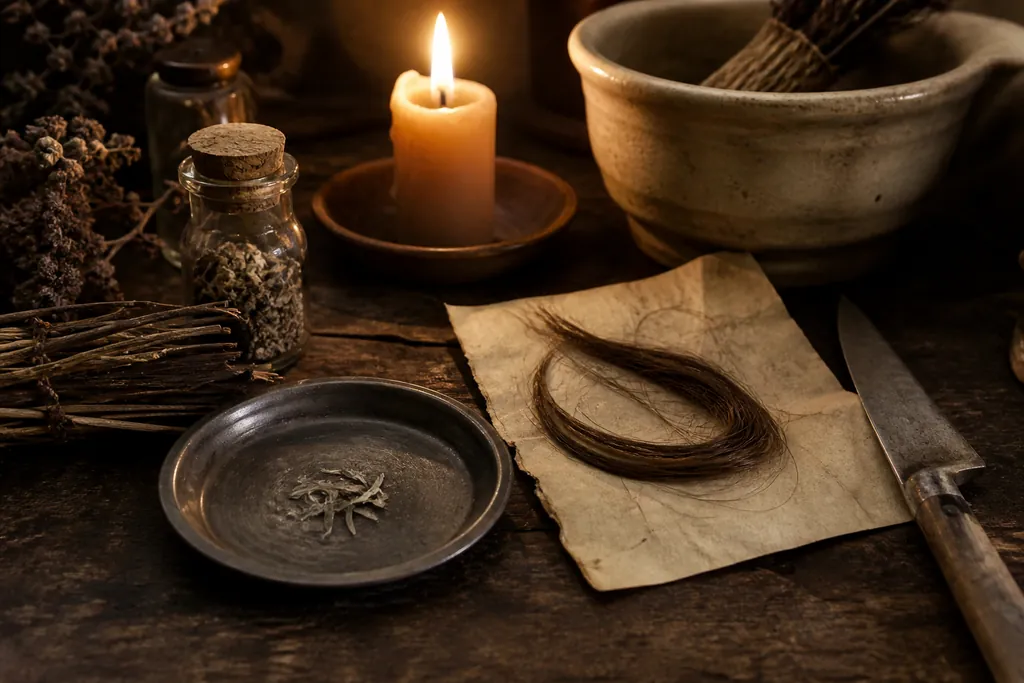
Hair and Nails in Magic and Folklore
Hair and nails have long been regarded as magically significant parts of the human body. In many traditions, they are believed to contain something of a person’s essence, vitality and identity. Because they grow from the body yet can be removed from it, they occupy a strange symbolic position: they are both part of the person and separate from the person. For this reason, hair and nail clippings appear in many forms of folk magic, protective charms, love spells, curse-breaking rituals and sorcery.
Hair is especially associated with strength, virility, sexuality, personal power and psychic protection. In many cultures, abundant hair was seen as a sign of force, beauty, kingship or spiritual potency. Monarchs, warriors, priests and magicians were sometimes imagined as carrying part of their authority in their hair. To cut the hair of another person could therefore be understood not simply as grooming, but as an act of humiliation, punishment or spiritual weakening.
One of the most famous examples is the biblical story of Samson, whose strength was lost after Delilah cut his hair. The story reflects a much older and wider belief: that hair can hold power, and that removing it may sever a person from that power.
In folklore, a witch’s magical power was often believed to be bound in her hair. Loose, shaken or flowing hair could symbolise unleashed power. Some traditions claimed that when a witch shook out her hair, the power of a spell was doubled. Similar ideas appear in many cultures, where cutting, binding, hiding or burying hair becomes a way of controlling magical influence.
Among the Bhils of Central India, suspected witches were reportedly tortured and then had a lock of hair cut off and buried, in the belief that this broke the connection between the witch and her magical ability. During the European witch hunts, accused witches were sometimes shaved. This was done partly because authorities believed that shaving deprived them of power, and partly because the body was then searched for marks interpreted as signs of the Devil.
Nails also carried a strong magical reputation. Like hair, they continue to grow and can be separated from the body. For this reason, nail clippings were treated with caution in many traditions. Some beliefs associated long or uncut nails with demons, impurity or evil influence. In certain Jewish customs, fingernails were kept short, while some traditions in Madagascar held that the Devil could dwell beneath neglected nails.
A great deal of Western magical lore concerning hair and nails may be traced to the Vendidad, a Zoroastrian liturgical text traditionally associated with purification laws, ritual protection and the struggle against spiritual pollution. In this tradition, hair and nails were treated as potentially dangerous remains of the body. Because they could be used by hostile magicians, witches or sorcerers, they had to be disposed of carefully.
According to the Vendidad, Ahura Mazda gave Zarathustra specific rituals for the safe disposal of hair clippings and nail parings. Hair was not to be thrown away casually. It had to be removed from sacred and domestic spaces, taken away from the faithful, the fire, the water and the holy baresma twigs. The instruction states that the hair should be taken ten paces from the faithful, twenty paces from the fire, thirty paces from the water and fifty paces from the bundles of baresma. A hole was then to be dug in the earth: ten fingers deep if the ground was hard, twelve fingers deep if the ground was soft.
The hair was placed into the hole while sacred words were spoken:
“Out of his pity Mazda made plants grow.”
After this, three furrows were to be drawn around the hole with a metal knife, or six, or nine, and the Ahuna Vairya prayer was to be chanted three times, six times or nine times.
The ritual for nails was similar, though slightly different. The nail clippings were to be taken outside the house and buried in a hole as deep as the top joint of the little finger. As the nails were buried, protective words were spoken:
“The words are heard from the pious in holiness and good thought.”
These instructions reveal how seriously hair and nails were treated in Zoroastrian ritual thought. They were not harmless waste. They were vulnerable remnants of the body, capable of attracting impurity or being used for harmful magic if left exposed.
This belief is found in many later magical and folk traditions. The custom of burying cut hair and nails survived across different cultures. Aleister Crowley was known to dispose of his hair and nail clippings carefully throughout his life. In Ozark folk belief, hair combings were buried rather than thrown away. French peasants buried hair. In Turkish and Chilean traditions, hair clippings were sometimes placed inside walls.
The idea behind these practices was both practical and magical. If hair and nails contained the personal essence of the individual, then leaving them exposed meant leaving oneself vulnerable.
The ceremonial magician Aleister Crowley famously wrote:
“Every intentional act is a magical act.”
This statement is useful when thinking about the folklore of hair and nails. The clipping, burying, burning, saving or binding of hair was not merely superstition in the minds of practitioners. It was an intentional act, performed with purpose, belief and magical logic.
Sorcerers, cunning folk and witches in many societies were believed to use hair in spells. A person’s cut hair could be used to cast a spell upon them, to bind them, influence them, heal them, or break a curse already placed upon them. In some traditions, the hair of a bewitched person was thrown into a fire so that the pain of the flames would be returned to the witch responsible for the bewitchment.
Other customs were more sinister. The hair of a dead man, buried beneath the threshold of an enemy, was said to cause illness or ague. In parts of Germany, a small bag of smooth human hair was placed on the stomach of a person suspected of being bewitched. If the hair became tangled after three days, it was taken as a sign that witchcraft had been involved.
Hair also appears frequently in love magic. In many traditions, a lock of hair could serve as a link between lovers. Hair was kept in lockets, sewn into charms, braided into bracelets or hidden in personal objects. Young women in past centuries sometimes made bracelets from their hair and gave them to lovers as tokens of loyalty and remembrance.
Pubic hair, because of its intimate and sexual association, was considered especially powerful in love charms. One well-known Scottish legend concerns John Fian, a 16th-century man accused of witchcraft. According to the tale, Fian attempted to make a young woman fall in love with him by using three of her pubic hairs in a charm. However, the hairs were secretly replaced with three hairs from a cow’s udder. As the story goes, the enchanted cow then followed Fian around town instead of the intended woman.
Such stories are humorous on the surface, but they reveal an important belief in sympathetic magic: that a part of the body can stand in for the whole person.
Red hair also developed strong magical associations in European folklore. In some old beliefs, red-haired people were considered witches, sorcerers or unusually fiery in temperament. There is evidence that some ancient pagan ritual specialists may have dyed their hair red for certain rites. Red hair was common among the Celts, whose traditions were often associated with enchantment, prophecy and magical practice. During the witch trials, red-haired individuals were sometimes viewed with suspicion because of these associations.
Witches were also said to harm animals by shooting magical hairballs into them. These hairballs supposedly entered the animal’s body without leaving an external wound and lodged inside the stomach or organs. Such beliefs belonged to a wider pattern of magical explanation for mysterious illness in livestock.
The cutting of hair was also governed by superstition. In many traditions, hair should be cut according to the phases of the moon. Cutting hair during the waxing moon was believed to encourage growth, while cutting during the waning moon was thought to slow growth. These lunar customs still survive today in folk beauty practices and magical household traditions.
Hair and nails therefore occupy an important place in magical history. They are intimate, personal and symbolically charged. They represent vitality, identity, sexuality, vulnerability and power. Whether buried for protection, saved as a token of love, burned to reverse a curse or hidden from enemies, hair and nails were never seen as ordinary waste in magical belief.
They were fragments of the self.
And in magic, a fragment of the self may be enough.
Continue Your Path into Real Witchcraft
Witchcraft, Power and the Occult World Community
Hair, nails, blood, breath, names, footprints, clothing, photographs — traditional witchcraft has always understood one central truth:
Magic works through connection.
A spell is not powerful because it is theatrical.
A charm is not powerful because it looks mysterious.
A ritual is not powerful because it copies something from a book.
Power comes from understanding the hidden links between person, object, intention, spirit, timing and force.
That is exactly what you can explore inside the Occult World Mystery School.
The community is not a casual newsletter or a fluffy spiritual club. It is a serious learning space for people who want to understand witchcraft, magic, symbolism and spiritual practice with structure and depth.
Inside the community, you can study protection, cleansing, grounding, energy awareness, magical intention, ritual work, spellcraft, divination, spirit work, occult symbolism, ancient grimoires and the practical structure of magical development.
If articles like this fascinate you, that is because you are already beginning to see the deeper pattern.
Folklore is not just old superstition.
It is a record of how people understood power.
It is a map of fear, protection, desire, influence and survival.
Inside the Witchcraft Course, which is included in the Occult World Mystery School, you can begin learning how these old ideas fit into a serious magical practice. You will explore the foundations of spellwork, the role of personal items in magic, the ethics of influence, protective techniques, ritual timing, magical tools, energy direction and the difference between fantasy and actual practice.
This is for you if you want to move beyond reading random articles and finally begin building a real path.
Not chaos.
Not confusion.
Not scattered information from social media.
A structured path.
Join the Occult World Mystery School and begin your training in witchcraft with depth, discipline and purpose.
Your path does not begin with a dramatic ritual.
It begins with understanding power — and learning how to use it wisely.
SEE ALSO:
Witch Bottles.
Sympathetic Magic
Protection Magic
Cunning Folk
Love Charms
The Evil Eye
Witchcraft and the Body
Moon Magic
FURTHER READING:
- Cavendish, Richard. The Black Arts. New York: Putnam, 1967.
- Leach, Maria, ed., and Jerome Fried, Assoc. ed. Funk & Wagnall’s Standard Dictionary of Folklore, Mythology and Legend. New York: Harper & Row, 1972.
- Opie, Iona, and Moira Tatem. A Dictionary of Superstitions. New York: Oxford University Press, 1989.
SOURCE:
The Encyclopedia of Witches, Witchcraft and Wicca – written by Rosemary Ellen Guiley – Copyright © 1989, 1999, 2008 by Visionary Living, Inc.




Follow