
Herne the Hunter: The Antlered Ghost of Windsor Forest
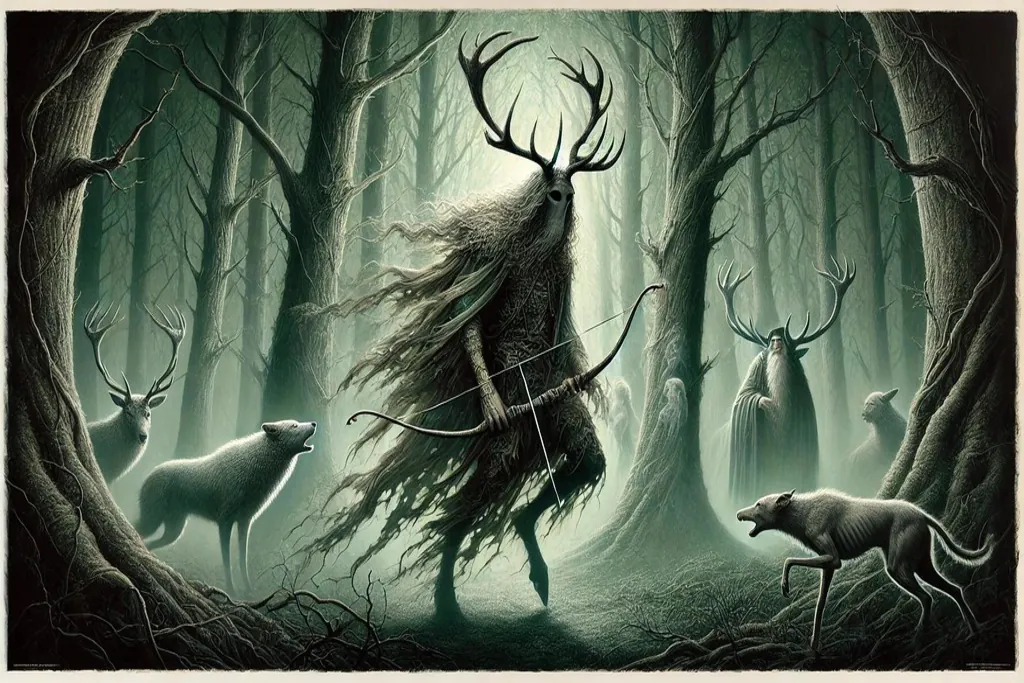
Herne the Hunter is one of the most haunting figures in English folklore: a spectral huntsman said to haunt Windsor Great Park near Windsor Castle in England. He appears as a dark, antlered rider, often wearing chains, mounted on a ghostly black horse and accompanied by baying phantom hounds.
His legend belongs to several worlds at once. Herne is a ghost of Windsor Forest, a tragic royal huntsman, a leader of the Wild Hunt, and possibly a survival of much older pagan imagery connected with the Horned God, Cernunnos, Pan, the hunt, the underworld, and the untamed powers of nature.
He is not merely a frightening apparition. He is a figure of death, wilderness, sovereignty, animal instinct, lunar mystery, and ancestral memory.
The Legend of Herne the Hunter
According to legend, Herne was once a royal huntsman in the service of an English king. Different versions name different kings, including Richard II, Henry VII, or Henry VIII.
One day, during a hunt in Windsor Forest, the king was attacked by a wounded stag. Herne saved the king’s life by throwing himself between the animal and the monarch. The stag struck Herne, leaving him mortally wounded.
As Herne lay dying, a mysterious wizard appeared. He told the king that Herne could be saved if the stag’s antlers were cut off and tied to Herne’s head. The strange ritual was performed, and Herne survived.
For a time, the king rewarded him with favour and honour. But Herne’s fellow huntsmen grew jealous. They resented his closeness to the king and eventually persuaded the monarch to dismiss him.
Disgraced and heartbroken, Herne went into Windsor Forest and hanged himself from an oak tree. From that moment onward, his spirit was said to haunt the forest, riding through the trees with antlers on his head, chains around his body, and phantom hounds at his side.
Herne’s Oak
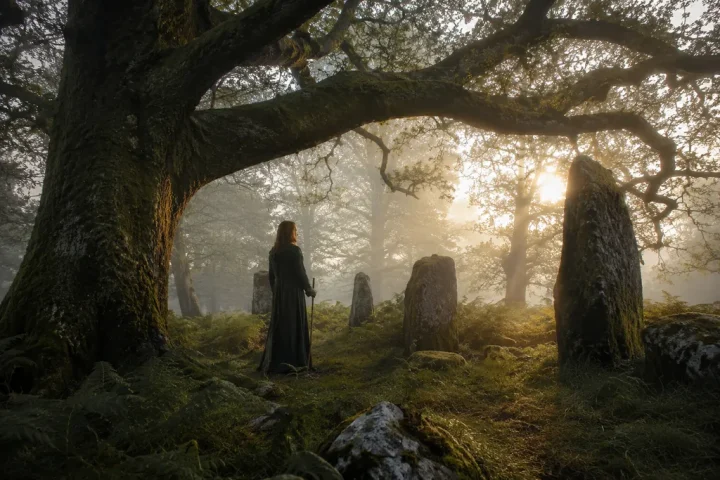
Herne’s ghost is closely associated with an oak tree in Windsor Great Park. According to tradition, this was the tree from which he hanged himself.
English ghost investigator Peter Underwood suggested that the legend may have been based on a real huntsman from the reign of Richard II, who ruled from 1377 to 1399. This huntsman was said to have hanged himself on an oak near Windsor Castle.
The original oak tree was believed to have blown down in 1863. Queen Victoria later had another oak planted in its place, preserving the memory of the legend.
Whether Herne was once a real man, a local ghost story, or a much older spirit given human history, the oak remains central to his myth. The tree connects him to death, sacrifice, haunting, and the deep memory of the land.
Herne and the Wild Hunt
Herne is often described as a leader of the Wild Hunt, the ghostly nocturnal procession known across many parts of European folklore.
The Wild Hunt is usually heard or seen at night. It may appear as a storm of riders, hounds, horns, dead souls, spirits, demons, or ancestral beings moving across the sky or through the forest. In some traditions, those who witness it are warned of death, disaster, war, or great change.
As a leader of the Wild Hunt, Herne is more than a local ghost. He becomes a psychopompic figure: one who moves between the world of the living and the realm of the dead. His hounds, horn, horse, and antlers mark him as a being of pursuit, transition, death, and wild supernatural power.
Herne’s association with the Wild Hunt also gives him lunar and nocturnal qualities. He belongs to the night road, the winter forest, the sound of hooves in darkness, and the call of the horn echoing between worlds.
Herne, Herlechin, and the Dead
Herne’s name has been linked with Herlechin, or Harlequin, another figure associated with the dead, the Devil, and the Wild Hunt. In medieval imagination, these figures often blurred together: ghostly huntsmen, demonic riders, ancestral leaders, pagan gods, and infernal spirits.
This connection places Herne inside a wider European tradition of spectral hunters. Similar horned or ghostly huntsmen appear in German and French folklore, where they may ride with the dead, punish the wicked, or appear before catastrophe.
Herne is therefore part of a larger mythic pattern: the dark rider of the forest, the antlered lord of the hunt, the spirit who appears when the boundary between the living and the dead grows thin.
Herne and Cernunnos
Although Herne is usually presented as a ghost of Windsor Forest, many writers have suggested that he may preserve older pagan elements. His antlers strongly recall Cernunnos, the Celtic horned god associated with fertility, animals, wild nature, the underworld, and the mysterious abundance of the forest.
Cernunnos is often shown seated, horned, surrounded by animals, and connected with serpents, torcs, and the powers of life and death. Herne, by contrast, appears as a restless mounted hunter. Yet both figures share powerful horned symbolism.
The antlers are not a minor detail. They place Herne in the world of the stag: virility, wilderness, sovereignty, seasonal death and rebirth, and the deep animal intelligence of the forest.
In modern Witchcraft and Wicca, Herne is often associated with the Horned God, and sometimes connected with Cernunnos and Pan. He may be understood as a local English expression of the Divine Masculine: wild, protective, primal, sexual, chthonic, and deeply tied to the cycles of nature.
Herne in Witchcraft and Wicca
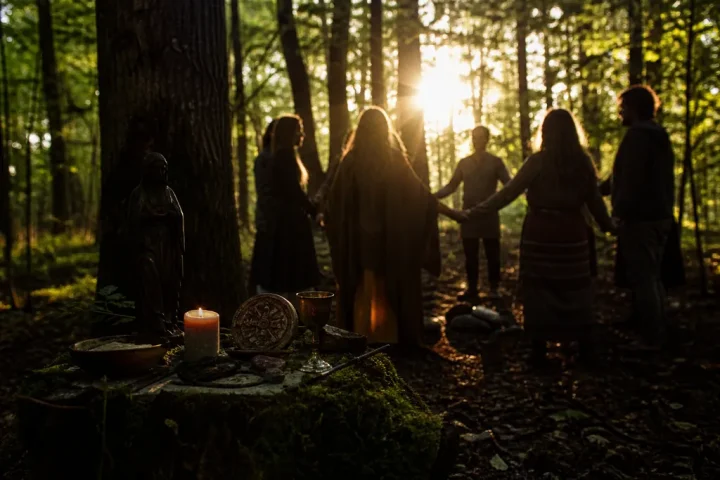
In modern Witchcraft, Herne has become an important figure for some practitioners who honour the Horned God. He represents the wild masculine principle, not as domination, but as instinct, protection, vitality, sacrifice, and connection to the living land.
For Wiccans and modern Pagans, Herne may be invoked or contemplated as a guardian of the forest, a lord of the hunt, a spirit of liminality, or a symbol of the untamed self.
His presence reminds practitioners that nature is not only gentle and beautiful. It is also dark, powerful, predatory, seasonal, and full of death as well as life. The forest gives, but it also takes. The stag is majestic, but also wounded. The hunt is thrilling, but also fatal.
Herne therefore carries a double teaching: he is both the hunted and the hunter, the sacrificed one and the haunting one, the servant of the king and the sovereign of the wild.
Sightings of Herne
Herne is said to appear in Windsor Forest, especially in times of great crisis. According to tradition, he appeared in 1931 before the Depression and again before the outbreak of the Second World War.
One dramatic account dates from 1962, when a group of youths in the forest reportedly found a hunting horn near a clearing. When they blew it, another horn answered from the darkness, followed by the baying of hounds. Suddenly, Herne and his ghostly company appeared, charging through the forest. Terrified, the youths dropped the horn and fled.
Other sightings of Herne have been connected with alleged witchcraft activity in Windsor Forest. Whether understood as ghostly folklore, psychic impression, pagan survival, or modern legend, Herne continues to hold power over the imagination.
He is not a dead myth. He remains a presence in English ghost lore, Witchcraft symbolism, and the wider mythology of the Wild Hunt.
The Symbolism of Herne
Herne’s image is rich in occult and folkloric meaning.
The antlers represent wild nature, animal power, fertility, death and renewal, and the sovereignty of the forest.
The chains suggest punishment, haunting, bondage, sorrow, and the unresolved pain of betrayal.
The black horse links him with night, death, travel between worlds, and the supernatural hunt.
The phantom hounds represent pursuit, instinct, warning, and the forces of the dead.
The horn belongs to summons, awakening, prophecy, and the call that crosses the boundary between worlds.
The oak tree represents endurance, sacrifice, ancestral memory, and the sacred power of the land.
Together, these symbols make Herne one of the most evocative figures in British folklore. He is ghost, god-shadow, hunter, victim, warning, and guardian of the old forest mysteries.
Herne as a Figure of Thresholds
Herne the Hunter stands at several thresholds.
He stands between human and animal.
Between king’s servant and outlaw spirit.
Between ghost and god.
Between Christian demonisation and pagan remembrance.
Between the living forest and the procession of the dead.
This is why his legend has endured. Herne is not simply a frightening ghost story for the fireside. He is a symbol of the wild forces that civilisation cannot fully erase.
He reminds us that beneath castles, kingdoms, churches, and laws, the ancient forest still watches. Its spirits may change names, but they do not disappear.
Continue Your Path Inside the Occult World Mystery School
Herne the Hunter belongs to the deep world of Witchcraft, Wicca, folklore, horned gods, forest spirits, the Wild Hunt, ancestral memory, and the old magical imagination of Britain.
If this article fascinates you, do not stop at reading about the old powers from a distance.
Inside the Occult World Mystery School, you can go deeper into Witchcraft, ritual practice, magical symbolism, folklore, spirit lore, protection, seasonal magic, and the mysteries of the Divine Masculine and Divine Feminine.
You will also be able to meet fellow Wiccans, witches, magical practitioners, and occult students who are walking similar paths. The community is a place to learn, ask questions, share experiences, and explore the old traditions with structure, seriousness, and support.
If Herne calls to something ancient in you, follow that call further.
Enter the Occult World Mystery School.
Study Witchcraft.
Connect with fellow Wiccans.
Explore the old gods, the spirits of the land, and the mysteries of the Wild Hunt.
And begin walking the path with knowledge, practice, and community.
SEE ALSO:
FURTHER READING:
- Folklore, Myths and Legends of Britain. London: Reader’s Digest Assoc., 1977.
- Guiley, Rosemary Ellen. The Encyclopedia of Witches and Witchcraft. New York: Facts On File, 1999.
- Underwood, Peter. A Gazeteer of British Ghosts. Rev. ed. London: Pan Books, Ltd., 1973.
SOURCES:
- The Encyclopedia of Ghosts and Spirits – Written by Rosemary Ellen Guiley – September 1, 2007
- The Encyclopedia of Witches, Witchcraft and Wicca – written by Rosemary Ellen Guiley – Copyright © 1989, 1999, 2008 by Visionary Living, Inc.


Follow