

Orcabella
Orcabella is an ancient goddess or spirit of Galicia, a region in north-western Spain that once belonged to the wider Celtic world. Her name is striking, mysterious and memorable, carrying the atmosphere of old folklore, wild landscape and forgotten goddess traditions.
She is described as a lusty hag, a powerful female figure with overwhelming vitality, sexual force and earthy appetite. At first glance, this image may seem grotesque or unsettling, but in Celtic and related mythologies, the hag is rarely just an old woman. She is often the land itself in its rawest form: ancient, demanding, fertile, dangerous and sacred.
Orcabella may belong to the same mythic family as the sovereignty goddesses of Ireland, who appear first as withered hags and later transform into beautiful young women when the rightful king accepts them. In this pattern, the goddess tests the ruler. If he has the courage, humility and worthiness to embrace her in her terrifying or unattractive form, she reveals her true radiance. Her transformation symbolises the fertility, prosperity and renewal that his rule will bring to the land.
Orcabella and the Celtic Spirit of Galicia
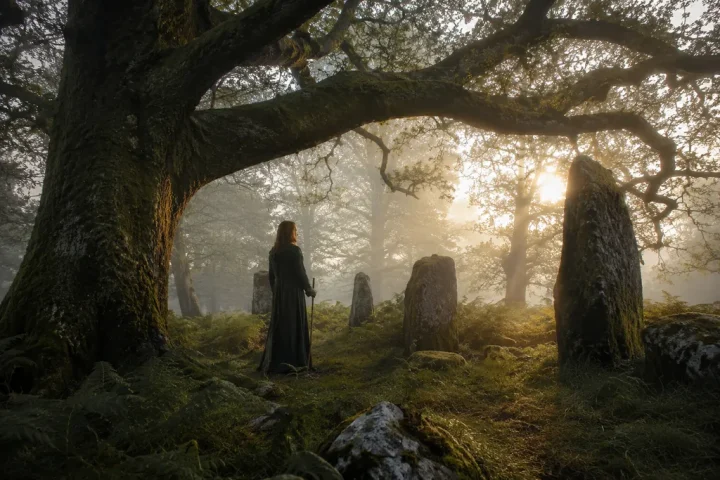
Galicia has deep Celtic associations. Its landscape of mountains, forests, coastlines, mist and stone has preserved many traces of pre-Christian spiritual imagination. In such a place, it is easy to understand how a figure like Orcabella could emerge: fierce, earthy, ancient and closely connected with land, fertility and sovereignty.
Orcabella is not a polished classical goddess. She does not belong to marble temples or refined mythological systems. She feels older, wilder and more local. She belongs to the rough edge of myth, where goddesses are not always gentle mothers or radiant maidens, but shapeshifting forces of land, hunger, death, desire and power.
Her Galician setting is important. She is a goddess of place, rooted in a specific cultural and geographical world. Her energy belongs to the ancient western edge of Europe, where the land meets the Atlantic and old Celtic memories linger in folklore, music, language and legend.
The Lusty Hag as Sacred Figure
The description of Orcabella as a lusty hag should not be dismissed as crude or comic. In mythology, the hag often represents a profound spiritual archetype. She is the old earth, the dark feminine, the body beyond social beauty, the devouring mother, the tester of heroes and the keeper of hidden fertility.
The hag is frightening because she refuses to be controlled by conventional ideas of beauty, obedience or refinement. She is not young, passive or decorative. She is hungry, powerful and unapologetically alive. In this sense, Orcabella represents a form of feminine power that is raw, ancient and untamed.
Her sexuality is not merely personal desire. It is mythic fertility. It is the appetite of the land itself. The fields must be renewed. The kingdom must be made fruitful. The ruler must unite with the goddess not as a fantasy of pleasure, but as an act of sacred legitimacy.
Orcabella’s hag form may therefore be understood as a test. Can the would-be ruler honour the land when it appears old, difficult, demanding and unattractive? Can he recognise divinity beneath the mask of decay? Can he embrace the truth of nature before receiving its beauty?
Orcabella and Sovereignty
Orcabella may be a sovereignty goddess. In Celtic tradition, sovereignty is often personified as a female figure who grants kingship. The king does not simply take power. He must be accepted by the land, and the land is embodied by the goddess.
This idea appears strongly in Irish mythology, where a hideous hag may approach a king or hero. The unworthy reject her because they see only ugliness. The worthy accept her, kiss her or unite with her, and she transforms into a beautiful young woman. Her transformation reveals the truth: the king has recognised the sacred power hidden beneath the surface, and because of this, the land will flourish under his rule.
If Orcabella belongs to this same symbolic pattern, then her story is about much more than erotic appetite. It is about the sacred contract between ruler and land. A king who cannot honour the goddess in her dark form is not worthy to rule. A ruler who seeks only beauty, pleasure and status will fail the deeper test of sovereignty.
Orcabella asks: can you love the land when it is barren? Can you serve power when it is not flattering? Can you recognise divinity when it appears in a form that challenges you?
The Transformation of the Hag
The transformation of the hag into the radiant maiden is one of the most powerful images in Celtic mythology. It reveals the hidden fertility within apparent decay. It teaches that beauty may be concealed beneath age, hardship and shadow.
In Orcabella’s case, this transformation may symbolise the renewal of the kingdom. The dried-up hag becomes a youthful, fertile woman, just as a suffering or barren land becomes prosperous when ruled by the right king. The body of the goddess and the body of the land mirror each other.
This is not simply a story about male power. In fact, the goddess holds the true authority. She decides who is worthy. She grants or withholds sovereignty. She is the one who transforms. The king may wear the crown, but the land-goddess gives the crown its sacred legitimacy.
Orcabella, therefore, is not an object of desire. She is the test, the judge and the source of power.
Orcabella and the Shadow Feminine
For modern witches and occultists, Orcabella can be understood as a figure of the shadow feminine. She embodies aspects of the goddess that are often hidden, feared or rejected: old age, hunger, sexuality, bodily power, rage, wildness and the refusal to be pleasing.
Many spiritual traditions overemphasise the gentle, beautiful or maternal aspects of goddess energy. Orcabella reminds us that the feminine divine is not always soft. Sometimes she is fierce, demanding and uncomfortable. Sometimes she appears as the part of nature we would rather not face.
To work symbolically with Orcabella is to confront the fear of ageing, the fear of desire, the fear of being too much, and the fear of the body in its raw truth. She teaches that power does not disappear because it is no longer young or socially acceptable. The hag is not powerless. She may be the most powerful figure in the myth.
Orcabella and Witchcraft
In witchcraft, Orcabella may be approached as a goddess or spirit of land power, sovereignty, fertility, sexual vitality, shadow work and transformation. Her symbolism belongs to the wild earth, the old woman, the shapeshifter, the sacred hag and the hidden beauty beneath the feared form.
She may be especially meaningful in magical work connected with reclaiming personal power, healing shame around the body, embracing mature feminine force, transforming rejection into sovereignty and working with the land as a living spiritual presence.
Orcabella’s energy is not delicate. She is not a goddess for shallow beauty spells or passive devotion. She belongs to deeper rites of truth, embodiment and power. She asks the practitioner to stop rejecting the parts of the self that seem too old, too hungry, too intense or too wild.
Her magic says: what you reject may be the very source of your sovereignty.
Orcabella and Manifestation
Orcabella’s myth also has a powerful connection with manifestation. She teaches that the outer world transforms when we stop rejecting the hidden or uncomfortable parts of ourselves.
The king who sees only a hag fails the test. The king who recognises the goddess beneath the hag receives the transformed maiden and the fertile kingdom. This is a profound manifestation principle. If we reject our shadow, our wounds, our ageing, our desire or our wildness, we remain separated from our full power. When we embrace the whole self, the world can begin to reflect that inner integration.
Orcabella is a goddess of radical acceptance. She does not ask to be loved only when she is beautiful. She asks to be recognised before the transformation. That is the test.
For anyone working with manifestation, Orcabella teaches that identity must include the rejected self. The radiant future is hidden inside the part we are afraid to claim. When we stop seeing ourselves as unworthy, unwanted or diminished, the inner hag becomes the sovereign goddess.
The Occult Meaning of Orcabella
Orcabella is a powerful and unusual goddess figure. She belongs to Galicia, Celtic memory, sovereignty myth, hag symbolism, fertility, sexuality and transformation. She may not be as widely known as the great goddesses of Ireland, Britain or classical mythology, but her image is unforgettable.
She reminds us that the divine feminine is not always graceful, obedient or easy to understand. Sometimes she is old, lusty, wild and demanding. Sometimes she tests the seeker before revealing her beauty. Sometimes she appears in the very form that society has taught us to reject.
Orcabella is the goddess behind the mask of the hag. She is the land before it blooms. She is desire before it is refined. She is sovereignty hidden beneath discomfort. She is the ancient feminine power that asks to be honoured completely, not only when it is pleasing to the eye.
To study Orcabella is to remember that true magic often begins where fear, desire and transformation meet.
Explore Orcabella, Mythology and Witchcraft with Occult World
If Orcabella fascinates you, then you are already sensing the deeper connection between mythology, witchcraft, sovereignty, shadow work and manifestation. Orcabella is not just an obscure goddess from Galician tradition. She is a powerful symbol of wild feminine energy, hidden beauty, land power and the transformation of what has been rejected into sacred authority.
Inside the Occult World Mystery School, you can explore goddesses like Orcabella in a deeper and more magical way. You can learn how mythology connects with witchcraft, manifestation, ritual practice, shadow work, sacred landscapes, fertility symbolism and the transformation of the self.
You will also find courses and discussions on Witchcraft, Ancient Grimoires, Kabbalah, Demonology, Angels, Hoodoo, Voodoo, Practical Tarot, Necromancy, Black Magick, the Illuminati and many other occult traditions. More importantly, you can meet fellow witches, occultists, magical practitioners and serious seekers who understand that mythology is not just something to read about. It is something to work with, embody and awaken within your own magical life.
If the name Orcabella calls to something ancient, wild and powerful within you, do not ignore it.
Join the Occult World Mystery School today and step into a living circle of mythology, witchcraft, manifestation, occult study and fellow seekers walking the hidden path together.
ORIGIN:
Celtic
Sacred site:
Orcabella is associated with Cape Finisterre (in Galician: Cabo Fisterra), part of the Costa de Morta, the “Coast of Death.” This coastal zone bears that name for two reasons:
• This Atlantic coast is extremely rocky and treacherous, the site of many shipwrecks.
• Finisterre means “End of the Earth.” Celtic cosmology envisioned it as literally the end of the road, the embarkation point for ferries to the islands of the dead.
The region was home to Celtic spiritual rituals and a pilgrimage route. There are many sacred stones in the area, including one called the Tomb of Orcabella. The region is now associated with the Way of Saint James.
SEE ALSO:
SOURCE:
Encyclopedia of Spirits: The Ultimate Guide to the Magic of Fairies, Genies, Demons, Ghosts, Gods & Goddesses – Written by : Judika Illes Copyright © 2009 by Judika Illes.

Follow