
Pellon Pekko
Pellon Pekko, also written Pellonpekko and sometimes simply Pekko, is an old Finnish and Karelian spirit or deity of the fields, especially associated with barley, agriculture and the brewing of beer. His name may be understood as “Pekko of the Field”, and surviving traditions place him among the powers whose favour determined whether the grain would rise from the earth and ripen successfully. Because barley was essential not only as food but also for brewing, Pellon Pekko naturally became connected with beer and the mysterious transformation of grain into an intoxicating sacred drink.
One of the earliest written references to Pellon Pekko appears in Mikael Agricola’s famous list of Finnish and Karelian deities, published in 1551 with his Finnish translation of the Psalms. Agricola wrote that “Pellonpecko Ohran casvon soi”, meaning that Pellon Pekko granted the growth of barley. Agricola’s list is enormously important because it preserves the names and functions of several pre-Christian beings at a time when their traditional worship was already being displaced by Christianity.
Barley, Beer and the Power of the Field
Pellon Pekko was not simply a general vegetation god. His strongest surviving association is specifically with barley and brewing. Finnish folk poetry connects him with the sowing of barley and with traditions surrounding the origin and preparation of beer, while dialect traditions describe pellonpekko or peltopekko as a supernatural being connected with both barley cultivation and beer-making.
In an agricultural society, such a power occupied an important place between human labour and the unpredictable forces governing the harvest. Seed could be planted correctly and the earth carefully worked, yet frost, drought, storms and disease could still destroy everything. The being who caused barley to grow therefore stood close to survival itself. When that same grain entered the brewing vessel and became beer, Pellon Pekko’s influence extended from the dark soil of the field into communal drinking, celebration and ritual.
Older occult reference works sometimes state that the first brewing of beer was dedicated to Pellon Pekko. The deity’s close association with brewing is well established, but this exact formula is much harder to document in early Finnish sources and should therefore be treated as a later summary of the tradition rather than as a securely attested universal rite.
Pekko Beyond Finland
Pellon Pekko is closely related to Peko, the agricultural and fertility spirit of the Seto people of south-eastern Estonia. Seto traditions surrounding Peko survived unusually late and preserve a much clearer picture of actual ritual practice. Wooden or waxen representations of Peko were kept privately, sometimes in connection with grain stores, and were brought into ceremonies concerned with fertility, protection of crops and agricultural prosperity.
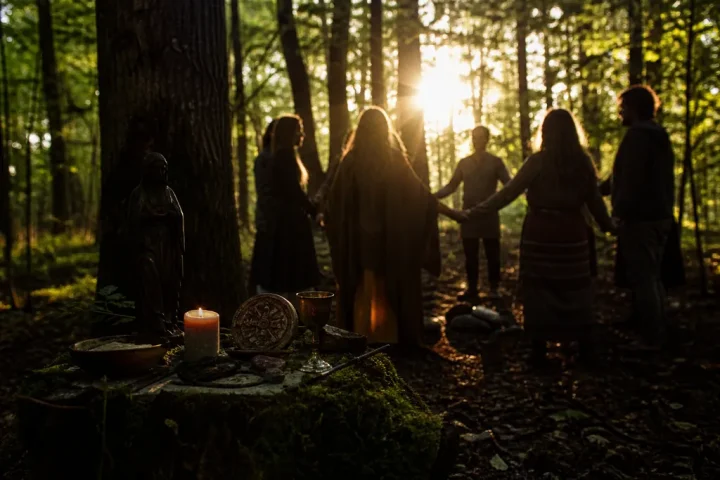
Ethnographic accounts describe gatherings in which people prayed to Peko for good harvests and protection from destructive weather. Grain was collected in his honour, beer was prepared and drunk, candles were burned, and the image of the deity could be carefully guarded from outsiders. Some traditions maintained that revealing Peko to strangers would diminish his power.
These Seto traditions do not prove that every Finnish custom surrounding Pellon Pekko was identical, but they reveal the wider Finnic religious world from which such a barley and fertility deity could emerge. The god of grain was not an abstract symbol. He belonged to the granary, the field, the brewing vessel and the dangerous uncertainty between sowing and harvest.
Pellon Pekko and Saint Peter
Later tradition sometimes associates Pellon Pekko with Saint Peter, whose Finnish name is Pietari and whose popular name forms include Pekka and Pekko. The similarity of names, together with the Christianisation of older seasonal customs, encouraged connections between the old agricultural spirit and the Christian saint.
It would be too strong, however, to say simply that Pellon Pekko “became” Saint Peter everywhere. The surviving evidence points more towards syncretism, in which an older name, feast custom or agricultural function could become attached to Christian observance while memories of the earlier supernatural figure remained beneath it. Such transformations are common in European folk religion, where the arrival of Christianity did not always erase older spirits so much as cover them with new names.
Behind the saint, the old figure of the field remained difficult to extinguish. Barley still pushed through the soil, beer still fermented in the vessel, and somewhere within the old songs survived the name of the being who, according to Agricola, gave the barley its growth.
The Spirit Behind the Barley
Pellon Pekko survives only in fragments, yet those fragments reveal an ancient religious world in which every stage of survival possessed its unseen powers. The field was not merely soil, barley was not merely a crop, and brewing was not merely a domestic craft. Growth itself depended upon forces that had to be recognised, respected and remembered.
That is what makes Pellon Pekko more than an obscure name from Finnish mythology. He belongs to the dark agricultural mysteries that existed long before modern farming separated human beings from the supernatural character of the land. Beneath every harvest lay the possibility of famine, behind every seed lay the mystery of resurrection from buried grain, and inside the brewing vessel another transformation waited to begin.
Stop Skimming Mythology and Start Studying It
If all you want is another list of gods with one-line descriptions, there are thousands of dead websites that can give you exactly that. If you want to understand what these beings meant, how ancient religions survived beneath Christian names and why spirits of grain, death, fertility, magic and transformation appear again and again across cultures, then enter the Occult World Mystery School and stop wasting your time on superficial occult content. Study mythology, spirits, grimoires, ritual magic, demonology and the old religious systems as interconnected traditions instead of disconnected trivia. The deeper material is there, but it will remain closed to anyone satisfied with standing outside and reading labels.





Follow