

Peterborough: The Wild Hunt and the Spectral Hunters of 1127
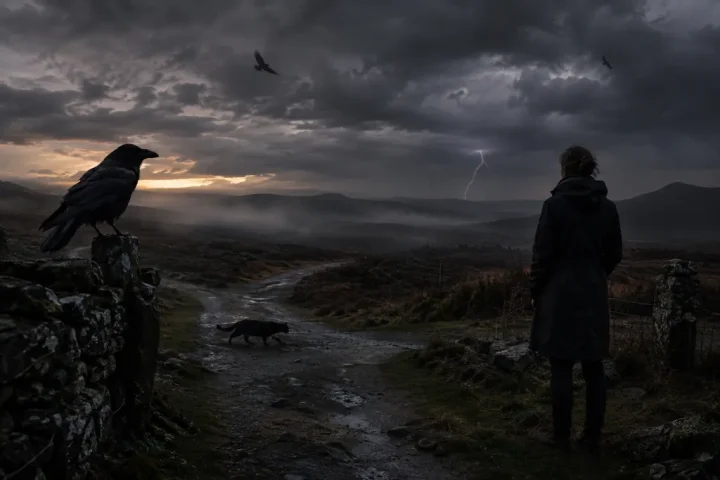
Among the oldest and most remarkable accounts of a supernatural hunt in medieval England is the apparition recorded at Peterborough in 1127. Long before folklorists began gathering Europe’s traditions of phantom riders, spectral hounds, wandering dead and airborne armies beneath the general name of the Wild Hunt, a monk at Peterborough Abbey described something strikingly similar. Huge black hunters were seen riding through the surrounding countryside with monstrous black hounds, while the sound of hunting horns was heard at night in the woods between Peterborough and Stamford.
The chronicler did not present the event as a picturesque local legend. He connected it directly with the arrival of a new and deeply unpopular abbot, Henry of Poitou, whose appointment to Peterborough he regarded with undisguised hostility. In the Peterborough continuation of the Anglo-Saxon Chronicle, Henry is condemned as a man who exploited the abbey, consumed its wealth and brought little benefit to the community. In the memorable words of the chronicler, he “did nothing good there and left nothing good there”. Almost as soon as Henry arrived, supernatural hunters supposedly began appearing in the surrounding landscape, and the phenomenon continued throughout Lent until Easter.
The monk’s account remains one of the most vivid descriptions of spectral hunting preserved from medieval England:
Let it not be thought remarkable, when we tell the truth, because it was fully known over all the country, that as soon as he came there … then soon afterwards many people saw and heard many hunters hunting. The hunters were black and big and loathsome, and their hounds all black and wide-eyed and loathsome, and they rode on black horses and black goats. This was seen in the very deer-park in the town of Peterborough, and in all the woods that there were between this town and Stamford, and the monks heard the horns blow that they were blowing at night. Trustworthy people noticed them at night, and said that it seemed to them there might well be about twenty or thirty hornblowers. This was seen and heard from the time he came there all Lent up to Easter.
The wording varies slightly between translations of the Anglo-Saxon Chronicle, with some translators rendering the animals ridden by the hunters as black bucks rather than black goats, but the essential features remain unchanged. The hunters are described as enormous, dark and repulsive; their hounds are similarly black and terrifying; and the phenomenon is presented not as a single fleeting apparition but as something repeatedly seen and heard by numerous witnesses over a period of weeks. The chronicler insists that the story was widely known, while the monks themselves supposedly heard the horns sounding through the darkness.
The Wild Hunt before it had a name
Calling the Peterborough apparition the Wild Hunt is useful, but the term must be applied carefully. The medieval chronicler did not call it by that name, nor is there evidence that medieval Europe possessed one universally recognised Wild Hunt tradition in the form later reconstructed by folklorists. Instead, medieval and later sources preserve a broad family of supernatural traditions involving ghostly armies, nocturnal riders, wandering dead, cursed hunters, phantom hounds and invisible processions whose approach might be announced by horns, shouting, barking or an overwhelming noise rushing through the night.
The modern concept of the Wild Hunt was shaped particularly strongly during the nineteenth century, when comparative folklorists such as Jacob Grimm attempted to bring together related traditions from Germany, Scandinavia, Britain and elsewhere. Grimm connected the German Wilde Jagd, or Wild Hunt, and the Wütendes Heer, the Furious Host, with pre-Christian Germanic mythology and especially with the god Wodan. His interpretation profoundly influenced later folklore studies, but modern scholarship is more cautious. Similar supernatural processions undoubtedly influenced one another and sometimes merged, yet it does not follow that every phantom army, spectral pack of hounds or mysterious aerial noise originated in one ancient pagan myth.
England alone preserved numerous related traditions under very different names. In Devon there were the Yeth Hounds and Wisht Hounds, while Cornwall knew Dando and his Dogs and other terrifying packs associated with the Devil. Northern English folklore included the Gabriel Hounds, which were often heard passing overhead rather than seen, while the mysterious Seven Whistlers were interpreted in several regions as omens of catastrophe and death. The huge, wide-eyed black hounds recorded at Peterborough inevitably invite comparison with later traditions of monstrous black dogs such as Black Shuck in East Anglia, although these traditions should not automatically be assumed to share a single origin.
The invisible hunt
One of the most disturbing features of Wild Hunt traditions is that the hunters do not always need to be seen. In many later accounts the supernatural company is heard rushing across the sky or through the landscape while remaining completely invisible. The phenomenon becomes a confusion of hunting horns, hounds, hoofbeats and voices, approaching gradually until the unseen hunt seems almost to be passing directly over the witness.
A powerful literary description of this form of supernatural hunting appeared in John Leyden’s Scottish Descriptive Poems in 1803. The lines are sometimes attributed to Leyden himself, but they belong to the anonymous Scottish poem Albania, which he reproduced in his collection:
… heard at midnight, or at noon,
Beginning faint, but rising still more loud
And nearer, voice [sic] of hunters, and of hounds,
And horns hoarse-winded, blowing far and keen …
The image is particularly effective because the terror comes from sound rather than sight. The hunt is recognisable in every auditory detail, yet no hunter appears on the road and no hound can be seen among the trees. Storm winds, echoing valleys, migrating birds and the strange acoustics of forests and moorlands may have contributed to some such experiences, but within folklore the explanation was not meteorological. Something was hunting in the darkness, and whatever it pursued did not belong entirely to the world of the living.
Walkelin and the army of the dead
One of the most important medieval parallels to the Peterborough apparition comes from Normandy rather than England. According to the Anglo-Norman historian Orderic Vitalis, a priest named Walkelin encountered an extraordinary supernatural procession at Bonneval on the night of 1 January 1091. Later retellings sometimes give the date as 1092, but Orderic’s chronology places the event at the beginning of January 1091.
Walkelin was returning home after visiting a sick parishioner when he heard what seemed to be an immense company approaching through the night. He initially imagined that it might be the army of a powerful nobleman and prepared to conceal himself, but what emerged from the darkness was something altogether more terrible. The procession contained dead men carrying enormous burdens, corpse-bearers transporting biers, sinners tormented by demons and women riding upon saddles pierced with burning nails. Clerics, monks, bishops and abbots followed, and behind them came an enormous armed host mounted on war-horses.
Orderic describes the army as one “in which no colour was visible, but only blackness and fiery flames”. Walkelin recognised people among them whom he knew to have died, and the sight convinced him that he had encountered the supernatural company he had previously heard described but never believed he would see himself. Confronted by the procession, he said:
“Doubtless these are Herlechin’s people.”
The expression refers to the familia Herlechini, one of several medieval names associated with wandering supernatural companies. The episode is particularly important because it clearly identifies many of the riders as the dead. They are not merely mysterious forest spirits or phantom huntsmen but souls suffering punishments corresponding to their earthly sins. In Orderic’s Christian interpretation, the procession becomes almost a moving vision of Purgatory and damnation, passing through the ordinary landscape and briefly revealing the fate of the dead to a living witness.
This theological setting should not be stripped away when comparing the episode with the Wild Hunt. Medieval clerics were perfectly capable of absorbing older supernatural motifs into Christian visions of sin, punishment and the afterlife. What may once have been understood differently could become a procession of damned souls, while a phantom hunter could become a demon. The Wild Hunt tradition was never static; it changed according to the religious and cultural world in which it was retold.
King Herla and the household of Herlethingus
Towards the end of the twelfth century, Walter Map recorded another extraordinary supernatural company in his De Nugis Curialium. Map refers to nocturnal companies associated with the name Herlethingus and describes a wandering household among whom “many persons were seen alive who were known to have died”. According to his account, the mysterious company had been reported for generations and was last seen in the marches of Wales and Hereford during the first year of the reign of Henry II, in 1154.
Unlike the monstrous hunters of Peterborough, the familia Herlethingi, or household of Herlethingus, resembled an enormous travelling retinue. It included men and women, carts, pack animals, panniers, hounds and hawks. When local people attempted to intercept the silent company, raising the countryside with horns and shouting, the procession rose into the air and disappeared. The event therefore combines ordinary features of a medieval household with something unmistakably supernatural: the company contains the dead, behaves unnaturally and ultimately escapes into the sky.
Walter Map also tells the celebrated story of King Herla, whom he presents as an ancient king of the Britons. Herla receives an invitation from a mysterious dwarf king and enters an Otherworldly realm in which time passes differently from the human world. When he returns, believing that only a short period has elapsed, he discovers that centuries have passed. Members of his company who dismount from their horses instantly crumble into dust, forcing Herla and his surviving followers to continue wandering.
It is tempting to identify Herla directly as the leader of the familia Herlethingi, but the relationship is not as straightforward as later folklore books sometimes suggest. Walter Map presents the stories separately, and scholars have long debated precisely how the traditions are connected. Nevertheless, both preserve the powerful medieval idea of a supernatural company that cannot fully return to the ordinary world and remains condemned to endless movement.
The names associated with these traditions are equally fascinating. Orderic records familia Herlechini, French sources contain forms such as Mesnie Hellequin, Walter Map gives Herlethingi, and Middle English later produced related expressions including Hurlewaynis kynne. These names have often been connected with Harlequin, the famous theatrical figure of early modern Europe, but the precise linguistic relationship remains disputed. What is clear is that long before Harlequin became a comic stage character, names resembling Hellequin and Herlechin were associated with frightening supernatural hosts.
The Fairy Hunt in Sir Orfeo
The spectral procession also overlaps with medieval traditions concerning fairy hunting. One of the most evocative examples appears in the Middle English romance Sir Orfeo, probably composed in the late thirteenth or early fourteenth century. The poem transforms the classical myth of Orpheus and Eurydice into a medieval story in which Orfeo’s wife, Heurodis, is abducted by the King of Fairy.
After losing her, Orfeo abandons his kingdom and withdraws into the wilderness, where he repeatedly witnesses supernatural companies moving through the landscape. One such vision is described in striking language:
He might se him bisides
(Oft in hot vnder-tides)
The king o fairy with his rout
Com to hunt him al about
With dim cri and bloweing,
& houndes also with him berking …
The image is immediately recognisable: an otherworldly king rides with his company, horns are blown, cries echo through the landscape and hounds bark around the hunters. Yet this is not explicitly a procession of the damned. It belongs to Fairyland.
Heurodis should not be described as Orfeo’s dead wife, because in the medieval version she has been abducted rather than killed. Nevertheless, the episode demonstrates how closely the fairy host could resemble other supernatural hunting companies. Fairyland itself often occupied an uncertain position in medieval imagination, neither completely separate from the realm of the dead nor identical with it. As these traditions developed, boundaries between ghostly processions, fairy ridings and supernatural hunts could become increasingly difficult to define.
Arthur and the supernatural hunt
Other legendary and historical rulers gradually became associated with phantom hunting companies, and King Arthur was one of the most important. Medieval continental sources refer to Arthur’s supernatural household, while French folklore eventually developed names such as la Chasse Artu, Arthur’s Hunt. The idea fitted naturally with the wider belief that Arthur had never truly disappeared from the world and might one day return.
Arthurian hunting traditions also survived in Cornwall. Castle-an-Dinas, near St Columb Major, became associated with Arthur in local legend, and later folklore claimed that his hunting horns could sometimes be heard over the surrounding moorland. These Cornish traditions belong to a later period than the medieval French references, but they show how readily Arthur could enter the same supernatural landscape as spectral hunters and fairy kings.
Arthur was not alone. Across Europe other famous rulers were drawn into comparable traditions. Charlemagne appears in later French and German stories, while local heroes and noblemen could acquire their own ghostly retinues. In Shropshire, Wild Edric, the historical Eadric the Wild who resisted Norman rule after the Conquest, became surrounded by supernatural traditions, including stories that connected him with mysterious women and later tales in which his spectral appearance foreshadowed national danger.
The leader of the Wild Hunt was therefore never fixed. He might be an ancient god, a legendary king, a dead nobleman, a sinner condemned to hunt forever or a demonic figure created by Christian interpretation. The identity changed from region to region while the fundamental image of the terrifying supernatural company survived.
Woden, Odin and the Wild Hunt
No figure has become more closely associated in modern occult and popular literature with the Wild Hunt than Woden or Odin, but the historical relationship requires caution. German and Scandinavian traditions certainly preserve supernatural hunters associated with Wodan, Wod or Odin, and later regional names such as Odinsjagt connect the god directly with a phantom hunt. Odin’s associations with war, death, ecstatic states and the gathering of slain warriors also made him an obvious candidate for interpretation as the leader of a spectral host.
The idea that the Wild Hunt was fundamentally a survival of Woden’s ancient retinue became especially influential through Jacob Grimm during the nineteenth century. Grimm argued that Christian folklore had transformed the pagan god and his followers into a terrifying nocturnal hunt. Under Christianity, the old deity could be demonised, while his supernatural followers became devils, damned souls or unquiet spirits.
This interpretation remains compelling in some regions, but it cannot be applied indiscriminately. There is no secure evidence that the black hunters reported at Peterborough in 1127 were understood by their witnesses as followers of Woden, nor should Herlethingus, Hellequin, Arthur’s Hunt and every other phantom company automatically be reduced to an Odin myth. The Wild Hunt is better understood as a network of traditions that repeatedly exchanged motifs and identities over many centuries.
The Hunt as punishment
As Christianity absorbed and reshaped supernatural traditions, the Wild Hunt became increasingly connected with punishment. Those who blasphemed, violated sacred days, committed murder or lived in notorious wickedness could be condemned after death to ride eternally through the night.
Orderic’s account of Walkelin makes this moral function explicit. The priest sees murderers tormented by demons, sinful women riding upon burning saddles and corrupt clergy undergoing punishment. The supernatural procession reveals that sin cannot escape judgement merely because death has occurred.
A comparable motif became attached to King Valdemar IV of Denmark, who died at Gurre Castle in 1375. Later legend claimed that Valdemar loved hunting and his castle so passionately that he declared he would prefer to keep Gurre rather than possess Heaven. One version records his boast:
God might keep his heaven to himself, provided he, Waldemar, might for ever live hunting in the forest of Gurre.
For this impiety, Valdemar was condemned to ride eternally through the surrounding countryside. Later tradition claimed:
He now rides every night from Burre to Gurre, and is known throughout the whole country as the Wild Huntsman.
The pattern is familiar. A human passion becomes excessive, sacred law is defied, and the punishment is not simply death but endless repetition. The sinner continues forever doing the very thing that had dominated his earthly life.
Dando and his Dogs
Cornwall preserved one of Britain’s most vivid Christian versions of the supernatural hunt in the story of Dando and his Dogs. Robert Hunt recorded the tradition in Popular Romances of the West of England during the nineteenth century. Dando is portrayed as a priest associated with St Germans who loves feasting, drinking and hunting far more than the spiritual obligations of his office. His greatest offence is that he continues hunting on Sundays.
During one Sunday hunt, a mysterious stranger riding a fiery horse joins the company. After the hunt, a dispute develops over the game, and Dando refuses to surrender his share. In the familiar later wording of the tradition, he cries:
‘You shan’t have it! I’ll go to hell for it rather than you shall get it.’
The stranger replies:
‘So you shall.’
Robert Hunt’s own version gives the exchange slightly differently, with Dando shouting, “I’ll go to hell after them, but I’ll get them from thee,” and the stranger answering, “So thou shalt.” The meaning remains the same. Dando has spoken his own condemnation.
The stranger seizes him and carries him away on horseback, followed by the pack of hounds. Horse, riders and dogs plunge into the River Lynher amid fire and steam, disappearing into the water. Dando’s punishment does not end there, because the hunt becomes eternal. According to Hunt, Dando and his hounds could still be heard in the early hours of Sunday mornings racing through the countryside in full cry.
The legend combines several themes already familiar from the wider Wild Hunt tradition: Sabbath-breaking, blasphemy, supernatural horses, phantom hounds, the Devil in disguise and eternal hunting as punishment. By the nineteenth century the Wild Hunt had become thoroughly Christianised in this Cornish story, yet beneath the moral lesson survives the much older terror of hearing an invisible hunt crossing the landscape.
Richard Cabell and the hounds of Dartmoor
A similar tradition became attached to Richard Cabell of Brook Manor near Buckfastleigh in Devon, who died in 1677. Cabell was a real local landowner, but after his death increasingly sinister legends accumulated around his memory. He was portrayed as a wicked man and, in later folklore, even as someone who had sold his soul to the Devil.
On the stormy night of his death, black hounds were supposedly seen or heard racing across Dartmoor and gathering around his house as though waiting to claim his soul. His unusual tomb beside Holy Trinity Church at Buckfastleigh later became part of the supernatural tradition, with stories suggesting that the elaborate structure had been designed to keep his restless spirit imprisoned.
The Cabell legend belongs to the same Devon landscape in which the Yeth and Wisht Hounds were believed to roam. Its importance lies in showing how easily the ancient pattern could absorb new personalities. A supernatural hunt did not require an ancient pagan god or medieval king. A notorious local figure could become the centre of the same imaginative structure, surrounded after death by hounds, storms and rumours of damnation.
The restless dead and the midwinter night
One of the strongest threads running through these traditions is the presence of the dead. Walkelin recognises deceased neighbours among Herlechin’s people. Walter Map says that individuals known to have died were seen among the household of Herlethingus. Medieval supernatural companies repeatedly blur the boundary between ghosts, demons, fairies and wandering souls.
This helps explain why such traditions became particularly associated with night, winter and periods of the year when the dead were believed to approach the living world most closely. Walkelin’s vision occurs at the beginning of January, while later European Wild Hunt traditions are frequently connected with the winter season and especially with the Twelve Days of Christmas. Midwinter was already a liminal period in European custom, a time when ordinary boundaries were weakened and supernatural beings might move more freely through the landscape.
The Hunt therefore became much more than a ghost story. It represented the terrifying possibility that the dead had not disappeared at all. They remained in motion, travelling through the same forests, roads and skies used by the living, and under certain conditions their procession might become visible or audible.
What was the Wild Hunt?
The Wild Hunt resists any single explanation. It has been interpreted as a memory of pagan ritual, the retinue of Woden, an army of the dead, a fairy procession, a Christian vision of damned souls, a personification of winter storms, a supernatural interpretation of migrating birds and a moral warning against violating sacred law. Elements of all these interpretations can be found somewhere in the enormous body of European tradition, but none explains every manifestation.
What survives historically is not one stable legend but a changing constellation of motifs. Spectral riders appear in one region while invisible hounds dominate another. A dead king may lead the Hunt in one country, Odin in another, Arthur somewhere else, and the Devil elsewhere still. Some hunts pursue sinners, while others gather the dead. Some travel across the ground, while others race through the sky. Fairy companies, ghostly armies and demonic processions repeatedly overlap until their boundaries become impossible to separate.
That fluidity is precisely what makes the tradition so powerful. The Wild Hunt absorbs whatever a culture fears might be moving beyond the edge of the visible world. It can carry the dead, the damned, the forgotten gods or those who have broken sacred law. Its horns announce that something is approaching, but the witness may never know exactly what.
The Peterborough manifestation of 1127 remains one of the most extraordinary English examples because it appears so early and because the chronicler insists upon its reality. He was not preserving a distant folktale from generations before his time. He was describing something he believed had occurred around his own monastery, witnessed by people throughout the surrounding country and heard by the monks themselves. For weeks, enormous black hunters supposedly rode between Peterborough and Stamford, accompanied by monstrous hounds and the sound of horns in the night.
Whether the chronicler understood these figures as demons, wandering dead, divine punishment directed at an unworthy abbot or something for which he possessed no precise theological category remains uncertain. What is certain is that more than nine centuries later the image has lost none of its power: somewhere beyond the monastery walls, in the dark woods of medieval England, the horns were sounding and the hunters were already riding.
Enter the Occult World Mystery School
The Wild Hunt is exactly what happens when you refuse to accept the shallow version of occult history. One spectral hunt opens into medieval chronicles, fairy traditions, armies of the dead, cursed kings, pagan gods, Christian demonology, forgotten regional folklore and centuries of attempts to understand what moves beyond the visible world. If you are satisfied with recycled paragraphs, simplified legends and occult trivia copied from one website to another, stay on the surface. If you want to understand where these traditions came from, how they changed, what they meant to the people who feared them and how they connect to the wider architecture of magic, spirits and supernatural belief, join the Occult World Mystery School.
There are thousands of spirits, gods, demons, magical systems, grimoires and forgotten traditions waiting beyond it, and reading about them is not the same as studying them. Stop collecting fragments. Stop standing outside the mysteries pretending that another article is enough. Enter the Occult World Mystery School, go deeper than the popular retellings, and start building the knowledge that separates the serious occultist from the casual spectator.
SEE ALSO:
SOURCE:
Haunted England : The Penguin Book of Ghosts – Written by Jennifer Westwood and Jacqueline Simpson – Copyright © Jennifer Westwood and Jacqueline Simpson 2005, 2008


Follow