
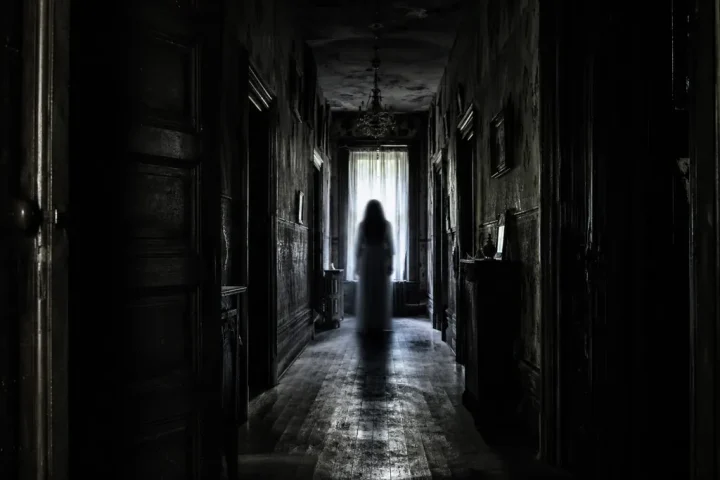
W. P. Witcutt noted in the journal Folk-Lore in 1944 that from 1922 to 1929 the attic of the manor house here was reputedly haunted by a phantom known as Plantie’s Ghost. The trouble began when workmen re-slating the roof disturbed a box made of lath and plaster, with a highly polished wooden door, and various bits of metal and wire fixed to the sides of it. The villagers called this contraption a ‘husher’, and said it had been put there ‘to amuse the ghost and keep it from harming people’. ‘Plantie’ was not, apparently, the name of the ghost itself, but that of a previous owner of the house who had tried to catch it and imprison it in a bottle; presumably the attempt failed and the ‘husher’ was installed as a second line of defence.
Though no exact parallel to this find has been reported, the underlying principles are sound, in folkloric terms. The roof-space is vulnerable to attacks from external evil forces, so protective charms of various kinds are sometimes placed there; various distracting devices, such as tangles of coloured threads in a bottle, can also be used to divert a supernatural creature from its harmful purposes.
SEE ALSO:
SOURCE:
Haunted England : The Penguin Book of Ghosts – Written by Jennifer Westwood and Jacqueline Simpson –
Copyright © Jennifer Westwood and Jacqueline Simpson 2005, 2008








Follow