
Snelston and the Phantom Hooves of Galley Hill
North of Caldecott in Rutland, the A6003 towards Uppingham crosses the remains of a village that has almost vanished from the landscape. Snelston was once a medieval settlement, but today little survives above ground. Its former street can still be traced as a hollow way, while the earth around it preserves faint signs of the houses and boundaries that once belonged to the people who lived there. The site is now protected as a Scheduled Monument, yet local tradition remembers more than abandoned foundations.
According to legend, a church once stood on the hill at Snelston. Nothing remains of it today, but the story claims that its bells were never removed and still lie buried beneath the ground where the church once stood. Whether there is any truth in the tale cannot now be established, but stories of lost bells often gather around deserted settlements, ruined churches and places where worship has fallen silent. At Snelston, the buried bells became part of the strange atmosphere of a village that disappeared but was never completely forgotten.
Beyond the abandoned settlement, the road rises towards Galley Hill, a name that carries its own grim history. Tradition says that a gallows once stood here, visible against the skyline as a warning to anyone approaching along the road. Such places rarely vanished completely from local memory. Long after the executions stopped, the landscape itself could retain a reputation for dread, and Galley Hill became associated with one of Rutland’s more unsettling ghost stories.
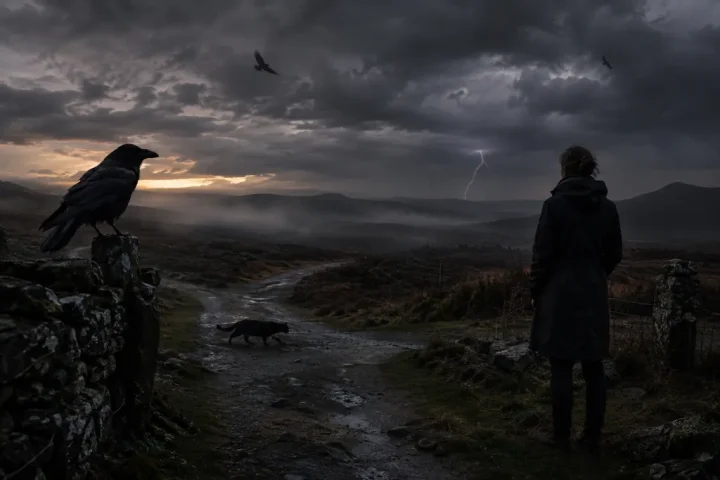
Travellers were said to hear the sound of trotting hooves moving ahead of them as they travelled either up or down the hill. Nothing could be seen on the road, yet the invisible horse seemed always to keep its place before the traffic. Living horses reportedly reacted with fear, sweating, shying and becoming difficult to control as though they sensed something that their riders could not.
By the middle of the twentieth century, the story was already described as an almost forgotten legend. No clear explanation for the phantom hooves survived. Perhaps people once imagined that they belonged to a horse pulling a condemned prisoner towards the gallows, completing the final journey again and again. Perhaps the haunting originated in some long forgotten accident on the hill, or perhaps the sound belonged to a spectral rider whose story had been lost while the haunting remained.
Whatever the origin, the legend leaves behind one of those disturbing images that make English ghost lore so compelling: an empty road, an abandoned medieval village and the steady sound of hooves belonging to a horse that cannot be seen. The traveller hears it ahead, the animals feel its presence, but the road remains empty.
Snelston itself has almost disappeared, yet the land still bears its outline. Galley Hill still rises beyond it. Somewhere beneath the earth, tradition says, the bells of a lost church remain buried, while on the old road the memory of an invisible horse continues to move through the darkness.
Enter the Occult World Mystery School
Haunted roads, execution sites and deserted villages are not simply picturesque ghost stories. They belong to a much older supernatural landscape in which violent death, abandoned sacred places and repeated human fear were believed capable of leaving something behind. If you want to understand why certain roads become haunted, why spirits attach themselves to particular places, and how folklore, death beliefs and occult traditions intersect, then reading another ghost story is not enough.
Join the Occult World Mystery School and go deeper into the forces behind the legends. Study spirits, hauntings, demons, forbidden traditions, grimoires and the darker systems of occult belief that shaped stories like the phantom hooves of Galley Hill. Stop standing outside the mystery pretending that the surface is enough. Enter the School and learn what may still be moving through the darkness.
SEE ALSO:
SOURCE:
Haunted England: The Penguin Book of Ghosts – Written by Jennifer Westwood and Jacqueline Simpson – Copyright © Jennifer Westwood and Jacqueline Simpson 2005, 2008



Follow