
Sphinx: The Riddling Guardian of Myth and Mystery
The Sphinx is one of the most mysterious beings in world mythology: part human, part beast, guardian of secrets, protector of sacred places, and destroyer of those who cannot pass her test. In Greek mythology, the Sphinx is usually described as a monster with the head of a woman and the body of a lion, sometimes with wings. Her name is linked to a Greek root meaning “strangler” or “throttler,” a reference to the deadly power of the lion and to the fate of those who failed her challenge.
Although the Sphinx appears in both Greek and Egyptian tradition, these two forms are not identical. The Greek Sphinx is usually female, dangerous, and riddling. The Egyptian sphinx is usually male and associated with kingship, divine protection, royal strength, and sacred authority.
The Greek Sphinx and the Riddle of Thebes
In Greek mythology, the Sphinx was the daughter of Echidna and either Orthus or Typhon. She was sent by Hera or Apollo to punish King Laius of Thebes, and she took up her place on a rock near the road to the city. There she stopped travellers and asked them a terrible riddle:
“What is it which, though it has one voice, becomes four-footed and two-footed and three-footed?”
Those who failed to answer were hurled from the rock or devoured. The Sphinx became a figure of terror, blocking the road to Thebes and bringing death to those who could not solve the mystery.
When Oedipus came before her, he answered correctly: the answer was man. As an infant, man crawls on hands and feet; in adulthood, he walks on two feet; and in old age, he uses a cane as a third foot. Defeated by the answer, the Sphinx threw herself from the cliff and died.
The Sphinx as Bandit, Goddess, and Psychological Symbol
Ancient writers and later interpreters attempted to explain the Sphinx in different ways. Pausanias, in his Description of Greece, rationalised the myth by suggesting that the Sphinx may have been a woman bandit who attacked travellers from her stronghold on Mount Phicium.
Carl Jung offered a psychological interpretation. To Jung, the Sphinx represented the Great Mother goddess, a powerful and primal feminine force destroyed by the stronger masculine force symbolised by Oedipus. In this reading, the story is not only about a riddle, but about the conflict between ancient feminine power and emerging heroic consciousness.
The Egyptian Sphinx
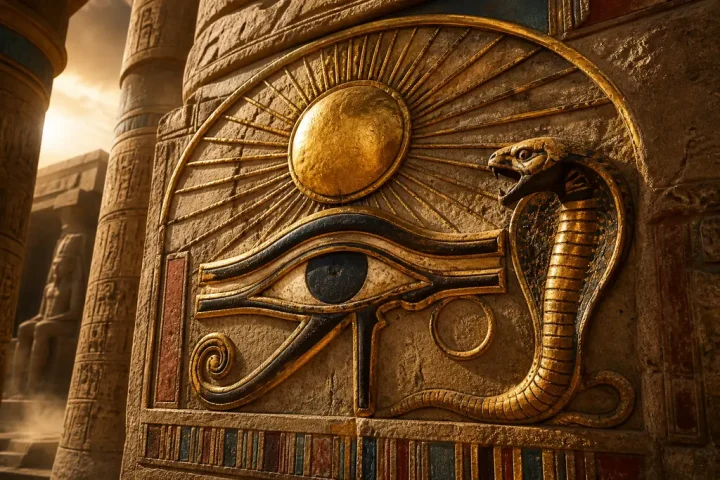
In Egypt, the sphinx is very different from the Greek monster of Thebes. Egyptian sphinxes are usually male and are connected with royal power, divine dignity, protection, and solar symbolism. The most famous sphinx in the world is the Great Sphinx at Giza, a vast figure with a lion’s body and a human head.
The Great Sphinx has inspired many interpretations concerning its age, purpose, and identity. In one tradition, it represents Horus trying to catch sight of his father, Ra, the rising sun, as he journeys across the valley. In Arabic, the Great Sphinx is known as the Father of Fear, a title that reflects the awe and dread this immense guardian has inspired for centuries.
Sphinxes as Guardian Spirits
Sphinxes are ancient, primeval guardian beings. They protect sacred places, thresholds, tombs, temples, homes, treasures, and hidden knowledge. Their presence suggests that a boundary has been reached and that not everyone is worthy to pass.
They are also keepers of secrets, but not ordinary secrets. The Sphinx guards the deep mysteries: questions of life, death, destiny, kingship, initiation, desire, and divine power. To encounter the Sphinx is to be confronted by a mystery that demands intelligence, courage, and transformation.
Magical and Spiritual Use of the Sphinx Image
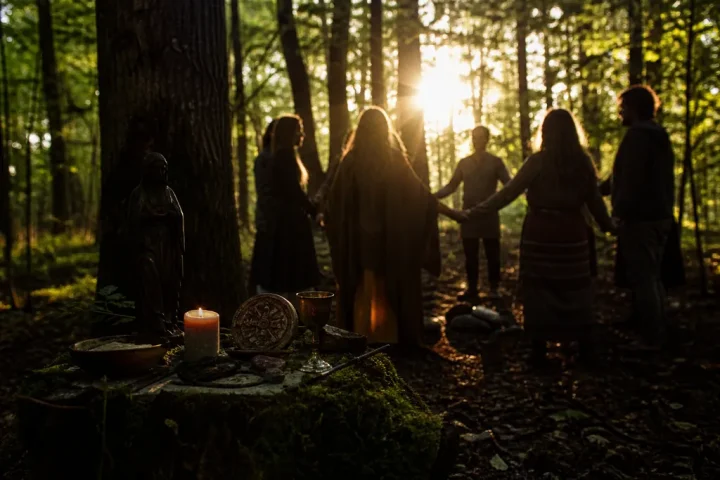
In magical and spiritual practice, the power of the Sphinx may be activated through its image. A personal sphinx may be requested to guard a home, temple room, shop, magical object, altar, or sacred space. This request may be made through dreams, visualisation, meditation, or shamanic journeying.
Another method is to speak directly to the image of the Sphinx and offer candles, incense, or water. The head of the Sphinx may be pointed in the direction from which danger, interference, or unwanted energy is believed to come. In this way, the Sphinx becomes not only a symbol, but a spiritual guardian.
Because sphinxes embody immense strength, mystery, and sovereignty, devotees and rulers have long desired to identify themselves with their power. Egyptian pharaohs, including Hatshepsut, commissioned images of themselves as sphinxes. To place one’s own head on the body of the Sphinx is to claim its might, guardianship, and divine authority.
The Female Sphinx and Erotic Power
Although many sphinxes are male, the Sphinx is also closely connected with a deep and enigmatic form of feminine power. In art and symbolism, the female Sphinx often represents beauty, danger, desire, silence, and mystery. She does not reveal herself easily. She asks questions. She tests. She fascinates and destroys.
German Symbolist painter Franz von Stuck portrayed the Sphinx as a nude woman reclining in the sphinx position, emphasising her erotic and dangerous allure. Other artists and performers also adopted the image of the Sphinx, including Sarah Bernhardt, Colette, and Ida Rubinstein. For these figures, the Sphinx became a symbol of feminine command, mystery, and artistic power.
The Sphinx in Art and Literature
The Sphinx has inspired artists, poets, and sculptors for centuries. Ingres and Gustave Moreau both painted the encounter between Oedipus and the Sphinx, focusing on the dramatic tension between human intellect and supernatural mystery.
Other artists inspired by the Sphinx include Gustave Doré, Odilon Redon, Louis Welden Hawkins, Elihu Vedder, Fernand Khnopff, Leonor Fini, and Franz von Stuck. Oscar Wilde’s tomb in Père Lachaise cemetery in Paris also resembles a sphinx-like being. Its sculptor, Jacob Epstein, called it a “Messenger of Beauty,” while others have described it as a strange fusion of angelic and demonic force.
Enter the Mysteries of the Sphinx
The Sphinx is more than a mythological monster. She is a guardian of thresholds, a keeper of forbidden knowledge, and a reminder that every true mystery demands an answer from the soul. To face the Sphinx is to face the question hidden inside yourself: are you ready to pass beyond the surface?
If you are drawn to ancient myths, spirits, demons, gods, goddesses, occult symbolism, magical practice, and the hidden meanings behind legendary beings like the Sphinx, join the Occult World Mystery School. Inside, you can explore deeper teachings, connect with fellow occultists, study ancient traditions, and continue your journey into the mysteries that ordinary books and surface-level articles only begin to reveal.
The Sphinx guards the gate. The question is whether you are ready to enter.
ICONOGRAPHY:
Ancient images of sphinxes, Egyptian and Greek, abound. Among the many modern artists inspired by the sphinx are Gustave Moreau, Gustave Doré, Odilon Redon, Louis Welden Hawkins, Elihu Vedder, Fernand Khnopff, Leonor Fini, and Franz von Stuck.
Sacred site:
The Great Sphinx at Giza, Egypt, remains the most famous sacred site associated with the Sphinx. It stands as one of the great images of ancient power: silent, watchful, and eternally facing the horizon.
SEE ALSO:
- Echidna
- Lilith
- Sekhmet
SOURCES:
- Encyclopedia of Spirits: The Ultimate Guide to the Magic of Fairies, Genies, Demons, Ghosts, Gods & Goddesses– Written by Judika Illes Copyright © 2009 by Judika Illes.
- Encyclopedia of World Mythology and Legend, Third Edition – Written by Anthony S. Mercatante & James R. Dow – Copyright © 2009 by Anthony S. Mercatante


Follow