

Badbh: The Crow Goddess of Battle, Death and the Otherworld
Badbh is one of the darkest and most formidable figures in Irish mythology, a warrior goddess whose presence is felt wherever blood is shed and death gathers close. Her name, usually written Badb in Old Irish and often rendered Badbh in modern usage, means “crow” or “scald-crow”, although the word also developed associations with witchcraft, fury and supernatural terror. She belongs to the battlefield, but she does not fight like a mortal warrior. Her power works through fear, confusion, prophecy and the certainty that every battle must eventually feed the dead.
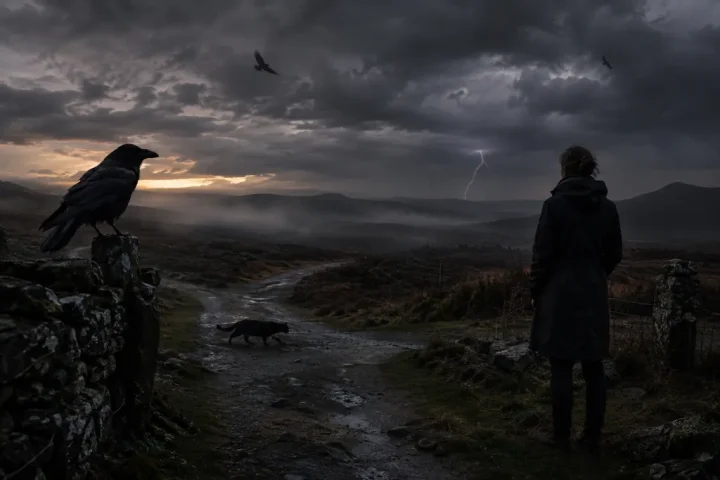
The crow is an appropriate form for such a goddess. Crows arrive wherever bodies fall, gathering above the battlefield while the fighting is still underway and descending when human violence has finished its work. Their ability to move between the living and the dead made them natural psychopomps, creatures believed to cross the boundary separating this world from the Otherworld. When Badbh appears as a crow, she is therefore not merely observing the slaughter. She is announcing that the boundary has opened and that death has already entered the field.
Badbh may be an individual goddess, but her identity is fluid. Her name can also function as a title applied to other Irish female powers associated with war and sovereignty. She is closely connected with the Morrígan, and some traditions treat Badbh and the Morrígan as different names or manifestations of the same being. Other sources place Badbh beside Macha and Nemain within a shifting group of battle goddesses whose distinctions were never as rigid as later mythological catalogues sometimes suggest.
This uncertainty is not a weakness in the tradition. It reflects the nature of Irish divine figures, whose names, titles and functions frequently overlap. Badbh can be encountered as a goddess in her own right, as one aspect of the Morrígan or as the crow-shaped presence through which the power of battle becomes visible.
The Crow Above the Battlefield
Badbh’s most important weapon is terror. She does not usually enter battle with spear and shield, nor does she stand openly beside the warriors she favours. Instead, she moves above the conflict, manipulating the emotions and perceptions of those below.
Her cry can shatter courage before the first blow is struck. She spreads panic through an army until disciplined warriors mistake allies for enemies or flee from dangers that exist only within their own minds. Confusion becomes as deadly as any weapon because a terrified army destroys its own formations and abandons the protection of collective strength.
This psychological warfare is central to Badbh’s character. She represents the moment when fear ceases to be an ordinary human response and becomes an independent supernatural force. A warrior may possess superior weapons and greater numbers, yet none of those advantages matter if Badbh has already entered his thoughts.
Her presence also reveals the outcome of a battle before the combatants understand what has happened. A crow circling above one side may be interpreted as a sign that death has chosen its victims. Warriors who recognise the omen know that the goddess is not simply predicting their fate but may already be guiding events towards it.
Badbh does not require every person on the battlefield to believe in her. Panic spreads through bodies before reason has time to challenge it. A sudden cry from the sky, an unexplained movement among the ranks or the sight of a black bird resting upon a weapon can become enough to break the will of men who had believed themselves fearless.
Badbh and the Morrígan
The relationship between Badbh and the Morrígan is among the most complicated questions in Irish mythology. The Morrígan may appear as a single goddess, yet her name can also describe a collective of closely related female powers. Badbh is frequently included within this group, alongside figures such as Macha and Nemain.
At times, the names appear almost interchangeable. A deed attributed to the Morrígan in one account may resemble the actions of Badbh in another. Both assume the form of a crow, both influence battles and both possess knowledge of approaching death. Their presence is especially powerful where warfare, sovereignty and prophecy meet.
It may therefore be more useful to understand them as manifestations of a shared divine current than to insist upon a permanent separation. Badbh expresses the screaming crow, the panic within the army and the presence that hovers over the newly dead. The Morrígan encompasses a wider range of power connected with war, kingship, sexuality, fate and the land itself.
Badbh is not diminished by this relationship. She becomes the concentrated form of one of the Morrígan’s most terrifying aspects. When the battle goddess takes flight as a carrion crow and casts her shadow across the field, the name Badbh becomes especially appropriate.
Some scholars have also compared Badbh with the Gaulish name Cathubodua, which appears to combine words associated with battle and crow. The similarity suggests that a crow-shaped battle goddess may once have been recognised across a broader Celtic religious world, although the surviving evidence is too limited to prove that Cathubodua and Badbh were understood as precisely the same deity.
Badbh in the Ulster Cycle
Badbh belongs to the supernatural world surrounding the heroes of the Ulster Cycle. In these tales, warfare is never entirely human. Battles unfold beneath the attention of gods, curses and prophetic forces that know the outcome long before the warriors reach it.
She is closely associated with Cú Chulainn, the greatest champion of Ulster. The young hero’s extraordinary violence makes him a natural figure for the battle goddesses to watch. His ríastrad, or battle frenzy, transforms his body into something almost unrecognisable, blurring the distinction between heroic warrior and supernatural destroyer.
Badbh’s relationship with Cú Chulainn is not simply protective. Irish goddesses of war do not behave like obedient guardians whose only purpose is to assist a favoured mortal. Their support may be conditional, dangerous or impossible to distinguish from a challenge. They strengthen heroes, test them and reveal the death waiting at the end of glory.
The crow hovering near Cú Chulainn becomes one of the most enduring images associated with his fate. When the wounded hero finally dies, a crow settles upon him, confirming that his life has ended and that the battlefield now belongs to the dead. Later readers often identify this bird with the Morrígan, but within the overlapping language of Irish tradition it also expresses the presence of Badbh.
The bird does not kill Cú Chulainn. It witnesses the final passage and announces that the warrior who resisted death beyond all mortal endurance has crossed into another realm.
The Cry That Foretells Death
Badbh is not restricted to the moment of battle. Her appearance may warn that death is approaching before weapons are drawn. A crow behaving unusually near a person or dwelling can become a sign that the goddess has turned her attention towards someone whose life is nearing its end.
Her voice is as important as her form. The harsh cry of the crow resembles a broken human call, and in the silence preceding conflict it can sound like a name being spoken from another world. To hear Badbh is to receive knowledge that cannot easily be refused or forgotten.
Irish supernatural tradition often links female spirits with prophetic lamentation. The later banshee cries for those who are about to die, while the washer at the ford cleans bloodstained garments belonging to warriors who have not yet fallen. Badbh participates in this world of female death prophecy, but her power is more ancient and more closely tied to the violence that produces the corpse.
Her prophecy does not necessarily offer a means of escape. The warning may simply confirm that fate has already begun to unfold. The person who hears her cry must decide whether to resist, prepare or walk knowingly towards the death that has been shown.
The Washer at the Ford
Badbh is sometimes associated with the supernatural figure known as the Washer at the Ford. This apparition appears beside a river or stream, washing clothing or armour stained with blood. The garments belong to someone who will soon die, even though the battle in which that death occurs may not yet have begun.
The image connects several of Badbh’s powers within a single vision. Water marks the boundary between worlds, while washing evokes purification and preparation for burial. Blood from a future wound has already reached the hands of the goddess, demonstrating that time does not bind her in the same way it binds mortals.
A warrior who encounters the Washer may recognise his own clothing among the garments. He is then forced to confront the certainty that the Otherworld has already received the image of his death.
The Washer is not always presented as Badbh herself, because several supernatural women share this role in Celtic tradition. Yet the association is entirely appropriate. Badbh is both the crow waiting above the battlefield and the woman preparing the bloodstained cloth beside the water. In one form she announces the death to the world; in the other she prepares for the spirit’s passage beyond it.
The House of Da Derga
Badbh is also connected with the world surrounding the House of Da Derga, the mysterious hostel at the centre of the Irish tale Togail Bruidne Dá Derga, or The Destruction of Da Derga’s Hostel. The story concerns King Conaire Mór, whose violation of sacred prohibitions leads him towards a catastrophic death.
Da Derga’s hostel becomes more than a physical building. It is a place where ordinary hospitality turns into fatal enclosure and where the boundaries between kingship, destiny and the Otherworld collapse. The people arriving there seem drawn into a pattern already prepared for them, while supernatural warnings accumulate around the doomed king.
To associate Badbh with this place is to emphasise her connection with unavoidable fate. She does not belong only to open battlefields. She also inhabits houses where violence is gathering and sacred laws have been broken beyond repair.
The hostel may be understood as a temporary court of the dead, filled with those who are still alive but have already crossed the threshold of destiny. Badbh’s presence within such a place reveals that death can claim its victims before the body has fallen.
Goddess of Battle or Goddess of Death?
Badbh cannot be reduced to a simple goddess of warfare because her deeper authority lies over the transformation that battle creates. She governs the psychological collapse preceding defeat, the moment when life leaves the warrior and the passage through which the dead enter the Otherworld.
Her crow form moves freely across these stages. Before the battle, the bird is an omen. During the battle, its cry spreads terror. After the battle, it descends to the bodies and becomes a visible sign that the dead have passed beyond human protection.
The goddess therefore stands at the meeting point of prophecy, violence and death. She does not merely decide who wins. She reveals that victory itself may be temporary, because every warrior eventually becomes part of the feast awaiting the crow.
This gives Badbh a severe form of wisdom. Kings may claim land and champions may achieve immortal fame, but the battlefield strips away every illusion of permanence. The crow sees ruler and servant alike as bodies that will return to the earth.
Badbh as Witch and Shape-Shifter
The word Badb acquired associations not only with the crow but also with the witch. This connection reflects the fear surrounding women who crossed boundaries, possessed forbidden knowledge or moved between human and animal forms.
Badbh’s transformations make her impossible to contain within one appearance. She can be a bird above the battlefield, a prophetic woman beside the ford or an invisible force spreading chaos through an army. Her shape is determined by the work she has come to perform.
This ability should not be interpreted as deception in the ordinary sense. Shape-shifting reveals that the goddess belongs to several realms simultaneously. The crow, the witch and the warrior spirit are not disguises hiding her true identity. Each form expresses a different aspect of what she is.
Her connection with witchcraft also places her outside the controlled structures of kings and armies. A king commands soldiers, but Badbh commands the fear moving inside them. A warrior controls his weapon, but she can transform the mind holding it.
The battlefield may belong to human rulers before the fighting begins, yet once blood is spilled it becomes the territory of the crow goddess.
Approaching Badbh
Badbh is not a gentle spirit who should be approached for comfort or casual curiosity. She belongs to fear, transformation and the knowledge that every conflict carries consequences beyond the intentions of those who begin it.
Those who honour her may seek courage, prophetic clarity or the strength to confront an enemy without surrendering to panic. She may also be approached as a guardian during periods of extreme change, particularly when an old identity must die before another can emerge.
Any devotion to Badbh should recognise that her power cannot be separated from death. She does not promise that every struggle will end in victory, but she may reveal what fear is attempting to conceal. Her presence demands honesty about the price of conflict and the parts of the self that must be surrendered.
Offerings associated with crows, dark berries, pure water and carefully chosen symbols of battle may be appropriate within modern practice, although no complete historical ritual system devoted specifically to Badbh has survived. Acts of respect towards crows and the protection of their habitats may offer a more meaningful expression of devotion than careless attempts to summon a goddess whose power has never existed for human entertainment.
The Crow Is Already Watching
Badbh endures because the crow still appears wherever human beings confront death. Its black shape remains visible above fields, roads and ruined places, while its cry continues to sound like a warning spoken in a language just beyond understanding.
The goddess reminds us that war begins long before weapons strike. It begins within the mind, where fear destroys judgement and hatred makes violence appear inevitable. Badbh may intensify that terror, but she also reveals it, forcing warriors to confront the force already moving through them.
She waits at the end of battle because every claim of glory eventually becomes silent beneath her wings. The hero, the king and the nameless soldier all enter the same darkness, while the crow passes freely between their bodies and the unseen world beyond.
To hear Badbh is to understand that death is near, but it is also to recognise that death is not empty. The Otherworld has already opened, and something ancient is watching from the threshold.
Stop Trembling Beneath the Wings of Power
The weak collect the names of gods and spirits as if occult knowledge were entertainment, yet they remain terrified of their own minds, their own destinies and every power that moves beyond the limits of ordinary belief. They read about Badbh while refusing to confront the fear, discipline and transformation that her presence demands.
Enter the Occult World Mystery School and stop crawling through scraps of diluted folklore. Study Demonology, Black Magick, divine powers, battlefield spirits and the hidden systems through which serious occultists learn to command themselves and reshape the world around them.
There are thousands of spirits, gods, demons, magical systems, grimoires and forgotten traditions waiting beyond the threshold. Power does not belong to passive spectators. Tear fear from your mind, seize the forbidden knowledge and join the Occult World Mystery School now.
ALSO KNOWN AS:
Badbh Catha (literally, the battle crow)
ORIGIN:
Irish
Manifestations:
She may manifest as a woman or crow and has been sighted as a huge crow riding a battle horse. If she manifests as a woman, she may be powerful and beautiful or haglike and terrifying. In one myth, the Badbh appears at Da Derga’s Hostel as a fierce crowlike hag in triple form (triplicate; three of her): black as a corpse or a crow and bleeding with her mouth on one side of her head and a rope around her neck. Birdlike she perches on one leg at the hostel’s threshold. She is simultaneously Death and a sacrificial victim; hag and carrion crow merged in one form.
COLOUR:
Black
BIRDS:
Crow, raven, scald crow
Husband:
Neit, a battle deity about whom little more is known than his name
Sisters:
Aine, Banbha, Eriu, Fotla, and Macha
SEE ALSO:
SOURCE:
Encyclopedia of Spirits: The Ultimate Guide to the Magic of Fairies, Genies, Demons, Ghosts, Gods & Goddesses – Written by: Judika Illes Copyright © 2009 by Judika Illes.



Follow