
Charlesgate Hotel: Boston’s Haunted Gothic Landmark
At the edge of Boston’s Back Bay, where Beacon Street meets Charlesgate East, stands a building whose reputation has long exceeded the boundaries of ordinary architectural history. The former Charlesgate Hotel has been described as one of the most haunted buildings in Boston, a place associated with suicides, shadowy figures, unexplained noises, Ouija-board experiments and rumours of occult activity. Over the decades, its reputation has grown until fact and folklore have become so entangled that the building is often described in terms that bear only a loose relationship to its documented past. The truth, however, is far more interesting than the legend alone, because Charlesgate genuinely possesses a long history of unusual architecture, real tragedy, student testimony and persistent paranormal stories that have survived across generations.
The building was completed in 1891 and was designed by the architect J. Pickering Putnam as an ambitious apartment hotel rather than simply as a conventional luxury establishment. Putnam conceived Charlesgate as a sophisticated residential building intended for wealthy tenants who desired many of the services associated with a hotel while maintaining the privacy of large individual suites. Contemporary accounts praised its spacious rooms, modern plumbing, electric lighting and unusual attention to ventilation and sunlight. The building rose seven storeys above the Back Bay and was regarded as one of the more distinctive architectural developments of its period.
Putnam’s design philosophy has itself become part of Charlesgate’s supernatural mythology. Later stories claimed that he belonged to an occult society and intentionally constructed the building using particular materials and geometric arrangements so that it would attract paranormal forces. No reliable historical evidence has ever been found to support this idea. In reality, Putnam was deeply interested in social reform, sanitation and progressive architecture, and his ideas were influenced by the utopian thinking associated with Edward Bellamy and the Nationalist movement. He designed buildings in ways that he believed would improve health and communal living, and he patented several innovations involving plumbing and sanitation. What later generations interpreted as deliberately mysterious architecture seems originally to have been the product of a highly unconventional but rational architectural philosophy.
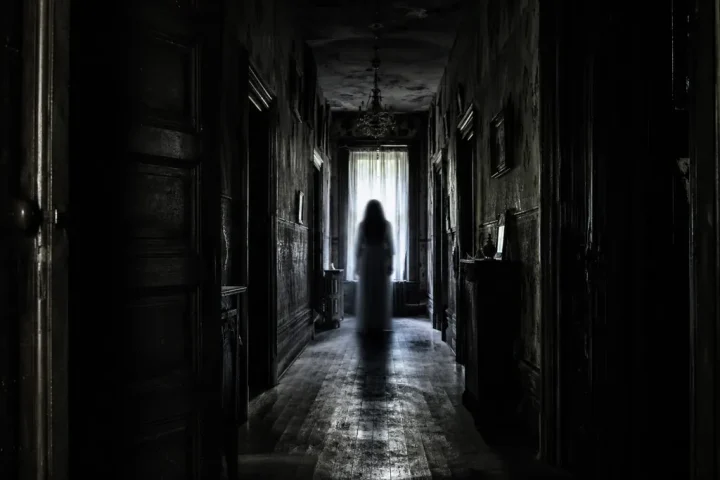
Charlesgate was initially constructed in an L-shaped configuration that followed Beacon Street and Charlesgate East. A substantial open area behind the building allowed sunlight and air to enter rooms that might otherwise have faced narrow interior courts. Over the years, however, neighbouring properties were acquired and incorporated into the complex, dramatically altering its internal arrangement. Rooms were subdivided, corridors changed, houses absorbed and new structures erected around what had once been open ground. By the twentieth century, the building had developed the labyrinthine character remembered by many later residents, with unexpected doors, awkward passages, disused fireplaces and spaces that appeared to have been sealed away.
These later alterations almost certainly contributed to stories about hidden rooms and concealed chambers. Former residents occasionally described finding doors behind closets or discovering spaces between walls that seemed inexplicable. In a building that had been enlarged and remodelled repeatedly across several generations, such spaces were entirely possible without requiring a supernatural explanation. Yet when these discoveries occurred during the years in which Charlesgate already possessed a reputation for hauntings, they inevitably became part of the growing mythology.
Death at Charlesgate
Although many tragedies associated with the building have been exaggerated or invented, at least one dramatic death inside Charlesgate is firmly documented. On 14 March 1908, a resident named Westwood T. Windram died by suicide inside his apartment. Contemporary newspaper reports stated that Windram, a businessman suffering from severe insomnia, shot himself with a revolver while his wife was nearby.
This incident becomes especially important when examining later stories about suicides at Charlesgate. During the building’s years as a university dormitory, students repeatedly claimed that someone had taken his or her own life inside a particular room, sometimes during the Boston University period and sometimes in an unspecified earlier era. Researchers working with Emerson College’s archives later attempted to verify these stories but could not identify a corresponding student suicide. The possibility therefore exists that the genuine 1908 death gradually became detached from its original context and re-emerged decades later as a campus ghost story.
Putnam himself also died at Charlesgate. After living in the building for many years with his wife, he died there on 23 February 1917. His death was not mysterious, but his intimate association with the building added another human presence to a place that later generations would increasingly imagine as inhabited by the past.
From Residential Hotel to University Dormitory
Boston University acquired Charlesgate in 1947 and converted it into a student residence known as Charlesgate Hall. The building remained under university ownership until 1972 and initially housed several hundred female students. By this time Charlesgate already possessed the visual qualities that encouraged imaginative interpretation. Its heavy Romanesque architecture, towers, dark masonry and complicated interior made it look considerably older and stranger than many surrounding buildings.
A Boston University residence publication from the 1950s reportedly referred to Charlesgate jokingly as the university’s own “witches castle”. Although the expression appears to have been humorous rather than paranormal, it shows that the building’s Gothic atmosphere was already shaping its identity long before the most dramatic ghost stories emerged.
One of the best-known legends from this period concerns a young girl who supposedly died after falling down an elevator shaft. In later versions she was identified as Elsa Putnam, the architect’s daughter, who was said to have chased a ball into an open elevator before falling to her death. Some versions embellished the story further by claiming that a decorative image of the child cracked at the exact moment she died and that her spirit subsequently wandered the corridors searching for her lost toy.
Historical research demonstrates that this story cannot be true. Elsa Putnam survived childhood, married, raised a family and lived until 1979. Whatever the origins of the elevator legend, she was not its victim.
There may nevertheless have been a genuine accident somewhere behind the folklore. Paranormal historian Sam Baltrusis has reported that in 1947 a female student apparently entered an open elevator shaft and fell several floors but survived. The incident has not been documented sufficiently to establish every detail with certainty, but if the account is correct it provides an obvious mechanism by which a frightening accident could gradually become a story about a dead child.
This process is characteristic of Charlesgate folklore. A real event becomes detached from its original circumstances, the identities change, additional details accumulate and eventually the transformed story is repeated as though it were established history.
The Horses Beneath the Building
Another enduring legend claims that horses once occupied stables beneath Charlesgate and drowned when the basement flooded. Some versions add that several young men also died while attempting to rescue the animals. According to later paranormal accounts, phantom horses can still occasionally be heard or seen near the lower parts of the building.
The story is atmospheric, but there is little evidence to support it. Original architectural descriptions do not identify stables inside Charlesgate, and research into the early plans has failed to uncover convincing documentation that horses were routinely housed beneath the building. No contemporary newspaper report describing a catastrophic flood involving drowned horses and rescuers has been located.
It remains possible that horses were temporarily kept somewhere in the enlarged complex during a later period, but without primary documentation the dramatic drowning story should be regarded as folklore rather than history. Its survival is nevertheless revealing because it demonstrates how Charlesgate gradually accumulated tragedies that seemed appropriate to its increasingly haunted reputation.
The Myth of Mafia Murders
The same problem surrounds stories that organised criminals once controlled Charlesgate during the Depression. According to some retellings, gangsters used the building for illegal activities and murdered enemies inside it, including several men supposedly executed in an elevator.
Research into property ownership has not supported these claims. Emerson College archivists examined the ownership history and found no evidence that the Mafia controlled Charlesgate. One individual associated with the property may have had connections with loan-sharking, which could have provided the initial spark for later criminal legends, but no credible evidence has emerged for the supposed executions.
The documented ownership history is far less sensational. Charlesgate passed through a series of ordinary owners and trusts before Boston University purchased it in 1947. The Mafia stories therefore belong to the later mythology of the building rather than its established historical record.
Satanic Rumours and Occult Activity
The most sensational stories about Charlesgate involve occult rituals, Satanic groups and even human sacrifice. These claims are frequently repeated in paranormal accounts as though the building had been a recognised centre of ritual activity for decades.
No reliable evidence supports that interpretation.
There is no documented history of human sacrifice at Charlesgate, no known police investigation into ritual murders and no credible evidence that J. Pickering Putnam belonged to a Satanic organisation or designed the building for occult purposes. What can be documented is the emergence of increasingly elaborate rumours among students during the second half of the twentieth century.
By the 1980s, Charlesgate was becoming a prominent part of Emerson College folklore. Emerson acquired the property in 1981 and used it as a dormitory for students in the arts and communications. The building’s unconventional layout, deteriorating interior and Gothic appearance made it an ideal environment for stories about hidden rooms, occult experimentation and haunted corridors.
Student publications and later paranormal writing began to describe strange rituals and demonic activity. A 1988 Halloween feature in the Boston Phoenix portrayed Charlesgate in deliberately sensational terms, while a 1990 article by former Emerson student Tracey Libby in FATE magazine described students who allegedly participated in occult or demonic practices. These accounts contributed enormously to the reputation of Charlesgate as a place where something darker than ordinary student experimentation had taken place.
There is an important distinction, however, between students experimenting with occult practices and the existence of an organised Satanic cult. Young residents clearly did experiment with Ouija boards, séances and alternative spiritual practices, and some former residents later described groups engaging in behaviour they interpreted as occult. What remains unsupported is the leap from those activities to stories of organised Satanism and human sacrifice.
The distinction matters because the real history of paranormal experimentation among residents is already sufficiently unusual without requiring invented atrocities.
Ouija Boards and the Charlesgate Sessions
Among the most persistent first-hand traditions connected with Charlesgate are accounts of students using Ouija boards inside the building. Former residents remembered experimenting with talking boards and becoming convinced that they were communicating with unseen entities.
Tracey Libby later described one series of sessions in which participants believed they had contacted personalities calling themselves “Mama” and “Pete”. The students reportedly came to believe that something had been opened through their experimentation and that the resulting presence was not entirely benign.
A persistent rumour subsequently developed that Emerson College had forbidden Ouija boards inside Charlesgate because too many residents had become frightened by unexplained experiences. Later researchers examined surviving housing and residence-life handbooks but found no written regulation prohibiting them. The fact that many students nevertheless believed such a rule existed reveals how deeply the paranormal reputation of the building had entered campus culture.
Stories concerning the boards became increasingly dramatic. Some residents claimed that planchettes moved with unusual force or answered questions with disturbing accuracy, while later retellings alleged that entire Ouija boards were thrown across rooms. These extreme versions are difficult to verify, but the basic tradition of students conducting sessions inside Charlesgate is well established through alumni testimony and contemporary accounts.
The Man in Black
Perhaps the most compelling recurring apparition in Charlesgate folklore is the figure known as the Man in Black.
During the 1980s, students began describing a dark male figure that appeared inside the upper floors of the dormitory. An Emerson student paper written in 1986 recorded accounts of a black-clad apparition associated particularly with the seventh floor. Later former residents described similar experiences, including a figure appearing inside bedrooms or passing through spaces where no person should have been able to move unnoticed.
One former resident interviewed by Sam Baltrusis recalled seeing a cloaked or dark figure cross through her room even though the nearby door had never opened. Other residents remembered shadows moving through hallways or forms appearing briefly before vanishing.
These accounts cannot establish the existence of an apparition, but they demonstrate that the Man in Black was not invented by a recent ghost-tour company. The figure formed part of the living student folklore of Charlesgate while the building was still functioning as an Emerson dormitory.
Things Moving in Empty Rooms
The Man in Black was only one aspect of the phenomena students associated with the building. Former residents described alarms activating even though they had not been set, music beginning unexpectedly from unused equipment, doors closing without apparent cause, toilets flushing in empty bathrooms and objects disappearing before returning in unexpected places.
Other accounts involved sudden cold air moving through otherwise warm rooms, unexplained temperature changes and bedding being disturbed when nobody had been nearby. A handwritten 1987 account preserved in Emerson’s Charlesgate material describes a student who felt movement in what should have been an empty upper bunk before later discovering its bedding displaced.
Individual incidents of this kind are easily dismissed in isolation, particularly in an old dormitory filled with hundreds of students and decades of unreliable plumbing and electrical systems. What made Charlesgate unusual was the accumulation of such experiences within a community already convinced that the building possessed a personality of its own.
Residents entering Charlesgate brought with them stories from previous generations, and every new unexplained sound or malfunction could therefore become part of the existing mythology. The building did not merely contain ghost stories; it functioned as an environment in which those stories continually reproduced themselves.
The Black Fog
One of the more disturbing accounts describes a student waking to discover what appeared to be a dense black mist hovering above him. According to the story, he initially struggled to move before watching the dark cloud travel across the room and disappear through a wall.
After investigating, he supposedly discovered a concealed space behind that wall.
This particular story originates in later paranormal material associated with investigator Christopher Balzano and has not been independently verified through contemporary documentation. The hidden-room element, however, has parallels in other former residents’ testimony. At least one student remembered discovering a concealed door inside a closet that led into a small unused space containing an old fireplace and other remnants of an earlier configuration of the building.
Such discoveries are entirely plausible given the extraordinary history of Charlesgate. For more than a century its rooms were repeatedly divided, enlarged, connected to neighbouring buildings and adapted for different uses. Spaces that seemed inexplicable to students in the 1980s may simply have belonged to earlier versions of the complex.
Yet discovering an old concealed chamber shortly after experimenting with a Ouija board or witnessing something strange would inevitably reinforce the impression that Charlesgate contained secrets deliberately hidden behind its walls.
How Charlesgate Became Haunted
The most revealing aspect of the Charlesgate story is that there appears to have been no single event that transformed the building into a haunted location.
The original Charlesgate was not widely described as a place of supernatural terror. A Boston Globe description published around the time Boston University acquired the property in 1947 presented it as remarkably respectable. The establishment had avoided the noisy social reputation of many hotels and had cultivated a relatively conservative atmosphere.
Over subsequent decades that identity changed.
The building aged, its architecture became increasingly eccentric in comparison with the modern city developing around it, and generations of students moved through rooms originally intended for affluent nineteenth-century residents. Genuine tragedies such as Windram’s suicide survived only faintly in memory, while elevator accidents, unexplained architecture and student rumours were transformed through repeated storytelling.
By the Emerson years, Charlesgate had become fertile ground for paranormal experimentation. Students interested in art, unconventional spirituality and alternative culture inhabited a Gothic building whose corridors already carried stories about suicides and hidden rooms. Ouija sessions generated new narratives, dark figures were reported in bedrooms and the building’s ordinary malfunctions became difficult to separate from its supernatural reputation.
The process illustrates how haunted places are created culturally as well as historically. A building does not necessarily become haunted because of one terrible death. Sometimes the haunting develops through layers of experience, memory, storytelling and expectation until the location acquires an identity that persists independently of the events that originally produced it.
The End of Charlesgate Hall
Emerson College continued using Charlesgate Hall until 1995. The building was sold on 29 September of that year, ending its long period as a university residence. Plans for residential conversion followed, and during the late 1990s the old complex was reorganised into separate condominium properties.
The original Charlesgate building became the Charlesgate Condominium, while adjoining portions of the historic property became the Barnes Mansion Condominium. The transformation removed much of the dormitory environment in which the most famous paranormal stories had developed, but it did not erase the reputation that students had created during the preceding decades.
By then the legends had escaped Charlesgate itself. They had entered magazine articles, paranormal books, Boston ghost lore and the memories of former residents who continued to describe experiences long after leaving the building.
The Haunted Legacy of Charlesgate
Charlesgate remains one of Boston’s most intriguing haunted locations precisely because its story cannot be reduced to a simple catalogue of ghosts. Some of its most dramatic legends collapse under historical investigation. Elsa Putnam did not die in an elevator shaft. The architect cannot be shown to have belonged to an occult cult. No credible evidence demonstrates that human sacrifices took place inside the building, and the supposed Mafia executions remain unsupported.
Other elements are far more substantial. A man genuinely died by suicide inside Charlesgate in 1908. Putnam himself died there nine years later. Students unquestionably experimented with Ouija boards. Emerson archives preserve contemporary accounts of strange experiences, and former residents repeatedly described dark figures, cold sensations, moving objects and unexplained events inside their rooms. The Man in Black appears repeatedly enough in student testimony to form a genuine part of Charlesgate’s paranormal tradition.
The result is a haunted building whose mythology developed organically rather than through one spectacular tragedy. Charlesgate became a vessel into which successive generations poured their anxieties, experiments and unexplained experiences. The architectural complexities left by more than a century of remodelling created real hidden spaces, while the building’s Gothic appearance encouraged increasingly supernatural interpretations of those discoveries.
Whether anything genuinely paranormal ever inhabited Charlesgate remains impossible to establish. What can be established is that generations of residents believed something unusual happened there, and that their stories became sufficiently consistent and persistent to transform an eccentric nineteenth-century apartment hotel into one of Boston’s most enduring haunted landmarks.
Perhaps that transformation is itself the most interesting mystery of Charlesgate. Buildings remember nothing in the ordinary sense, yet people continually invest them with memory. Corridors become associated with apparitions, rooms acquire reputations and forgotten architectural spaces become entrances into stories about the dead. Once enough people share those stories, the boundary between a building’s physical history and its supernatural identity becomes remarkably difficult to separate.
Charlesgate survives within precisely that boundary.
Go Beyond the Haunted Story
Reading about Charlesgate is easy. Understanding why places become haunted, how spirit communication is supposed to function, why Ouija sessions sometimes produce terrifying experiences and how occult traditions have attempted to work deliberately with unseen intelligences requires something far deeper than another evening spent collecting ghost stories.
Join the Occult World Mystery School and move beyond passive fascination with the supernatural. There are thousands of spirits, gods, demons, magical systems, grimoires and forgotten traditions waiting beyond it, and the people who genuinely understand occultism are the ones who are willing to study what others merely sensationalise. Enter the Mystery School, learn the systems behind spirit communication, hauntings, ceremonial magic, necromancy and the darker currents of occult practice, and stop allowing other people to tell you what the mysteries supposedly mean. Study them for yourself.
THE CHARLESGATE HOTEL
4 CHARLESGATE EAST
BOSTON, MASSACHUSETTS 02116
SEE ALSO:
SOURCE:
Encyclopedia of Haunted Places -Ghostly Locales from around the World – Compiled & Edited by Jeff Belanger – Copyright 2005 by Jeff Belanger



Follow