
The Protocols of the Elders of Zion: The Forgery That Shaped Modern Conspiracy Theory
Few fraudulent documents have caused as much lasting harm as The Protocols of the Elders of Zion. Although repeatedly exposed as a fabrication, the text became one of the most influential works in the history of modern antisemitism. Its accusations helped shape political propaganda, extremist ideology and many of the conspiracy theories that continue to circulate today.
The document claims to reveal the proceedings of a secret gathering of Jewish leaders who are supposedly planning to conquer the world. Divided into twenty-four “protocols”, it describes an imaginary campaign involving political manipulation, financial control, social unrest and domination of the press.
According to the forgery, Jewish conspirators secretly control political movements, economic institutions and the media. Their alleged objective is to destroy Christianity, weaken established governments and replace the nations of the world with a single global empire ruled by a Jewish monarch.
None of this was true. The protocols were not the record of a secret meeting, nor were they written by Jewish leaders. They were an antisemitic invention created by combining material from earlier political satires, novels and conspiracy literature.
A Forgery Constructed from Earlier Works
A large part of The Protocols was plagiarised from Dialogue in Hell Between Machiavelli and Montesquieu, written by the French lawyer and political satirist Maurice Joly in 1864. Joly’s work had nothing to do with Judaism. It was an attack on the authoritarian government of Napoleon III, presented as an imaginary conversation between the political philosophers Montesquieu and Machiavelli.
The creators of The Protocols took passages from Joly’s satire, altered their meaning and placed the words into the mouths of fictional Jewish conspirators. Political criticism aimed at a French emperor was transformed into supposed evidence of an international Jewish plot.
Other elements resemble a chapter from Hermann Gödsche’s 1868 novel Biarritz. In Gödsche’s fictional story, representatives of the Twelve Tribes of Israel gather in a Prague cemetery to report on their progress towards world domination. Although originally published as fiction, the scene was later removed from its literary setting and circulated as though it described an actual event.
The completed forgery also drew upon nineteenth-century antisemitic propaganda, anti-Masonic accusations, anxieties about industrialisation and fears surrounding secret societies. Ideas about hidden masters directing civilisation from behind the scenes were woven together with older religious prejudices and political paranoia.
The exact identity of the person or group responsible for compiling the document remains disputed. Some accounts have connected its production with Russian political agents operating in Paris, while other theories have named particular individuals associated with the Russian secret police. What is certain is that the document emerged from an atmosphere in which antisemitism could be used as a political weapon.
Publication in Imperial Russia
Versions of The Protocols began circulating in the Russian Empire near the end of the nineteenth century. An abbreviated form appeared in a Russian newspaper in 1903, followed by pamphlet editions during the revolutionary unrest of 1905 and 1906.
The document also appeared as an appendix to The Great in the Small, a book by the Russian Orthodox mystic Sergei Nilus. Nilus presented the protocols as evidence that the arrival of the Antichrist and the collapse of Christian civilisation were approaching.
This apocalyptic interpretation helped the forgery gain followers among monarchists, extreme nationalists and members of the Black Hundreds, a violent reactionary movement that supported the Russian tsar and promoted antisemitic persecution.
During the Russian Revolution and the civil war that followed, the document became especially popular among opponents of Bolshevism. Revolutionary change was portrayed not as the result of complex political, social and economic conditions, but as proof of a hidden Jewish conspiracy.
This accusation ignored the diversity of Jewish political life and the fact that Jewish communities themselves experienced persecution, poverty and violence. Nevertheless, the myth offered extremists a convenient enemy upon whom every crisis could be blamed.
From Russia to Nazi Germany
Refugees and political exiles carried copies of The Protocols into Central and Western Europe after the Russian Revolution. German translations quickly found an audience among radical nationalist organisations searching for explanations for military defeat, economic collapse and political instability.
Adolf Hitler and other National Socialist propagandists embraced many of the document’s central claims. The forgery appeared to support their portrayal of Jews as the hidden force behind capitalism, communism, liberalism and every other movement they opposed.
The contradiction did not matter. Conspiracy theories rarely require their enemies to behave consistently. Jews could be accused of controlling banks while simultaneously organising communist revolution because the purpose of the myth was not to describe reality. Its purpose was to create fear, hatred and obedience.
After Hitler came to power in 1933, ideas drawn from The Protocols became part of the propaganda culture of Nazi Germany. Antisemitic material was distributed through newspapers, political organisations and schools, helping prepare the population for increasingly severe persecution.
The consequences were not merely intellectual. The fantasy of a secret Jewish enemy contributed to the ideological climate in which exclusion, deportation and mass murder became possible.
Worldwide Circulation
British and American editions of The Protocols appeared in 1920, and the text soon circulated throughout Europe, the Americas and other parts of the world. Industrialist Henry Ford promoted its accusations through his newspaper, The Dearborn Independent, bringing the conspiracy theory to a large American audience.
Journalists and researchers repeatedly demonstrated that the document was fraudulent. Comparisons between The Protocols and Maurice Joly’s earlier work revealed extensive plagiarism, yet exposure did not completely destroy its influence.
For committed conspiracy theorists, proof of forgery could itself be reinterpreted as evidence of a cover-up. This pattern remains common in conspiratorial thinking: information that contradicts the theory is absorbed into the theory and presented as proof that the imagined conspiracy is even more powerful.
After the Holocaust and the Second World War, public distribution of the document became less acceptable in much of Western Europe and North America. However, it never disappeared. It continued to circulate through extremist political groups, antisemitic publications and later through online networks.
The Protocols Without the Jews
One of the most disturbing aspects of the document’s legacy is the way its basic structure survived even when explicit references to Judaism were removed.
As early as 1919, extracts were republished as though they revealed a Bolshevik plan for world conquest. Later conspiracy writers transferred the same accusations to communists, international bankers, Freemasons, globalists, shadow governments or unnamed “insiders”.
The identity of the alleged conspirators changed, but the story remained recognisable. A tiny elite secretly controlled governments, manipulated financial crises, corrupted religion, dominated the media and planned to establish a centralised world government.
These themes later became central to stories about the New World Order and other supposed systems of global control. Many people repeating such claims may not realise that the narrative structure was inherited from an antisemitic forgery.
The vocabulary may change, yet the underlying myth remains the same.
The Protocols in Modern Conspiracy Culture
During the late twentieth century, The Protocols returned to sections of the conspiracy literature. Some writers reproduced the text while claiming that it described a conspiracy unrelated to Judaism. Others quoted it directly or suggested that its exposure as a fraud was itself deceptive.
Milton William Cooper included the protocols in his influential 1991 book Behold a Pale Horse. Cooper attempted to distance the document from its antisemitic origins by suggesting that references to Jews should instead be understood as references to a secret elite. However, reproducing the text inevitably helped introduce the forgery to a new generation of readers.
David Icke’s writings about shape-shifting reptilian entities also incorporated themes resembling those found in The Protocols. Although the supposed rulers were no longer presented simply as Jewish leaders, the narrative continued to revolve around bloodlines, financial control, media manipulation and a hidden plan for global domination.
This does not mean that every theory about political corruption, concentrated wealth or institutional power is antisemitic. Governments, corporations and intelligence organisations can act secretly, and powerful groups can abuse their influence. The danger arises when complex events are reduced to the actions of an all-powerful hidden race, religion or supernatural bloodline.
The Lasting Warning of the Protocols
The Protocols of the Elders of Zion demonstrates how a fabricated text can acquire political power when it confirms existing fears and prejudices. Its success did not depend upon evidence. It depended upon repetition, emotional manipulation and the human desire to find a single hidden explanation for a complicated world.
Studying the document does not require accepting its claims. On the contrary, understanding its origins helps reveal how conspiracy mythology is created, adapted and passed from one generation to another.
The names of the supposed secret rulers may change, but the pattern remains familiar: society is portrayed as a theatre, visible politics becomes a deception and an invisible elite is blamed for every revolution, war, financial crisis and cultural transformation.
Recognising this pattern is essential, especially when exploring secret societies, occult traditions and hidden history. Serious investigation must distinguish between documented secrecy, symbolic belief, political propaganda and deliberate fabrication.
Explore the Hidden History Behind Conspiracy Beliefs
The world of secret societies, forbidden texts and occult history is filled with mysteries, but not every mysterious claim is true. Some documents preserve genuine esoteric traditions, while others were created to deceive, manipulate or spread hatred.
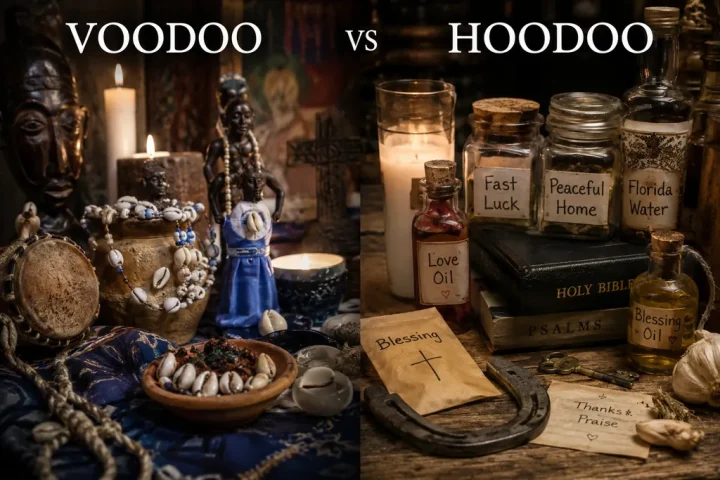
Inside the Occult World Mystery School, we examine hidden history with curiosity, depth and discernment. You can explore courses on ancient grimoires, demonology, angels, Hoodoo, Vodou, Kabbalah, black magick, necromancy, Tarot, Lenormand and the secret traditions that have shaped Western esotericism.
More importantly, you will enter a community where occult knowledge can be studied seriously rather than consumed as empty sensationalism. Meet other seekers, ask questions, share discoveries and learn to separate authentic esoteric teachings from propaganda, fantasy and deliberate deception.
Join the Occult World Mystery School and go beyond the surface of conspiracy, symbolism and secret history. The hidden world is waiting to be explored—but true knowledge begins with learning how to distinguish mystery from manipulation.
SOURCE:
The Element Encyclopedia of Secret Societies : the ultimate a-z of ancient mysteries, lost civilizations and forgotten wisdom written by John Michael Greer – © John Michael Greer 2006







Follow