

Wild Edric: The Saxon Rebel Who Rides from the Haunted Hills
Wild Edric, also known as Eadric the Wild or Eadric Silvaticus, was an eleventh-century English landowner whose resistance to the Norman Conquest became inseparable from the supernatural traditions of the Welsh Marches. History remembers him as a rebel who fought William the Conqueror’s forces, while folklore transformed him into the husband of a fairy woman, the guardian of hidden mineral wealth and the leader of a ghostly company that rides from beneath the Shropshire hills whenever England approaches war.
The historical Eadric belonged to the old Anglo-Saxon ruling class that survived, at least briefly, after the Norman victory of 1066. His estates lay across Shropshire and Herefordshire, where English, Welsh and Norman interests collided along a violent and unstable frontier. Medieval writers called him Silvaticus, a Latin name that suggested wildness, woodland and life beyond the secure boundaries of royal authority. The English title “Wild Edric” carried much the same meaning, marking him as a man of the forests and borderlands who could not easily be contained.
Later accounts described him as a relative of Eadric Streona, the notorious Ealdorman of Mercia who repeatedly changed allegiance during the wars between Edmund Ironside and the Danish king Cnut. Whether every detail of this family connection can be accepted remains uncertain, but the association added another layer of danger to Wild Edric’s reputation. He came to be seen as the descendant of a powerful yet treacherous house, living in a region where loyalty could determine whether a man remained lord of his lands or became an outlaw hunted by the new rulers of England.
Rebellion in the Welsh Marches
Wild Edric first emerged as a serious opponent of Norman power during the summer of 1067. William had conquered the English crown, but much of the country remained unsettled, especially along the Welsh frontier, where Norman castles and garrisons attempted to impose control over populations that had little reason to accept them.
Edric allied himself with the Welsh rulers Bleddyn and Rhiwallon and led attacks against the Norman presence in Herefordshire. His forces ravaged the countryside and threatened Hereford, while the dense forests and broken hills of the Marches gave the rebels opportunities to strike without submitting to a conventional battle. The Normans had taken the crown, but in the west their authority remained precarious.
The rebellion continued for several years. In 1069, Edric joined Welsh and English forces in an attack upon Shrewsbury, where fighting and fire devastated much of the town. He was never remembered as a man who had been decisively defeated in the field, yet by 1070 he abandoned the uprising and submitted to William.
The reasons for this surrender are unknown. The wider resistance to Norman rule was collapsing, and Edric may have concluded that continued rebellion would bring destruction upon his estates and followers. Later chroniclers claimed that William received him honourably, while surviving references suggest that Edric accompanied the king during a campaign against Scotland in 1072.
After that point, he disappears from dependable historical records. No surviving source tells us when he died, where he was buried or whether he retained any meaningful power under Norman rule. This unexplained ending allowed legend to claim him. A rebel who vanished from history without a recorded grave could easily become a warrior who had never truly died.
The Women in the Forest of Clun
Within a century of his rebellion, Wild Edric had become the central figure in one of England’s earliest recorded fairy-bride stories. The tale appears in Walter Map’s De Nugis Curialium, written during the late twelfth century and filled with accounts of supernatural women, restless corpses and mysterious beings who moved between the human world and the Otherworld.
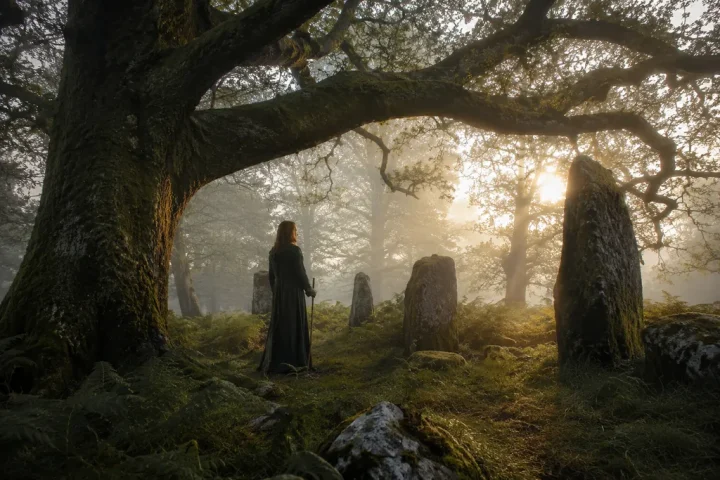
According to Map, Edric became separated from his companions while hunting in the Forest of Clun. Darkness fell before he found his way home, leaving him to wander through a landscape already associated with ancient woodland, uncertain boundaries and the proximity of Wales. Eventually, he saw light shining from a large house hidden among the trees.
Inside, a company of women danced in a circle while singing words he could not understand. They appeared taller and more beautiful than ordinary mortals, and their clothing was made from fine linen that marked them as beings of extraordinary rank. Their movements possessed a grace that seemed impossible within the human world.
Among them, Edric saw one woman whose beauty surpassed that of the others. Overcome by desire, he entered the house and seized her. Her companions fought fiercely to prevent him from carrying her away, attacking with their nails and teeth, but Edric escaped with the woman and brought her into his own world.
The medieval story does not describe this encounter as a gentle courtship. It begins with force, danger and the violation of a supernatural gathering. The woman remained silent for three days, refusing to respond to the man who had taken her. On the fourth day, she finally spoke and agreed to remain with him under one condition.
Edric must never reproach her for her origins or mention the sisters from whom he had abducted her. Should he break that promise, she warned that he would lose both his bride and the good fortune that accompanied her presence. He would then waste away through grief and die before his natural time.
Edric accepted the prohibition and pledged that he would remain faithful. The supernatural woman became his wife, and later Shropshire tradition gave her the name Lady Godda, although that name does not appear in Walter Map’s earliest version.
The Fairy Bride at William’s Court
The marriage between Wild Edric and his fairy wife became famous throughout the region. Noblemen travelled to see the mysterious woman whose beauty and manner seemed to confirm that she did not belong entirely to the mortal world. According to later versions of the legend, William the Conqueror heard rumours of her and summoned the couple to his court.
Witnesses accompanied Edric so that they could attest to the extraordinary circumstances in which he had found his bride. When Lady Godda appeared before the king, her beauty was said to be sufficient proof of her supernatural nature. She did not resemble a frightened captive or an ordinary woman of the Marches, but a being whose presence carried the splendour and danger of the Otherworld.
The story places the fairy bride before the very monarch whom Edric had once resisted. In historical terms, he had submitted to William’s authority, while in legend he brought something before the Norman court that conquest could neither explain nor possess. His fairy wife became evidence that the old landscape still contained powers beyond the reach of royal castles and armies.
For many years, Edric and Lady Godda were said to have lived happily among his estates in the western Shropshire hills. Their marriage prospered because he respected the prohibition she had imposed, yet fairy-bride stories almost always turn upon the breaking of a sacred condition. Human impatience eventually destroys what enchantment has made possible.
The Broken Promise
One evening, Edric returned late from hunting and found that his wife was absent. When she eventually appeared, he spoke in anger and accused her of having been detained by her sisters. The words were careless, but they directly violated the promise upon which their marriage depended.
Lady Godda vanished immediately.
Edric searched for her in the Forest of Clun, returning to the place where he had first seen the illuminated house and the dancing women. No entrance appeared among the trees, and no song answered his calls. The doorway into the Otherworld had closed.
In one version of the story, Edric’s grief destroyed him. He wandered through the forest calling for his lost wife until sorrow weakened his body and brought about an early death. This ending fulfilled the warning Lady Godda had given him before their marriage.
Later folklore refused to leave them separated. Instead of allowing Edric to die alone, Shropshire tradition reunited him with Lady Godda beneath the earth, where both were absorbed into a much older cycle of legends concerning enchanted sleepers, subterranean warriors and ghostly armies waiting for the hour of national danger.
The Haunted Mines of Shropshire
The later legend places Wild Edric beneath the Stiperstones and among the old lead-mining country of western Shropshire. The jagged quartzite ridge rises above a landscape scarred by shafts, engine houses and abandoned workings that once descended deep into the hills.
According to local tradition, Edric was not permitted an ordinary death because he had abandoned his rebellion and accepted Norman rule. His submission became a spiritual offence for which he was condemned to remain beneath his native land. Other versions suggest that enchantment drew him underground or that supernatural enemies imprisoned him there.
Whatever the cause, Wild Edric was believed to inhabit the mines with Lady Godda and the warriors who had once followed him. The underground realm restored his fairy wife to him, but their reunion came at the cost of endless confinement. They remained suspended between death and life, unable to leave the hills except when England faced a grave threat.
Miners referred to the unseen inhabitants of the workings as the Old Men. Tapping heard within the rock was sometimes interpreted as the sound of their tools, and the direction of the knocking could indicate the location of a rich vein of ore. The tradition resembles stories of knockers found in other British mining districts, where subterranean beings could guide miners towards mineral wealth or warn them of impending collapse.
The sounds beneath the Stiperstones were therefore not always regarded as threatening. Wild Edric and his followers might still protect those who worked within the land that had once belonged to him. Their presence transformed the mine into something more than a place of industry. It became the hidden court of a defeated Saxon lord, guarded by dead warriors and joined to the supernatural world through his fairy bride.
The Ghostly Ride
The most dramatic aspect of the Wild Edric tradition concerns the spectral host that emerges from beneath the Shropshire hills whenever England approaches war. Edric and his warriors are said to ride across the landscape in the direction of the country from which danger will come. Their appearance does not predict a minor dispute, but a conflict serious enough to threaten the realm.
Later descriptions portray Wild Edric riding a white horse while dressed in green. A white feather rises from his cap, and a short sword hangs from a golden belt. His hair is dark and curling, while his bright black eyes possess an intensity that distinguishes him from any living rider.
Lady Godda accompanies him, her long fair hair falling towards her waist as she rides beside the spectral company. She also wears green, with a white linen band across her forehead and a golden ornament above it. A dagger hangs at her side, revealing that she is no passive fairy bride but a member of the supernatural war band.
The riders are sometimes preceded by the sound of a horn echoing over the hills. Their horses gallop across ground that should be impassable at night, and the company may vanish before witnesses can determine where they are going. Such sightings were later associated with the Napoleonic Wars and the Crimean War, while further traditions connected Edric’s appearance with the world wars of the twentieth century.
These reports belong to folklore rather than documented military history, yet their persistence reveals the power of Edric’s legend. The man who once fought a foreign conqueror became the guardian expected to return whenever another enemy threatened England.
Wild Edric and the Wild Hunt
The spectral riders connect Wild Edric with the widespread European tradition of the Wild Hunt. This supernatural procession may be composed of dead warriors, spirits, fairies or hunters who race across the sky and through isolated landscapes. Their appearance is often interpreted as an omen of war, plague or sudden death.
In Britain, the leader of the Hunt varies according to the region. Odin, Herne the Hunter, King Arthur and other supernatural figures may command it, while local heroes sometimes assume the role in landscapes where their legends remain strong.
Wild Edric became the natural leader of a Shropshire Wild Hunt because his story already united warfare with the Otherworld. He had resisted conquest, entered a supernatural marriage and disappeared without a known grave. The ghostly host allowed those separate elements to merge into a single myth.
His ride also transforms his historical surrender into something more ambiguous. Although legend punishes him for submitting to William, it grants him the opportunity to become England’s defender. He remains beneath the hills because of his failure, yet he may redeem himself whenever the country requires his sword.
The Sleeping Hero Beneath the Hill
Wild Edric belongs to the larger tradition of the sleeping hero, the great warrior who does not truly die but waits in an enchanted chamber until the land faces its greatest crisis. King Arthur is said to rest in Avalon or beneath a hill, while other legendary rulers sleep inside mountains surrounded by armed companions.
Edric’s version of the tradition is more haunted. He does not rest peacefully in preparation for a triumphant return, but remains trapped within mines filled with the memory of labour, danger and buried wealth. His warriors are not merely sleeping soldiers. They are the Old Men whose tools can still be heard behind the rock.
Lady Godda’s presence deepens the enchantment. She links the underground host to the fairy world from which she came, suggesting that Edric’s realm beneath the Stiperstones is not simply a tomb. It is an Otherworld court concealed within the physical landscape.
The mines become a threshold between human history and supernatural time. Above ground, centuries pass and kingdoms change. Beneath the hills, Edric remains the same warrior who once fought the Normans, still surrounded by the men who followed him and still accompanied by the wife he had lost.
Rebel, Ghost and Guardian
Wild Edric survives because no single interpretation can contain him. The historical man was an Anglo-Saxon landowner who resisted Norman rule and later submitted. The medieval legend transformed him into the mortal husband of a fairy woman whose prohibition he broke. Shropshire folklore then placed him beneath the earth, where he became both a cursed ghost and a guardian of the land.
These identities strengthen one another rather than creating contradiction. His rebellion explains why the people of the Marches remembered him. His disappearance from history allows him to pass into the supernatural world. His fairy marriage gives him access to powers beyond ordinary death, while his confinement beneath the mines binds him permanently to the landscape.
Even his curse contains an element of honour. Edric may be punished for abandoning the struggle, but he is not reduced to a helpless spirit. He retains his horse, his weapons and the loyalty of his warriors. When England is threatened, he rides again.
The story therefore expresses a longing for the warrior who cannot be defeated because he has passed beyond history. Norman conquest may have ended the world Edric knew, but folklore restored his authority beneath the very land the conquerors claimed.
The Horn over the Stiperstones
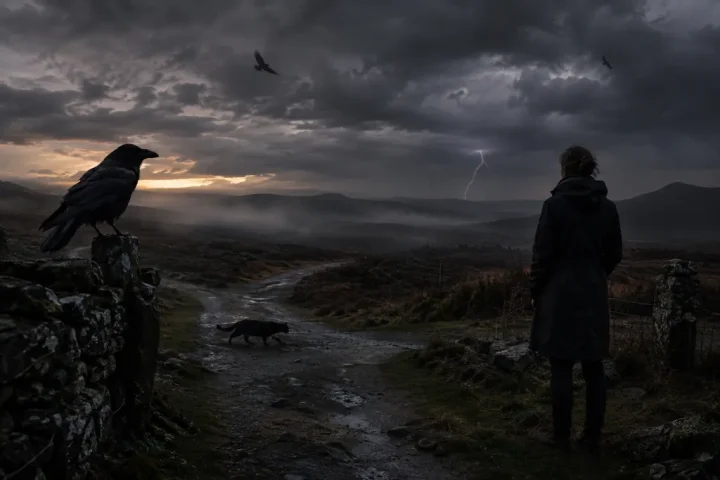
The Stiperstones remain one of Shropshire’s most atmospheric landscapes. Their broken ridge stands above abandoned lead mines and old routes through the border country, where weather can transform familiar paths within minutes. Mist covers the slopes, wind moves through the rocks and distant sounds become difficult to place.
Within such a landscape, the legend of Wild Edric does not feel entirely removed from possibility. The tapping heard beneath the earth may be stone settling inside forgotten workings, yet tradition interprets it as the labour of the Old Men. A distant cry may be a bird, while those who know the story listen for a hunting horn.
Wild Edric vanished from written history after 1072, but the legend insists that he remains below. Lady Godda rides beside him, while armed followers wait within the darkness of the mines. They do not emerge for curiosity or spectacle. Their appearance announces that England stands on the edge of serious conflict.
When the spectral company crosses the hills, the time for preparation has already passed.
Stop Standing Outside the Hidden Kingdom
Most people will treat Wild Edric as nothing more than a charming border legend, reducing a Saxon rebellion, a fairy marriage and a haunted underground army to a few harmless lines of folklore. That is precisely how the modern world keeps ancient knowledge powerless: it strips the mystery from the story, ignores the spiritual structure beneath it and leaves readers with nothing but entertainment.
Refuse that ignorance. Enter the Occult World Mystery School and study the spirits, fairy traditions, haunted landscapes and forbidden systems that ordinary history refuses to confront. There are thousands of spirits, gods, demons, magical systems, grimoires and forgotten traditions waiting beyond the threshold. Stop consuming fragments from the surface. Descend into the hidden world, seize the knowledge buried beneath centuries of fear and join the Occult World Mystery School now.
FURTHER READING:
- Briggs, Katherine. An Encyclopedia of Fairies: Hobgoblins – Brownies – Bogies and Other Supernatural Creatures. New York: Pantheon Books, 1976.
- Folklore, Myths and Legends of Britain. London: Reader’s Digest Assoc., 1977.
- Hole, Christina. Haunted England. London: B. T. Batsford, 1940.
SOURCE:
The Encyclopedia of Ghosts and Spirits – Written by Rosemary Ellen Guiley – September 1, 2007






Follow