

Agasou: The Leopard Spirit of Ancestry, Kingship and Dahomey
Agasou is a powerful ancestral spirit associated with the royal traditions of Dahomey and with the sacred leopard, an animal long connected with authority, ferocity, protection and kingship in West Africa. Within Haitian Vodou he survives as a lwa of ancestry, family, lineage and the spiritual inheritance carried from Africa into the Caribbean. His traditions preserve memories of kings, migrations, conquest and ancestral power, making him one of the spirits through whom the connection between Haiti and Giné, the spiritual homeland of Africa, remains especially visible.
The precise identity of Agasou is surrounded by several overlapping traditions, and these traditions do not always agree. In one account, he is understood simply as an ancestral leopard spirit whose cult predates the establishment of the Dahomean monarchy. Another tradition identifies him with a legendary founder of the Dahomean royal line, born from the union of the human princess Aligbono, daughter of the king of Tado, and a leopard spirit named Kpo. The name Kpo itself means “leopard”, and the leopard became an important royal symbol associated with the rulers of Dahomey.
Other accounts interpret the leopard ancestry in more historical terms. Agasou has been described as a war chief associated with the neighbouring Yoruba state of Oyo, a formidable warrior whose ferocity earned him the name Kpo. In some versions he was driven into exile because of his aggressive nature, while in others it was his supernatural reputation that made him dangerous. According to these stories, Kpo possessed magical abilities so extraordinary that he could transform himself into a leopard.
A related tradition tells of a war chief known as Kpo who secretly became the lover of either the wife or daughter of the king of Tado and fathered a son with her. After the king’s death, the child’s mother attempted to secure the throne for her son, but the people instead supported the king’s nephew, the son of his sister. The rejected claimant was forced to flee and eventually established himself in Allada, one of the important kingdoms that preceded the later rise of Dahomey. In this interpretation, the leopard ancestor becomes part spirit, part remembered warrior and part dynastic founder.
There is also the possibility that Agasou was never originally the ancestor of the Dahomean royal family at all. Leopard spirits were reportedly revered by populations living in the region before the dynasty that eventually ruled Dahomey came to power. The Gedevi people, who were displaced during the expansion of the kingdom, are associated with the veneration of a leopard spirit. If this tradition preserves an older layer of religious history, the later rulers of Dahomey may have incorporated an existing leopard cult into their own royal ancestry, transforming a local territorial spirit into a dynastic ancestor.
Agasou in Dahomean Tradition
Within the religious traditions connected with Dahomey, Agasou is regarded as an ancestral spirit and as a protector of royal lineage. His leopard nature is therefore much more than an association with an animal. The leopard embodies sovereignty, dangerous strength, territorial authority and the supernatural potency of kingship. Agasou represents the ancestral force standing behind the continuity of a family, a dynasty and a people.
This connection between spiritual ancestry and political legitimacy was extremely important in the societies from which many Vodou traditions emerged. Ancestors were not merely remembered dead relatives. They remained participants in the life of the community, capable of protecting descendants, maintaining continuity and enforcing obligations between generations. A royal ancestor possessed these qualities on an even greater scale, becoming guardian not simply of a household but of an entire lineage and its inherited authority.
Agasou in Haitian Vodou
When the religious traditions of West and Central Africa were carried across the Atlantic through the violence of the slave trade, spirits travelled with the people who served them. In Haiti, Agasou became particularly associated with home, family, ancestry and lineage. His presence embodies the idea that ancestral power survived displacement and that the bond with Giné could not be destroyed merely by separating people from the African lands of their birth.
Agasou is traditionally regarded as a king, preserving the royal character associated with his Dahomean origins. He is also described as serving within the spiritual forces of Lord Agwé, the great lwa of the sea, ships and deep waters. In this capacity Agasou is sometimes called a lieutenant in Agwé’s army, creating an intriguing connection between ancestral authority and the ocean that separates Haiti from Africa.
One important Haitian legend places Agasou directly within the transmission of Vodou itself. According to this tradition, Ayida-Wedo asked him to bring Vodou and the power of the ancestors from Giné to Haiti. Agasou accepted the task and crossed the waters with the assistance of a crab. Because of this sacred relationship, devotees associated with Agasou have traditionally avoided eating crab as a sign of respect and remembrance.
The story carries a meaning far deeper than a simple tale of supernatural travel. The Atlantic Ocean was the route through which enslaved Africans were violently removed from their homelands, yet within Vodou the same ocean became a spiritual bridge connecting Haiti with Giné. Agasou therefore represents the survival of ancestral memory across that rupture. The ancestors were not left behind. Their spirits, ceremonies, obligations and powers crossed the sea with their descendants.
The Leopard and the Ancestors
The leopard remains the central symbol through which Agasou’s nature is understood. It is an animal of extraordinary physical power that moves silently, watches carefully and attacks with devastating force when necessary. Within royal symbolism it expresses controlled danger: the sovereign possesses enormous power precisely because that power does not need to be displayed constantly.
For Agasou, leopard symbolism also reflects the mysterious relationship between human ancestry and spiritual ancestry. Whether the legendary leopard Kpo is interpreted literally as a spirit, symbolically as a totemic ancestor or historically as a powerful warrior whose reputation became mythologised, the essential message remains the same. The lineage protected by Agasou possesses an ancestry that reaches beyond ordinary human memory into the sacred world.
Agasou consequently stands at the meeting point of family, territory, kingship and spiritual inheritance. To honour him is to acknowledge that identity does not begin with the individual. Behind every living person stands a succession of generations, remembered and forgotten, whose actions continue to shape the present.
Syncretism with Saint Louis
In Haiti, Agasou has been syncretised with Saint Louis, the canonised king of France. The association reflects the royal character of both figures rather than suggesting that the African lwa and the Catholic saint are identical. During the development of Haitian Vodou, Catholic saints frequently became visual or devotional counterparts through which African spirits could be represented within a colonial environment dominated by Christianity.
The image of a sacred king provided an appropriate Catholic counterpart for a lwa whose traditions already revolved around royal ancestry and legitimate authority. Behind the saint’s image, however, remained the much older memory of the leopard, Dahomey and the ancestral line that Agasou protects.
Agasou and the Survival of African Spiritual Power
Agasou reveals something fundamental about Vodou itself. Vodou is not simply a collection of spirits detached from history. Its lwa carry memories of African peoples, kingdoms, migrations, families and religious traditions that endured one of the most violent forced migrations in human history. Names such as Agasou preserve fragments of Dahomey, Tado, Allada and Giné within a living spiritual tradition that continued to develop in Haiti.
For this reason, Agasou is more than the Leopard Spirit. He embodies the endurance of lineage. His legends proclaim that ancestry can survive exile, that spiritual inheritance can cross an ocean and that the dead remain capable of protecting those who remember them. Behind the leopard’s eyes lies the memory of Africa, the authority of kings and the continuing presence of generations whose power has never entirely disappeared.
Enter the Occult World Mystery School
Reading about Agasou is only the outer gate. If you want to understand Vodou beyond sensationalised internet folklore, confused spirit lists and recycled occult misinformation, then enter the Occult World Mystery School and study the traditions in their wider spiritual and historical context. Go deeper into the lwa, Giné, the Rada and Petwo nations, ancestral service, ritual symbolism, sacred relationships and the extraordinary religious world that developed between West Africa and Haiti.
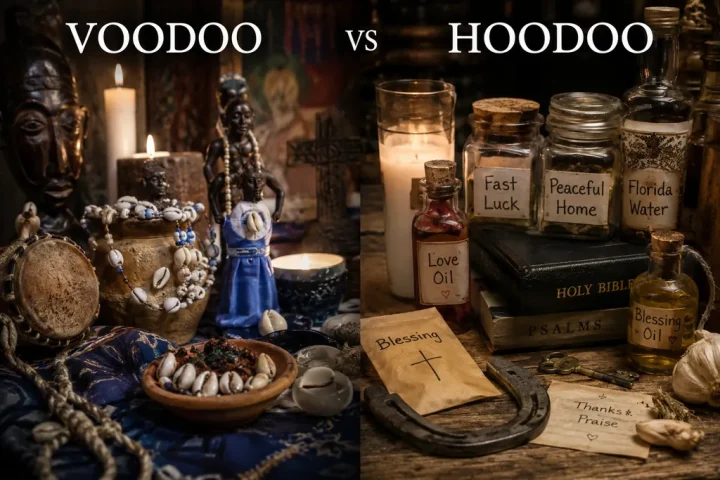
And do not stop with Vodou. The Mystery School takes you into Hoodoo, where African-American conjure, rootwork, spiritual protection, candle work, herbs, powders, oils, ancestral practices and practical magic reveal an entirely different tradition shaped by the African diaspora. Vodou and Hoodoo are not interchangeable, and serious students must learn the difference rather than collapsing every African-derived practice into one vague idea of “magic”.
If you are satisfied with collecting spirit names and reading fragments, remain outside. If you want to understand where these traditions came from, how spirits, ancestors and magical practices developed, and why their influence remains so powerful, join the Occult World Mystery School and begin studying properly. There are thousands of spirits, gods, demons, magical systems, grimoires and forgotten traditions waiting beyond it. Stop standing at the threshold. Enter the Mystery School and go deeper.
ALSO KNOWN AS:
Agassou; Agassu; Roi d’Agasou (Haiti)
ORIGIN:
Dahomey
CLASSIFICATION:
Lwa
Manifestations:
He manifests as a man or leopard. Even as a man, there may be a reference to leopards: leopard-skin clothing or leopard-pattern fabric, for instance.
ICONOGRAPHY:
Agasou is represented by images of Saint Louis or a leopard.
Consort:
Silibo Vavou
Sacred animals:
Leopard, crab
COLOURS:
White, brown, and the spectrum from yellow to gold
DAY:
Thursday
Feast:
25 August
SEE ALSO:
SOURCE:
Encyclopedia of Spirits: The Ultimate Guide to the Magic of Fairies, Genies, Demons, Ghosts, Gods & Goddesses– Written by Judika Illes








Follow