

The Aesir
The Aesir, written more accurately as Æsir, are the dominant family of gods in surviving Norse mythology. They inhabit Asgard, the fortified divine realm connected to the human world by the burning rainbow bridge Bifröst. From Asgard, the Aesir preserve cosmic order while preparing for the destruction they know will eventually come.
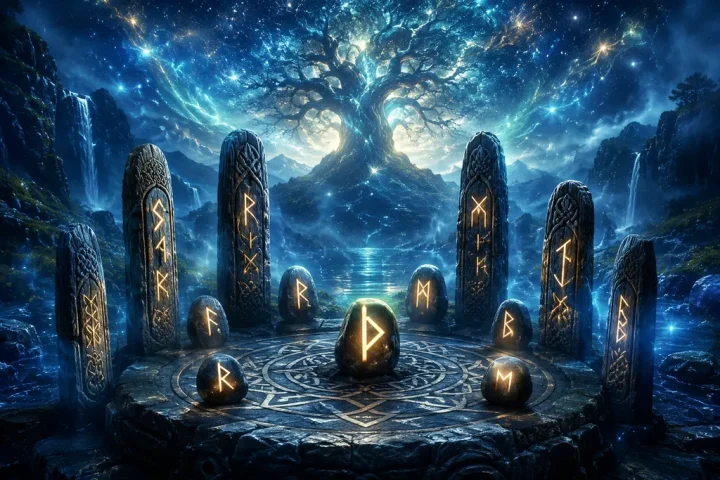
The Old Norse singular form of the name is áss, while Æsir is plural. The word is generally traced to the reconstructed Proto-Germanic term ansuz, which referred to a god or divine power. It is related to the name of the Ansuz rune in the Elder Futhark. Older writers sometimes claimed that the Aesir came from Asia or what is now Turkey, but this idea does not reflect their accepted linguistic origin. It developed largely from the writings of Snorri Sturluson, who attempted to explain the pagan gods as extraordinary human rulers who had migrated into northern Europe.
Snorri was writing in thirteenth-century Christian Iceland. He preserved an immense amount of pre-Christian tradition, but he also needed to make that material acceptable within a Christian intellectual world. His prologue to the Prose Edda therefore presents the gods as celebrated ancestors whose descendants gradually began to worship them. This interpretation is now understood as euhemerism rather than reliable history.
The Aesir are frequently associated with sovereignty, warfare and the defence of the ordered world. Yet they are not distant or immortal beings who exist beyond danger. They suffer injury, experience grief and make disastrous choices. Their power cannot release them from fate. Even Odin, who sacrifices relentlessly for wisdom, cannot prevent the final catastrophe foretold for him.
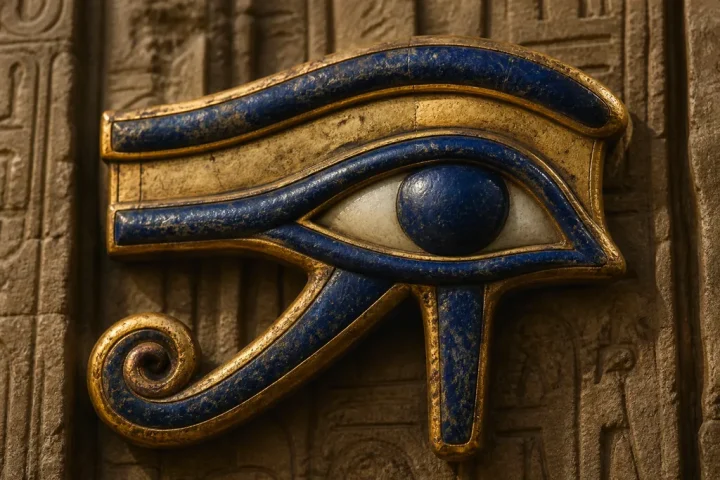
Odin stands at the centre of the Aesir. He rules through knowledge rather than simple physical strength. He sacrifices one of his eyes for a drink from Mimir’s well and later hangs wounded upon the world tree so that he may seize the mystery of the runes. His pursuit of wisdom has no natural boundary because he knows that Ragnarök is approaching. Every secret he obtains becomes another weapon against an ending that cannot ultimately be escaped.
Thor represents a more immediate form of divine protection. His hammer, Mjölnir, crushes the giants who threaten the inhabited world. Thunder announces his movement across the heavens, while the hammer itself became one of the most enduring religious symbols of the Viking Age. Thor protects the boundaries that separate civilisation from the forces continually attempting to overwhelm it.
The Aesir also embody law, kingship, sacrifice and the terrible cost of maintaining order. Tyr loses his hand when the gods bind the wolf Fenrir. His mutilation is not an accidental wound but the price of a broken pledge. Baldr becomes the focus of divine grief when his death reveals that even the most beloved of the gods cannot be preserved forever. Heimdall remains at the edge of Asgard, listening for the first sign that the final assault has begun.
Loki occupies an unstable position within this divine society. He moves among the Aesir and shares adventures with them, yet he is not securely rooted within their order. His intelligence repeatedly rescues the gods from danger, but his resentment eventually turns him against them. After causing Baldr’s death, Loki becomes one of the powers destined to break the divine world apart.
The War Between the Aesir and the Vanir
One of the oldest remembered events in the mythology is the war between the Aesir and the Vanir. The Vanir form another divine family whose powers are closely connected with fertility, prosperity and the mysterious forces that generate life. The surviving accounts of the conflict are fragmentary, and no single interpretation has gained universal scholarly acceptance.
The Völuspá remembers this struggle as the first war in the world. It associates the beginning of the conflict with Gullveig, a mysterious woman whom the gods pierce with spears and burn in Odin’s hall. She survives the flames and is born again, suggesting that the power she represents cannot be destroyed through violence.
Neither pantheon succeeds in conquering the other. The conflict eventually ends through negotiation and an exchange of hostages. Njord and his children enter the society of the Aesir, while figures from the Aesir pass into the world of the Vanir. Their reconciliation changes the divine order permanently.
The peace is therefore more than a political settlement between rival gods. It represents the merging of different sacred powers into a larger religious world. After the truce, the distinction between Aesir and Vanir remains visible, but the two groups are no longer separated by war. Vanir deities such as Freyr and Freyja become central figures within the mythology preserved around Asgard.
Some earlier scholars interpreted the war as a distorted memory of conflict between historical peoples or competing religious cults. Others understood it as a mythic expression of tension between different kinds of divine authority. The surviving sources do not permit a final answer. What remains unmistakable is that the Norse cosmos could not be sustained through the power of the Aesir alone. Its order emerged only after the rival families had recognised that neither could annihilate the other.
The Aesir and Ragnarök
The power of the Aesir is always overshadowed by Ragnarök. Odin will be swallowed by Fenrir. Thor will kill the world serpent but die from its venom. Tyr and the monstrous hound Garm will destroy one another. Heimdall and Loki will meet in a final confrontation from which neither will return.
Their greatness lies not in defeating fate but in facing it with full knowledge of what has been foretold. Odin continues to gather wisdom even though wisdom cannot save him. Thor continues to defend the worlds even though he knows the final enemy will poison him. The Aesir preserve order because surrendering before the appointed end would be a greater defeat than death itself.
After Ragnarök, however, the cosmos is renewed. A new earth rises from the sea, and some of the divine powers return. The destruction of Asgard is not absolute oblivion. It is the violent passage through which another world becomes possible.
The Aesir therefore represent far more than a pantheon of warrior gods. They embody the struggle to defend meaning inside a universe ruled by fate. Their myths confront the price of knowledge, the fragility of civilisation and the courage required to stand against an ending that cannot be avoided.
Enter the World Behind the Myth
Reading a few paragraphs about Odin and Thor does not make you a student of Norse spirituality. It leaves you standing outside the gates of Asgard, staring at symbols whose real power you have never learned to approach.
Stop consuming fragments and pretending that information is initiation. Enter the Occult World Mystery School and begin studying the gods, spirits, magical traditions and forbidden systems that ordinary websites are too frightened to explore. There are thousands of spirits, gods, demons, magical systems, grimoires and forgotten traditions waiting beyond it. The gate is open—but only those with the courage to cross it will discover what lies on the other side. Join the Occult World Mystery School now.
SEE ALSO:
- Norse Mythology
- Angerboda
- Ashura
- Balder
- Freya
- Freyr
- Frigg
- Jotun
- Loki
- Sif
- Skadi
- Vanir
Source:
Encyclopedia of Spirits: The Ultimate Guide to the Magic of Fairies, Genies, Demons, Ghosts, Gods & Goddesses – Written by Judika Illes

Follow