

Agove Minoire
Origin: Haitian Vodou
Classification: Lwa (loa), deified spirit of the dead
Domain: Forest groves, liminal wilderness, sacred sexuality, thresholds
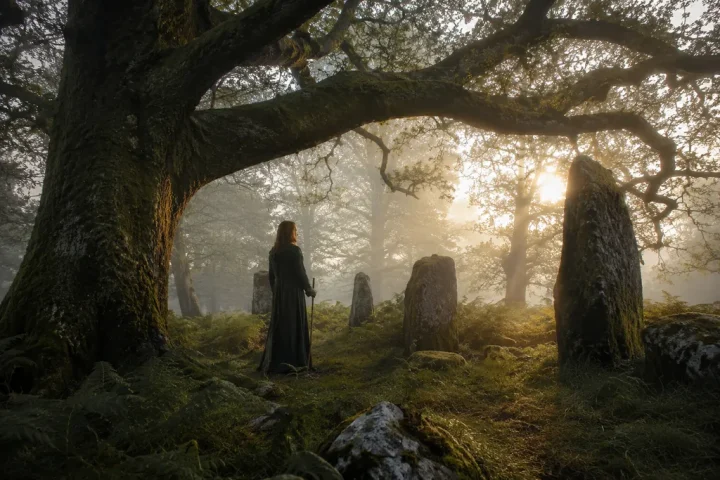
Agove Minoire is a female lwa in Haitian Vodou associated with forest groves, uncultivated land, and liminal natural spaces. She belongs to a category of spirits who guard places that exist between human settlement and the wild, regions where spiritual presence is strong and boundaries between worlds are thin.
As a deified spirit of the dead, Agove Minoire is not a creator goddess but a powerful ancestral force whose authority is rooted in chthonic and funerary energies. She is most often approached for protection, grounding, and spiritual clarity, particularly when working in secluded or natural environments.
Symbolism and Attributes
Agove Minoire is most commonly symbolized by a phallus carved from wood, a deliberately paradoxical emblem for a female lwa. In Vodou symbolism, the phallus represents creative force, vitality, fertility, and raw life energy rather than gender alone. As a guardian of forests and groves, Agove Minoire embodies the generative power of nature itself, which transcends human distinctions of male and female.
The use of wood as the material for this symbol reinforces her deep connection to trees, forests, and living natural matter. The carved wooden phallus functions as both a ritual object and a protective marker anchoring her presence within the physical world.
In some traditions, Agove Minoire is also symbolized by a mirror. The mirror signifies reflection, truth, and self-recognition, suggesting her role as a revealer of hidden aspects of the self. It may also function as a spiritual threshold or portal, reinforcing her association with liminal spaces and transitions between visible and invisible realms.
Spiritual Character
Agove Minoire is generally perceived as reserved, watchful, and potent. She does not seek attention but is understood to be constantly present within her domain. Her power is quiet but pervasive. Disrespect toward forests, groves, or sacred natural spaces may provoke her displeasure, while those who approach with humility may receive protection or insight.
Her presence is often felt rather than seen, manifesting as a sudden stillness in the woods, an uncanny awareness of being observed, or moments of deep introspection experienced in solitude within nature.
Ritual Context
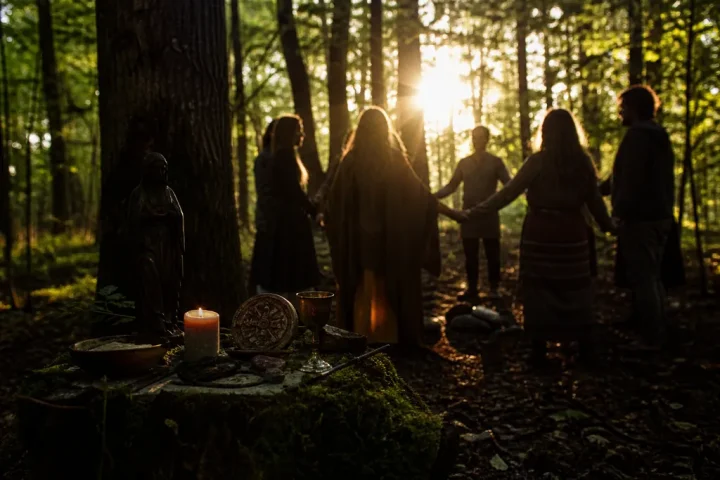
Agove Minoire may be honored at forest edges, groves, or secluded outdoor shrines. Rituals dedicated to her tend to be simple and restrained, emphasizing respect rather than spectacle. Natural materials are preferred over elaborate ceremonial objects.
Her symbols, whether the carved wooden phallus or a mirror, may be placed discreetly in natural settings or on altars devoted to earth-based or ancestral spirits. As with many lwa, she should be approached with clarity of intention and an understanding of spiritual boundaries.
Interpretation
Agove Minoire represents an intersection of death, sexuality, nature, and spiritual truth. Her imagery challenges rigid notions of gender and power, reminding devotees that life force and fertility exist beyond human categories. As a forest guardian, she embodies the living consciousness of the wild and serves as a reminder that nature is sacred, aware, and responsive to those who enter its domain.
SOURCE:
Encyclopedia of World Mythology and Legend, Third Edition – Written by Anthony S. Mercatante & James R. Dow– Copyright © 2009 by Anthony S. Mercatante






Follow