
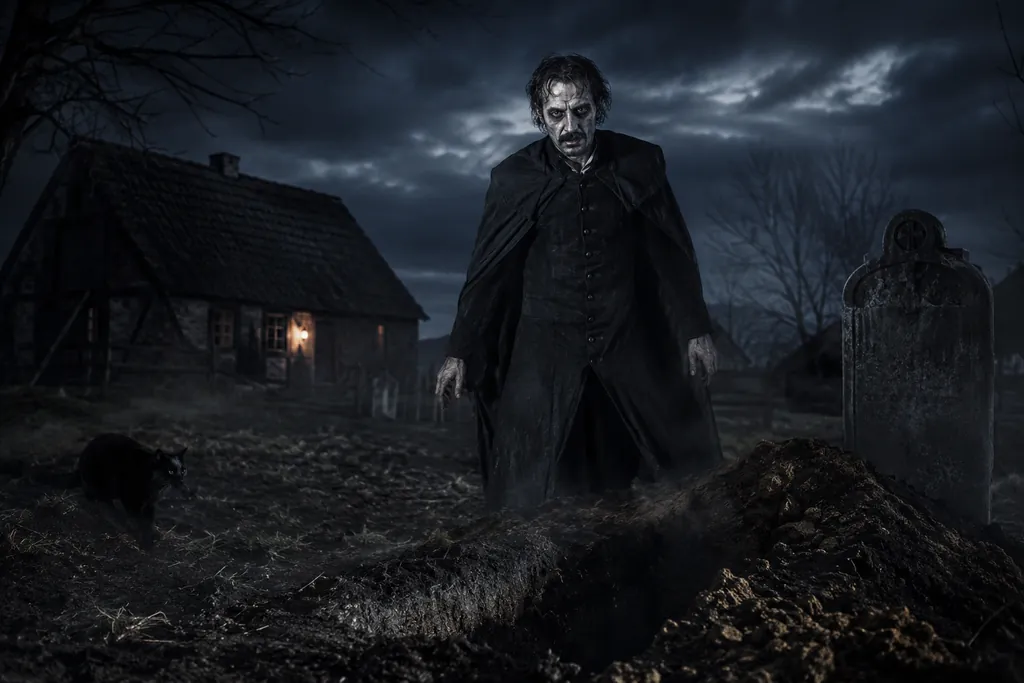
Johannes Cuntius: The Pentsch Vampire
Johannes Cuntius, also known as the Pentsch Vampire, is one of the stranger cases in early modern vampire lore. His story comes from Silesia and was recorded by Henry More in An Antidote Against Atheism in 1653. Unlike many vampire accounts that focus mainly on blood-drinking or the corruption of a corpse, the case of Cuntius combines several frightening traditions at once: vampirism, poltergeist activity, demonic disturbance, sexual assault by an incubus, and signs of diabolical possession.
This makes the story especially important in the study of European supernatural belief. Cuntius was not remembered simply as a revenant who rose from the grave. He was described as a restless, violent, sexually predatory, destructive spirit whose presence affected not only his home, but the entire village around him.
The Death of Johannes Cuntius
Johannes Cuntius was an alderman, a man of social standing and local authority. At the age of sixty, he was kicked in the groin by one of his horses. The injury caused him to fall gravely ill, and as death approached, his behaviour became increasingly troubling.
On his deathbed, Cuntius reportedly declared that his sins were too great to be forgiven by God. He also confessed that he had made a pact with the Devil. In the religious imagination of the seventeenth century, this was not a minor detail. A deathbed confession of this kind would have marked him as spiritually damned, morally corrupted, and vulnerable to demonic forces.
When he died, his eldest son saw a black cat run towards the corpse and violently scratch the dead man’s face. Immediately after this, a great tempest arose. The storm did not subside until Cuntius was buried.
Despite the sinister signs surrounding his death, Cuntius’s friends persuaded the local church to bury him on the right side of the altar. This was an exceptionally sacred and honoured place of burial. In theory, such a location should have offered spiritual protection, but according to the legend, even this holy position could not contain the horror that followed.
The Incubus in the Shape of the Dead Man
Only one or two days after Cuntius died, rumours began spreading through the village. A being in his form was said to be visiting women as an incubus. This was not merely a ghostly apparition. The spectre was accused of forcing itself upon women, creating fear, shame, and terror throughout the community.
The connection between vampires and sexuality is ancient and persistent. Many revenants were believed not only to feed on the living, but to return with obsessive desires, especially towards widows, lovers, or women in the village. In the Cuntius case, this sexual aggression became one of the clearest signs that the dead man had not passed peacefully into the afterlife.
Even after burial, the disturbances continued. The grave had not silenced him. Instead, his presence seemed to intensify.
Poltergeist Activity in the Cuntius House
The Cuntius home became the centre of violent supernatural disturbances. At night, heavy trampling sounds echoed through the house, so powerful that the entire building shook. Objects were thrown about by unseen forces. Sleeping people were beaten. Dogs barked throughout the town, as if reacting to something invisible moving through the streets.
Strange footprints appeared around the house. They were said to belong neither to man nor beast, suggesting that the disturbance was not merely human, animal, or natural, but something monstrous and otherworldly.
This is one of the reasons the story stands out. Cuntius behaved not only like a vampire, but also like a poltergeist. His presence was physical, noisy, violent, and invasive. He did not merely appear in visions. He shook the house, hurled objects, attacked sleepers, and left signs behind.
The Violent Spectre
The list of disturbances attributed to the Cuntius spectre was long and grotesque. He was said to demand conjugal rights with his widow and molest other women. He strangled old men, wrestled with people, and galloped around the house like a horse, perhaps echoing the animal injury that had led to his death.
He vomited fire. He spotted the church’s altar cloth with blood. He bashed the heads of dogs against the ground. He turned milk into blood, drank up supplies of milk, and sucked cows dry. He threw goats about, devoured chickens, and pulled up fence posts.
These details place the Cuntius case firmly in the world of early modern supernatural terror. The vampire was not only a danger to individual bodies, but to the household, livestock, food supply, religious space, and social order. His presence polluted everything: the home, the animals, the church, the widow, and the village itself.
Foul Breath, Terrible Smells, and the Atmosphere of Death
The Cuntius house was also filled with dreadful smells and the sensation of foul, icy breath. This detail is important because many old vampire and revenant traditions associate the undead with corruption, coldness, decay, and polluted air.
The dead, when improperly buried or spiritually corrupted, were believed to carry the atmosphere of the grave back into the world of the living. The icy breath suggests the touch of death itself, while the terrible smell points to spiritual and bodily corruption.
In folklore, evil rarely remains invisible. It leaves signs. It affects animals. It alters food. It disturbs sleep. It creates foul odours. It changes the feeling of a place.
The Cuntius house became a haunted environment, saturated with the presence of the unquiet dead.
Signs of Vampirism at the Grave
Eventually, signs of vampirism appeared around the grave itself. Mouse-sized holes were found going all the way down to the coffin. When the villagers filled the holes, they reappeared.
This was interpreted as evidence that the corpse was not resting properly. In vampire lore, disturbances around a grave often indicated that the dead person was active, escaping, feeding, or maintaining some unnatural connection with the world above.
The villagers finally decided to have the body of Johannes Cuntius dug up. In many vampire cases, exhumation was the turning point. The community would inspect the corpse for signs of supernatural preservation, blood, swelling, movement, or other unnatural conditions. The grave was no longer treated as a place of rest, but as the suspected source of the evil.
Why the Pentsch Vampire Matters
The case of Johannes Cuntius is valuable because it shows how fluid early vampire belief could be. The vampire was not always the elegant blood-drinker of later fiction. In older folklore, the vampire could be a corpse, a ghost, a demonised dead person, a plague-bringer, a sexual predator, a household spirit, a poltergeist, or a diabolical revenant.
Cuntius combines many of these traits. He returns after death. He torments the living. He attacks women as an incubus. He disturbs the household. He harms animals. He pollutes sacred space. He drains milk and livestock. He leaves physical signs at the grave.
This makes him a powerful example of how vampire lore was once tied to fear of sin, improper death, demonic pacts, haunted houses, social disorder, and the terrifying idea that the dead might return not as loved ones, but as enemies.
According to Montague Summers in The Vampire in Europe:
His Skin was tender and florid, his Joynts not at all stiff, but limber and moveable, and a staff being put into his hand, he grasped it with His fingers very fast; his eyes also of themselves would be one time open, and another time shut; they opened a vein in his Leg, and the blood sprang out as fresh as in the living; his Nose was entire and full, not sharp, as in those that are ghastly sick, or quite dead: and yet Cuntius his body had lien [sic] in the grave from Feb. 8 to July 20 which is almost half a year. . . .
His body, when it was brought to the fire, proved as unwilling to be burnt, as before to be drawn; so that the Executioner was fain with hooks to pull him out, and cut him into pieces to make him burn. Which, while he did, the blood was found so pure and spiritous, that it spurted into his face as he cut him; but at last, not without the expense of two hundred and fifteen great billets, all was turned into ashes. Which they carefully sweeping up together . . . and casting them into the River, the Spectre never more appeared.
Continue Your Study Inside the Occult World Mystery School
If the story of Johannes Cuntius fascinates you, do not stop at one strange vampire legend.
Inside the Occult World Mystery School, you can go deeper into the hidden world of vampires, spirits, demons, witchcraft, hauntings, possession, necromancy, folklore, and the darker side of occult history. Stories like the Pentsch Vampire are not merely old superstitions. They reveal how earlier cultures understood death, sin, fear, the body, the soul, and the dangerous boundary between the living and the dead.
In the Occult World Mystery School, you can explore these subjects with structure, depth, and serious occult context. You will find courses and teachings on demonology, witchcraft, spirits, ritual practice, dark folklore, magical traditions, and the hidden forces behind supernatural belief.
Do not remain a spectator of legends.
Study the dead.
Study the spirits.
Study the demons.
Study the old fears that shaped occult history.
Join the Occult World Mystery School and continue your path into vampire lore, demonology, witchcraft, necromancy, hauntings, and the forbidden mysteries of the unseen world.
FURTHER READING:
- Barber, Paul. Vampires, Burial and Death: Folklore and Reality. New Haven, Conn.: Yale University Press, 1988.
- Summers, Montague. The Vampire in Europe. New York: E. P. Dutton, 1929.
SOURCE:
the Encyclopedia of Vampires, Werewolves, and Other Monsters – Written by Rosemary Ellen Guiley -Copyright © 2005 by Visionary Living, Inc.



Follow