
Fort Wetherill: The Haunted Fortress of Jamestown, Rhode Island
On the rocky eastern shore of Conanicut Island, where granite cliffs fall towards the cold waters of Narragansett Bay, the concrete batteries of Fort Wetherill remain embedded in the landscape like the ruins of a forgotten war. Their gun emplacements are empty now, their military purpose long obsolete, while passages once occupied by soldiers disappear beneath earth, vegetation and decades of graffiti. From the upper ground there are commanding views across the East Passage towards Newport, but inside the surviving fortifications the atmosphere changes dramatically as daylight gives way to enclosed chambers, echoing corridors and openings leading into darkness. It is within this abandoned military architecture that one of Rhode Island’s enduring collections of supernatural stories has developed, involving phantom voices, moving shadows, apparitions of soldiers and, most unusually, a mysterious black dog said to wander through the ruins.
Fort Wetherill’s reputation as a haunted place is considerably more complicated than many modern accounts suggest. The military history of the location is well documented, but the supernatural stories are largely preserved through folklore and later eyewitness testimony rather than contemporary military records. Some legends have also accumulated details that cannot presently be substantiated. This distinction does not make Fort Wetherill less interesting as a haunted site; on the contrary, it reveals how the history of an actual place gradually intertwines with supernatural tradition until it becomes difficult to determine where memory ends and legend begins.
A Fortress Above Narragansett Bay
The military significance of the site predates Fort Wetherill itself. During the American Revolution, colonial forces attempted to fortify the strategically important eastern side of Conanicut Island in order to defend the approaches to Newport. British forces captured Jamestown and Newport in December 1776 and remained dominant in the lower Narragansett Bay until 1779, while French forces also occupied Jamestown briefly during the Rhode Island campaign of 1778. The location that would eventually become Fort Wetherill therefore belonged to a defensive landscape shaped by war long before the concrete batteries familiar to modern visitors were constructed.
A permanent defensive structure known as Fort Dumpling was erected at the southeastern end of Jamestown around 1799–1800. Built upon rocky outcroppings known locally as the Dumplings, it was intended to work with Fort Adams on the opposite side of the water to prevent hostile vessels from approaching Newport Harbor. It never saw the military action for which it had been designed and gradually deteriorated during the nineteenth century, becoming a picturesque ruin frequently represented in paintings and prints. By the end of that century, however, changing naval technology demanded something vastly more formidable. What remained of Fort Dumpling was destroyed in 1898 as the United States developed a new generation of coastal fortifications.
The new installation became part of the Endicott system, an ambitious programme intended to modernise America’s coastal defences. In 1900 the site was renamed Fort Wetherill in honour of Captain Alexander Macomb Wetherill, who had been killed while leading his company during the assault on San Juan Hill in Cuba on 1 July 1898. The Jamestown Historical Society records a family tradition that Wetherill’s widow appealed directly to President William McKinley after delays surrounding the return of her husband’s body, and that the president promised both to honour Captain Wetherill and to assist his son in entering West Point. The Jamestown fort was particularly appropriate because members of the Wetherill family maintained connections with the area.
By the early twentieth century the peaceful cliffs had become a formidable coastal artillery installation. Fort Wetherill contained seven separate batteries, with enormous concrete and earthworks sheltering weapons that included 12-inch and 10-inch disappearing guns. Beneath and around the firing positions were ammunition spaces, plotting rooms, communications areas and other military facilities, protected by walls of concrete and enormous banks of earth intended to withstand enemy fire. Much of this construction survives in ruinous form, creating the subterranean and semi-subterranean environment that now provides the setting for many of the site’s ghost stories.
The Soldiers of Fort Wetherill
Fort Wetherill remained militarily important during the first half of the twentieth century, although its guns never fired upon an invading fleet. In 1940, as another world war approached, the United States began expanding the installation together with nearby Fort Getty. New barracks at Wetherill could accommodate approximately 1,200 men, and soldiers trained there in artillery spotting, observation and signalling. Personnel were also involved with the minefields and anti-submarine nets protecting the approaches between Jamestown and Newport. The National Park Service notes that the Olmsted Brothers participated as landscape architects in wartime work at Fort Wetherill and Fort Getty, an unusual connection between one of America’s best-known landscape-design firms and a heavily fortified coastal military installation.
The Second World War transformed coastal defence so rapidly that the enormous fixed batteries were becoming obsolete almost as soon as they were prepared for combat. Aircraft, radar and changing naval warfare reduced the usefulness of the older Endicott fortifications, and the guns at Wetherill were never required to repel an enemy attack. After the war the installation was reduced to caretaker status, its weapons were eventually removed, and by 1970 the property had been placed on the federal surplus list. Rhode Island formally acquired the 61.5-acre site in 1972, transforming the former military position into the state park that exists today. The cliffs and surviving defences now attract hikers, photographers, fishermen and divers rather than artillerymen, although substantial remains of the military complex continue to dominate the landscape.
This documented history is important when approaching the supernatural traditions surrounding Fort Wetherill because some popular retellings imply that tremendous numbers of soldiers died inside the fort. There is no evidence for such a massacre. Wetherill was a military installation rather than a battlefield, and its major twentieth-century batteries were never attacked. Whatever lies behind the fort’s reputation for hauntings, the explanation cannot simply be that hundreds of men were killed within its tunnels during combat.
The Black Dog of Fort Wetherill
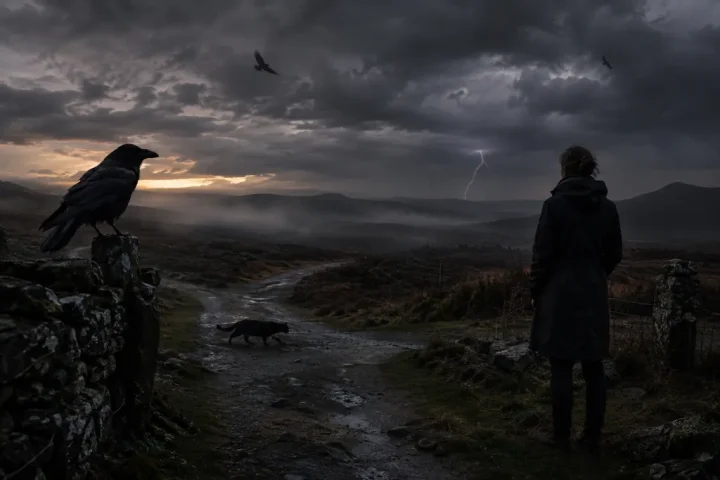
The most distinctive supernatural creature associated with Fort Wetherill is not a dead artilleryman but a phantom black dog. Modern accounts describe an unusually large dark hound wandering through the ruins, sometimes giving it glowing or reddish eyes and claiming that it can disappear abruptly or pass through walls. Others report hearing barking, growling or howling even though no visible animal can be located. The apparition has consequently acquired the modern nickname of the Demon Dog of Fort Wetherill.
The legend is frequently pushed backwards into the Revolutionary period. One popular version claims that British troops who occupied Jamestown in 1776 were disturbed by a mysterious black dog prowling around the defences and interpreted its presence as an omen of death. This story has been repeated extensively on paranormal and travel websites, but no contemporary eighteenth-century military document has so far been located that confirms it. There is also an obvious historical complication: Fort Wetherill did not exist in 1776, while Fort Dumpling itself would not be constructed until around the turn of the nineteenth century. There was an earlier Revolutionary battery in the vicinity, so a tradition could conceivably have attached itself retrospectively to the site, but claims that British soldiers literally encountered the creature inside Fort Wetherill in 1776 confuse later geography with earlier history.
Other versions place the beginning of the black-dog story considerably later and associate it with servicemen stationed at Wetherill during the First World War. This uncertainty about the legend’s chronology strongly suggests that the story developed through oral transmission and later retelling rather than surviving as a single, well-documented military incident. The black dog may therefore be better understood as part of the supernatural folklore of the place rather than as an apparition whose earliest appearance can be assigned confidently to a particular year.
Its symbolism nevertheless has much older roots. Spectral black dogs occur throughout British folklore, where creatures such as Black Shuck and other regional phantom hounds have been interpreted as supernatural guardians, apparitions of the dead or warnings of approaching disaster. A black dog appearing before British soldiers would therefore have carried an ominous cultural significance entirely independent of Fort Wetherill. Later versions of the Rhode Island story explicitly claim that encountering the animal, particularly meeting its gaze, foretells death. Whether this aspect originally belonged to the Jamestown legend or was added because of the broader black-dog tradition is impossible to establish, but the resemblance is striking.
Modern visitors have continued to report experiences that reinforce the legend. On HauntedPlaces.org, one visitor writing in 2016 described hearing a deep growl from vegetation while exploring the fort before discovering that the location was associated with a phantom dog. Another visitor that year claimed to have seen a black dog in a photograph taken at the site, while a 2017 contributor described seeing a black dog running through a nearby field without an obvious owner. A later account from 2021 described barking followed by the sight of a dark animal-like form apparently turning towards a place where no corresponding passage existed. These testimonies are fascinating as folklore, but the website itself explicitly warns that its submissions are anecdotal and largely unverifiable.
There are also obvious natural explanations that must remain part of the story. Fort Wetherill State Park permits pets, and dogs are genuinely encountered on the property. One commenter responding to the paranormal reports pointed out that loose dogs are common in the area, offering a straightforward explanation for at least some sightings, smells and noises. The existence of ordinary dogs does not prove that every reported experience has an ordinary explanation, but it demonstrates why individual encounters cannot automatically be regarded as evidence of a spectral animal.
Voices in the Concrete Chambers
The black dog may be Fort Wetherill’s most unusual supernatural inhabitant, but it is not the only phenomenon reported there. Visitors have described hearing whispering, footsteps, screams, hissing and other sounds for which they could find no immediate source. Shadowy forms are also part of the modern folklore, sometimes appearing briefly inside corridors or emerging unexpectedly in photographs. The original Occult World entry for Fort Wetherill, published in 2004, already described the location as associated with disembodied voices, ghost sightings, eerie sensations and shadow figures, demonstrating that these claims were circulating well before the current wave of social-media paranormal tourism.
Later witness accounts provide more detail. One visitor reported whispering in one part of the fort and unusually loud hissing elsewhere, while another photograph submitted to the same paranormal database was interpreted by its photographer as containing a tall dark figure behind a living person. A separate account published in 2024 described a visitor hearing what sounded like two men whispering and another witness claiming to have seen three rapidly moving shadows. None of these experiences has been independently verified, but collectively they show how consistently voices and dark moving forms have become associated with the modern supernatural reputation of the site.
The architecture of Fort Wetherill also provides an unusually powerful environment for ambiguous sensory experiences. Thick concrete walls, enclosed rooms, partially buried passages, open shafts and corridors connecting to outside spaces can distort the direction and distance of sound. Wind entering openings can produce strange tones, while waves striking the cliffs below, distant visitors, birds and animals can generate noises whose origins become difficult to identify once they travel through reinforced concrete chambers. A person entering an unlit passage after hearing that the fort is haunted is consequently standing in an environment where perfectly ordinary sounds can acquire a deeply unsettling character.
This does not render every report meaningless. It simply makes Fort Wetherill a particularly difficult site at which to separate genuine anomalies from environmental effects. The fort’s supernatural reputation is therefore strongest when treated as a body of recurring testimony rather than as a collection of proven paranormal events.
Ghostly Soldiers
Apparitions resembling soldiers have also entered the folklore surrounding Wetherill. Paranormal sources describe military figures appearing around the batteries or walking through areas where men once trained during the two world wars. Some accounts assign uniforms to particular periods, although reliable documentation for individual sightings is scarce.
Such apparitions are almost inevitable within the folklore of abandoned military installations. The surviving architecture preserves the physical spaces where thousands of soldiers once worked, slept, trained and waited, and a visitor standing inside those empty structures can still recognise their original purpose. Observation rooms face the sea, ammunition spaces remain beneath vanished guns and corridors terminate in positions from which artillery crews once watched Narragansett Bay. Even without supernatural activity, the absence of those men can feel strangely present.
What makes Wetherill interesting is that the military ghosts coexist with the much stranger tradition of the black dog. The resulting folklore does not revolve around a single tragedy or identified dead person but instead treats the entire landscape as a place in which fragments of its past occasionally intrude upon the present.
The Troubling Story of the 1985 Murders
One modern story requires considerably more caution. Numerous websites claim that four women in their twenties were murdered in 1985 and their bodies left near the docks at Fort Wetherill. Some versions add that the killings were followed by more than two hundred reports of paranormal activity made to local police, including screams, cold spots and sensations of being watched. The story has been copied widely enough that it now appears to form part of the accepted internet history of the fort.
Despite its frequent repetition, however, credible documentation for the alleged quadruple murder is remarkably difficult to find. The accounts encountered during research repeatedly lead back to paranormal sites, travel articles and websites copying one another rather than to contemporary newspapers, police documentation, court records or named victims. One article even attributed the claim to Wikipedia, illustrating how an unsupported statement can circulate through secondary sources until repetition itself begins to resemble verification.
For that reason, the alleged murder of four young women should not presently be treated as established historical fact. The same caution applies to the supposed two hundred police reports of paranormal activity. Until an original police source or reliable contemporary reporting can be located, that dramatic figure belongs to the folklore surrounding Fort Wetherill rather than its verified history.
There is, intriguingly, a genuine unresolved 1985 mystery connected with the location. Brothers Stephen J. Harris and Robert W. Harris, aged twenty and twenty-one, disappeared after apparently going fishing at Fort Wetherill State Park on 5 November 1985. According to an account based on former missing-person records, the brothers left a note telling their parents where they were going. When their father later searched for them, their locked vehicle and fishing equipment remained at the park but the young men were nowhere to be found. Both men subsequently appeared in the Doe Network’s Rhode Island missing-person records.
Whether this genuine disappearance had any influence upon later tales of murders at Fort Wetherill cannot be established, and there is no responsible basis for claiming that one story transformed into the other. Their coincidence in both year and location nevertheless demonstrates why the folklore of haunted places must be handled carefully. Real tragedy, uncertain memory and supernatural storytelling can occupy the same landscape for decades until their boundaries become extremely difficult to recognise.
Why Fort Wetherill Feels Haunted
Fort Wetherill possesses almost every physical quality associated with a haunted location. Its fortifications were constructed for warfare but never fulfilled the violent purpose for which they were designed. Their weapons have disappeared while the concrete shells remain. Vegetation has reclaimed embankments that once concealed artillery positions, and rooms formerly occupied by soldiers now open into darkness. Above them lies one of Rhode Island’s most beautiful coastal landscapes, while below the cliffs the Atlantic water moves relentlessly against stone.
That contrast contributes powerfully to the atmosphere. In daylight the location can seem picturesque, even peaceful, yet the interior fortifications preserve a completely different sensation. Sound behaves strangely. Darkness begins abruptly beyond entrances. Human figures can appear only briefly between concrete walls before disappearing behind another passage. The history of military occupation is visible everywhere, but the people who inhabited that world have vanished.
Perhaps that is enough to create ghosts. Perhaps the black dog, whispered voices and shadows are psychological responses to a place saturated with atmosphere and expectation. Perhaps some experiences arise from animals, echoes, darkness and suggestion. Yet the persistence of the stories means that Fort Wetherill has acquired a second history alongside its official military one, a supernatural history built not from artillery records and government reports but from encounters repeated by visitors who believe that they experienced something they could not explain.
The strongest approach is neither to dismiss those accounts automatically nor to embellish them into certainty. Fort Wetherill’s mystery lies precisely in the tension between what is documented and what is remembered. We know that soldiers occupied these cliffs for generations. We know that the batteries and tunnels survive. We know that modern witnesses continue to report strange sounds and fleeting shapes. We know that the black dog has become inseparable from the folklore of the site. What we do not know is whether anything actually remains there when the visitors have gone and the empty gun batteries fall silent.
The Haunted Legacy of Fort Wetherill
Fort Wetherill is therefore more than another abandoned military site decorated with ghost stories. It is a place where several periods of American military history overlap with a developing body of supernatural folklore. Revolutionary defences gave way to Fort Dumpling, Fort Dumpling disappeared beneath the modern coastal fortress, and that fortress in turn became an abandoned relic inside a state park. Each transformation left traces behind, both physical and imaginative.
Among those traces walks the legendary black dog, appearing in stories whose supposed origins move backwards and forwards through history. Around it have accumulated soldiers who no longer belong to the living garrison, voices without visible speakers and shadows that vanish into concrete darkness. Some stories withstand investigation better than others, while several dramatic claims dissolve into uncertainty when their sources are examined closely. That uncertainty should not be regarded as a weakness in the legend. It is part of what makes Fort Wetherill fascinating.
A haunted place does not exist only because somebody once died there. It exists because history, environment, memory and human experience combine until a location acquires an identity beyond its physical remains. Fort Wetherill has unquestionably acquired such an identity. Whether the phantom hound is an echo of ancient black-dog folklore, whether the shadow figures are remnants of soldiers who once watched the Atlantic, or whether every supernatural encounter ultimately has an ordinary explanation remains unresolved. The concrete batteries continue to face Narragansett Bay, and the stories continue to gather around them.
Do Not Stand Outside the Mystery
Fort Wetherill is only one doorway into a far older and darker landscape of supernatural belief. Ghosts, phantom animals, death omens, necromancy, spirit communication and the rituals devised to contact the dead belong to traditions stretching across cultures and centuries, and reading another haunted-location story will never give you mastery of them. If you want entertainment, remain on the surface and keep collecting ghost stories. If you want to understand why human beings have summoned spirits, entered haunted places, worked from forbidden grimoires and deliberately crossed the boundaries between the living and the dead, then it is time to stop behaving like a spectator.
Join the Occult World Mystery School. There are thousands of spirits, gods, demons, magical systems, grimoires and forgotten traditions waiting beyond it. Enter the Mystery School, study the material that casual readers never reach, and take your occult education seriously. Stop watching from outside the gates. Open them.






Follow