
Gris-gris are charms, amulets, or talismans used in Vodun, Vodoun, and Voodoo to bring good luck, ward off evil, protect the owner, prevent misfortune, and attract desired results such as love, money, health, and safety. They are also called gri-gri.
The original gris-gris were probably dolls, poppets, or images of the gods. Most modern gris-gris are small cloth bags filled with herbs, oils, stones, small bones, hair and nail clippings, pieces of clothing soiled with perspiration, and other personal items. These ingredients are usually gathered under the direction of a particular god and designed to protect the owner.
The origin of the word gris-gris is uncertain. Many scholars trace it to juju, the West African name for a fetish or sacred object. Juju may have been a European translation of the native expression grou-grou, which may have developed into gris-gris. Another possible origin is the French word joujou, meaning “doll” or “plaything.” Since many African fetishes were made in the shape of dolls, early Europeans on the West African coast may have mistaken serious religious objects for innocent-looking poppets.
In New Orleans, gris-gris are especially common. They are made to attract money and love, stop gossip, protect the home, maintain good health, prevent property loss, financial ruin, illness, and other forms of bad luck. Even police officers have been known to carry gris-gris for protection.
A gris-gris is ritually made at an altar and consecrated with the four elements: earth, represented by salt; air, represented by incense; water; and fire, represented by a candle flame. The number of ingredients is always one, three, five, seven, nine, or thirteen. The ingredients can never be even in number and can never number more than thirteen. Stones and coloured objects are selected for their occult and astrological properties, depending on the purpose of the gris-gris.
Once made, gris-gris may be buried on property, hung over doorways, attached to doors, or worn on the person.
Legends about the famous New Orleans Vodun queen Marie Laveau say that her gris-gris contained bits of bone, coloured stones, graveyard dust, also called goofer dust, salt, and red pepper. More elaborate gris-gris may have been made from tiny birds’ nests or horsehair weavings.
A red-flannel bag containing a lodestone, or magnet, was a favourite gris-gris for gamblers and was believed to bring good luck. Another gambler’s gris-gris was made from a piece of chamois, a piece of red flannel, a shark’s tooth, pine-tree sap, and a dove’s blood. The blood and sap were mixed together and used to write the amount the gambler wanted to win on the chamois. The chamois was then covered with the red flannel, with the shark’s tooth placed between the layers, and the whole charm was sewn together with cat’s hair. For the best, if uncomfortable, results, the gris-gris was worn in the left shoe.
Gris-gris can also be used to cause another person bad luck. This is known as “putting a gris-gris” on someone. Throwing a gris-gris bag filled with gunpowder and red pepper in someone’s path or on their doorstep supposedly causes that person to get into a fight. To get rid of someone, Marie Laveau was said to write that person’s name on a small balloon, tie the balloon to a statue of St. Expedite, and then release it. The victim would depart in whichever direction the balloon flew. Leaving a gris-gris, usually in powder form, at someone’s front door was also a warning that the person was out of favour with “the voodoos” and should watch their step.
One of Marie Laveau’s more horrible wangas, or bad-luck charms, was reputedly a bag made from the shroud of a person who had been dead for nine days. Into the bag went a dried, one-eyed toad, the little finger of a black person who had committed suicide, a dried lizard, bat’s wings, a cat’s eyes, an owl’s liver, and a rooster’s heart. If such a gris-gris were hidden in a victim’s pillow, the unfortunate person would surely die. Many white masters in old New Orleans who mistreated their black slaves reportedly found some kind of gris-gris in their handbags or pillows, such as a small sack of black paper containing saffron, salt, gunpowder, and pulverised dog manure.
In Santería, gris-gris bags are called resguardos, meaning “protectors.” A typical resguardo under the protection of the thunder-god Changó might contain herbs, spices, brown sugar, garlic, aloes, stones, or other small sacred relics, tied in red velvet and stitched with red thread. Finally, the Santero attaches a tiny gold sword, the symbol of St. Barbara, who is Changó’s image as a Catholic saint. If the sword breaks, it is believed that Changó has interceded on the owner’s behalf.
Gurunfindas are talismans prepared by Santería’s black witches, the mayomberos, to ward off evil from themselves and direct it magically to others. To make a gurunfinda, the mayombero first hollows out a guiro, a hard, inedible fruit found in the tropics, and fills it with the heads, hearts, and legs of a turtle and various species of parrots; the tongue and eyes of a rooster; and seven live ants. Next, the mayombero adds seven teeth, the jawbone, and some hair from a cadaver, along with the cadaver’s name written on a piece of paper and seven coins to pay the dead spirit for his services. Rum is then poured over the mixture, and the guiro is buried beneath a sacred ceiba tree for twenty-one days. When the mayombero disinters the guiro, he marks the outside of the fruit with chalk and hangs the charm from a tree near his home.
Sources: The Encyclopedia of Witches, Witchcraft and Wicca by Rosemary Ellen Guiley, and The Encyclopedia of Magic and Alchemy by Rosemary Ellen Guiley.
Continue Your Study Inside the Occult World Mystery School
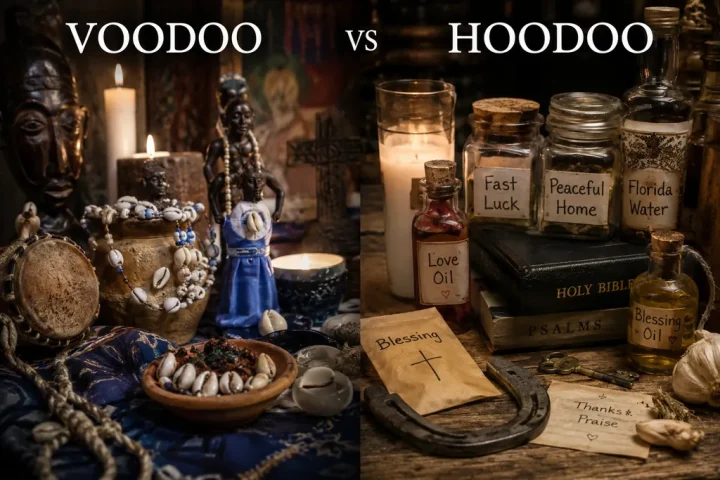
Gris-gris belong to a much deeper world of Voodoo, Vodou, spirit work, folk magic, protection, charms, ritual objects, saints, spirits, offerings, and sacred power. If this subject fascinates you, do not stop at the surface.
Inside the Occult World Mystery School, you can go deeper into the traditions, symbols, spirits, and magical practices that shaped Voodoo and related systems of spiritual work. The Voodoo Course gives you a structured way to study the history, spirits, rituals, ethics, symbolism, and living power behind this tradition, without reducing it to fear, superstition, or Hollywood fantasy.
You can also explore the Hoodoo Course, where you will learn more about practical folk magic, roots, herbs, candles, oils, prayers, ancestors, protection work, and spiritual remedies.
Do not only read about magic from the outside.
Enter the community. Study the tradition. Learn the symbols. Understand the spirits.
Join the Occult World Mystery School and begin your deeper path into Voodoo, Hoodoo, and the living language of magical power.
SOURCES:
- The Encyclopedia of Witches, Witchcraft and Wicca – written by Rosemary Ellen Guiley – Copyright © 1989, 1999, 2008 by Visionary Living, Inc.
- The Encyclopedia of Magic and Alchemy Written by Rosemary Ellen Guiley Copyright © 2006 by Visionary Living, Inc.






Follow