
The Haunted Ice House of Burlington, Vermont
On Burlington’s old waterfront, only a short distance from the waters of Lake Champlain, the building at 171 Battery Street once housed one of the city’s best-known restaurants, the Ice House. For decades diners came there for views across the lake, unaware that employees working behind the scenes told a very different kind of story. According to accounts collected by paranormal researcher Thomas D’Agostino, the former restaurant developed a reputation for unexplained sounds, disappearing objects and the apparition of an elderly woman who seemed to move through the building as though the restaurant, its customers and the modern city around her simply did not exist.
The history beneath those stories is complicated. Burlington’s waterfront has been repeatedly rebuilt since the early nineteenth century, and several versions of the Ice House story have blurred together different structures, businesses and periods of the city’s past. The result is a haunting tradition in which genuine local history has become intertwined with stories whose historical foundations are far less certain.
That distinction does not make the Ice House less intriguing. In fact, the real history of Burlington’s waterfront provides a remarkable setting for the phenomena later reported there.
Steam, Ice and the Burlington Waterfront
The area around Battery and King Streets played an important role in the early development of Burlington’s commercial waterfront. In 1808, brothers John and James Winans began building the steamboat Vermont near the foot of King Street. When it entered service the following year, the vessel became the first steamboat to operate on Lake Champlain and one of the earliest commercially operated steamboats of its kind.
The achievement transformed transportation on the lake and helped establish Burlington as an increasingly important commercial centre. Ships, warehouses, workshops and wharves gradually crowded the shoreline as goods and passengers moved between Vermont, New York and Canada.
Later histories of the Ice House often claim that John Winans built his home on the future restaurant site in 1808 or 1809 and that the residence burned in 1868 before being rebuilt as an ice-storage warehouse. This story became particularly associated with the Ice House Restaurant itself and was repeated in walking tours and local historical material.
The documentary evidence, however, is considerably less straightforward.
Research undertaken for the National Register of Historic Places identified the surviving building at 171 Battery Street as dating from approximately 1901. Historical mapping showed two tenement houses occupying the property in 1893, one of brick and the other of wood, which makes it difficult to identify the present structure directly with a building supposedly erected immediately after the 1868 fire.
The National Register research did note evidence that the later building appears to have been used for ice storage at some point, although that particular use could not be documented conclusively. Other known uses included a beer warehouse, bottling works and sheet-metal warehouse. Burlington’s waterfront evolved continuously, and buildings were frequently altered or replaced as commercial requirements changed.
The safest conclusion is therefore that the property belongs firmly within the history of Burlington’s waterfront economy and became associated with the city’s natural-ice trade, but the familiar story connecting the existing structure directly with John Winans’s early nineteenth-century house should be regarded cautiously.
When Ice Was an Industry
Before mechanical refrigeration changed everyday life, natural ice was an enormously valuable commodity. During Vermont winters, workers cut great blocks from frozen lakes and ponds before transporting them to insulated warehouses where they could survive well into summer.
Lake Champlain became an important source of commercial ice. By the end of the nineteenth century, tens of thousands of tons could be harvested during a productive winter, with teams of men and horses moving the enormous blocks from the frozen lake towards storage facilities along Burlington’s waterfront.
The work was physically demanding and potentially dangerous. Workers cut geometric channels through thick ice before manoeuvring large blocks towards ramps, conveyors and storage buildings. Inside an icehouse, layers of insulation prevented the stock from melting as rapidly as it otherwise would, allowing hotels, restaurants, households and businesses to purchase ice throughout warmer months.
It is this industrial world that gives one of the Ice House haunting stories its peculiar power.
Employees reportedly heard the unmistakable sound of something heavy being dragged across the floor, a scraping noise they believed resembled large blocks of ice being moved through the building. According to D’Agostino’s account, the sounds were familiar enough that long-serving employees became accustomed to them.
The association is tempting. If the building really had once been used for ice storage, phantom sounds resembling the movement of its former cargo would seem almost perfectly matched to its history.
Within paranormal terminology, such experiences are often described as a form of residual haunting, in which an event or repeated activity appears somehow to replay itself without responding consciously to observers. Rather than an intelligent ghost deliberately attempting to communicate, the phenomenon is imagined as an impression left upon a location and periodically repeated.
Whether anything of that kind actually occurs remains impossible to demonstrate. An old timber commercial building can produce extraordinary noises as wood contracts, pipes move, refrigeration systems operate and temperatures fluctuate. Sound can travel unpredictably through walls and floors, particularly inside structures that have been remodelled repeatedly.
Yet to the employees who believed they heard ice moving through a building whose very name preserved that vanished industry, the connection must have been difficult to ignore.
The Old Woman with the Bell
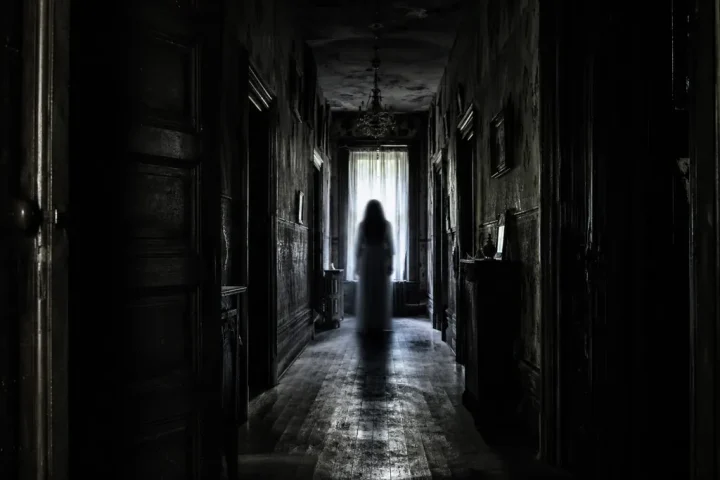
The most memorable apparition associated with the former Ice House Restaurant is an unidentified elderly woman carrying or swinging a bell.
Thomas D’Agostino traced the story through his own family. His wife’s daughter and her fiancé had moved to Burlington because of her employment, and the fiancé obtained work as a chef at the Ice House. According to D’Agostino, the chef was cleaning the kitchen when movement at the edge of his vision attracted his attention.
When he turned, he reportedly saw the semi-transparent figure of an elderly woman.
She appeared to be swinging a bell.
The chef moved towards the apparition, but before he could reach her she vanished. D’Agostino wrote that other employees had also encountered the mysterious woman, suggesting that the experience was not regarded among the staff as an isolated incident.
No convincing identity has ever been established for the apparition. There is no reliable evidence linking her to the Winans family, a former owner, a worker from the ice industry or any documented death at the property. Attempts to assign names to unidentified ghosts frequently say more about later storytelling than about the phenomenon itself, and in this case the woman is better left as the witnesses apparently knew her: an unknown figure from another time.
Her bell adds another layer of mystery. Bells were commonplace in earlier commercial and domestic environments, where they could summon workers, announce arrivals or regulate routines, but no particular historic bell-ringer has been connected with the building.
The image nonetheless remains unusually distinctive. A translucent elderly woman standing amid a modern restaurant kitchen and silently swinging a bell belongs to a very different category from the vague shadows that populate so many haunted-building stories. If the testimony is accurately preserved, the apparition appeared sufficiently complete for the witness to recognise both the woman and the object she carried.
Things That Refused to Stay Where They Were Put
Employees reportedly encountered other, less dramatic disturbances throughout the restaurant. Objects placed in obvious locations disappeared and were later recovered in unexpected corners of the kitchen or basement.
Experiences of this kind occur repeatedly in haunting and poltergeist literature. Keys, tools, jewellery or household objects vanish from places where witnesses insist they had been left before reappearing somewhere that appears illogical. Paranormal researchers sometimes call this the disappearing-object phenomenon and interpret it as evidence of either poltergeist activity or an intelligent presence interacting with its surroundings.
Ordinary explanations are usually impossible to eliminate completely. Restaurants are busy environments in which numerous employees move utensils, ingredients, cleaning equipment and personal belongings constantly. Memory is imperfect, and objects can easily be moved without the original user noticing.
What distinguished the Ice House stories was the way these incidents became incorporated into a much broader perception among employees that the building was active. D’Agostino described one long-serving cook as being so accustomed to unusual occurrences that the restaurant supposedly seemed unusually quiet when nothing happened.
That observation gives the haunting an almost domestic quality. Whatever the staff believed occupied the building was not necessarily experienced as an overwhelming evil presence. Instead, unexplained activity had apparently become part of the rhythm of working there.
A Haunted Reputation Beyond One Witness
D’Agostino remains the principal source for the detailed stories involving the old woman, dragged ice and disappearing objects, but the Ice House’s haunted reputation was not limited entirely to his account.
Restaurant reviewers also acknowledged that Burlington residents regarded the establishment as haunted. Gayot, for example, mentioned the local reputation while noting that its reviewers encountered nothing paranormal during their visit.
That independent reference is useful because it confirms that by the time the Ice House was operating as a restaurant, stories about supernatural activity had circulated beyond a single employee or paranormal investigator.
Unlike some heavily investigated haunted locations, however, the Ice House does not possess an enormous archive of identified witnesses, historical séances, formal psychical investigations or decades of documented paranormal research. Most of the distinctive phenomena still depend upon the testimony preserved by D’Agostino.
The haunting should therefore be understood as a strong piece of Burlington ghost folklore supported by several reported employee experiences rather than as an exhaustively documented paranormal case.
From Warehouse to Restaurant
By the 1970s the waterfront building had entered another stage of its long life. Renovation was underway by 1976, when historical-survey researchers recorded substantial alterations intended to adapt the property for commercial use. A lakeside dining deck was among the changes, transforming an old industrial structure into a place where customers could eat overlooking Lake Champlain.
The Ice House eventually became a familiar Burlington restaurant and remained part of the waterfront for decades. Its heavy timber construction helped preserve the atmosphere of the older commercial building, and the massive beams that had once supported industrial loads remained visible to later generations of diners.
Those same architectural features contributed naturally to its haunted personality. Thick wooden beams, basements and older storage spaces allowed the modern restaurant to retain a physical connection with the working waterfront that had preceded it.
By the 1990s, photographs show the Ice House operating as an established lakeside restaurant. It continued serving customers into the twenty-first century and was still hosting events in 2015.
The restaurant has since closed permanently.
The building itself survives at 171 Battery Street, but visitors looking for the old Ice House Restaurant will no longer be able to sit down for dinner and wait to see whether the woman with the bell passes through the kitchen.
Ghosts of a Vanished Waterfront
There is something particularly appropriate about a haunting associated with an icehouse. Natural-ice harvesting was once an essential industry involving enormous numbers of workers, horses, ships and warehouses, yet it disappeared astonishingly quickly after artificial refrigeration became widespread.
The physical infrastructure survived longer than the work itself. Warehouses were converted, demolished or given completely new purposes, while the lake continued freezing every winter as though the vanished industry had never existed.
If one accepts the paranormal interpretation of the Ice House phenomena, the sounds of heavy ice moving across the floor become an echo not simply of an individual ghost but of an entire lost way of life.
The woman with the bell is harder to explain. She does not fit neatly into the industrial narrative and cannot presently be linked to any known person. That uncertainty arguably makes her more interesting. Many haunted-location stories become weaker when researchers force an apparition into an invented biography merely to provide an explanation. Sometimes the honest conclusion is that witnesses believed they saw someone whose identity remains unknown.
The same caution applies to the building itself. The romantic story of an 1808 house destroyed by fire and reborn as the Ice House has been repeated often enough to feel authoritative, yet the documentary record suggests a more complicated sequence of buildings and uses on the property.
Ghost folklore frequently behaves in exactly the same way. Memories belonging to different eras merge together, historic people migrate into later buildings and genuine incidents attract details from entirely unrelated events. Eventually the resulting narrative becomes almost impossible to separate into its original components.
At Burlington’s Ice House, the architecture and the haunting have both acquired that layered character.
The Haunted Ice House Today
The former restaurant therefore deserves a place within Vermont’s supernatural folklore, but not because every story attached to it can be demonstrated historically. Its importance lies in the combination of a genuine waterfront setting, Burlington’s vanished natural-ice industry and a small but memorable collection of paranormal testimony.
Employees reportedly heard something resembling blocks of ice scraping across floors long after the ice workers had disappeared. Objects wandered from the places where they had been left. Most strikingly, at least one chef believed he saw the semi-transparent figure of an elderly woman silently swinging a bell before she vanished from sight.
Perhaps the old building merely amplified the noises and uncertainties common to any structure that had endured generations of industrial and commercial use. Perhaps workers interpreting strange experiences through the knowledge that they were employed in an old “Ice House” naturally imagined sounds associated with its former purpose.
Or perhaps something remained behind.
The restaurant is gone, but the building still stands close to the waters that shaped its history. Lake Champlain continues beyond Battery Street, frozen in winter and dark beneath the night sky, while Burlington’s modern waterfront occupies the ground where steamboats, warehouses and ice workers once transformed the city.
If places can retain anything of the lives that passed through them, there could hardly be a more appropriate setting in which to hear the sound of ice being dragged across an empty floor.
Go deeper than another ghost story
The apparition at Burlington’s Ice House raises the same questions that have followed haunted places for centuries. Are apparitions conscious spirits, residual impressions, projections of the human mind, or manifestations of something for which ordinary language has no adequate explanation? Reading another collection of ghost stories will never answer those questions, because occultism demands considerably more than passive fascination with the unexplained.
Join the Occult World Mystery School and stop remaining on the safe side of the mystery. There are thousands of spirits, gods, demons, magical systems, grimoires and forgotten traditions waiting beyond it, alongside centuries of teachings concerning spirit communication, necromancy, mediumship, divination and encounters with the unseen. If you genuinely want to understand the forces people have feared, summoned and attempted to communicate with throughout history, then stop collecting supernatural anecdotes and begin studying the traditions behind them. Enter the Mystery School and take your occult education seriously.
THE FORMER ICE HOUSE RESTAURANT
171 BATTERY STREET
BURLINGTON, VERMONT 05401
SEE ALSO:
SOURCE:
Encyclopedia of Haunted Places -Ghostly Locales from around the World – Compiled & Edited by Jeff Belanger – Copyright 2005 by Jeff Belanger





Follow