

Olokun: Lord of the Deep, Keeper of Wealth, Birth and the Dead
Olokun is one of the most mysterious powers of the African spiritual world, a deity whose realm begins where sunlight disappears into the ocean and human certainty comes to an end. Across traditions in Nigeria and the African diaspora, Olokun is associated with immense wealth, fertility, healing, spiritual depth and the terrifying mysteries hidden beneath the sea. Yet there is no single description that can contain this spirit completely. In some regions Olokun is male and reigns as a magnificent king beneath the waters, while elsewhere Olokun is female and approached as a primordial mother, queen or ancient power of fertility. In the diaspora, gender may become still more fluid, and the relationship between Olokun and Yemaya varies according to lineage and tradition.
The name is usually interpreted as “owner of the ocean” or “possessor of the sea”, combining the idea of ownership with the Yoruba word òkun, meaning ocean. The title expresses far more than residence. Olokun does not simply inhabit the sea but possesses the hidden riches, dangers and spiritual mysteries contained within it.
The ocean is one of the few realms on Earth where enormous regions remain inaccessible to ordinary human life. Its surface may glitter under sunlight, but beneath that familiar beauty lies crushing pressure, absolute darkness and forms of existence adapted to conditions humans cannot survive. Olokun belongs to that depth. To approach this spirit symbolically is therefore to approach what remains concealed beneath appearances, whether that hidden reality concerns wealth, ancestry, memory, spiritual power or death.
Olokun in Benin
Among the Edo people of Benin, Olokun has historically been understood predominantly as a male deity associated with the vast waters and with supernatural wealth. His cult became deeply connected with the political and ceremonial world of the Kingdom of Benin, where the riches of the sea reflected the magnificence expected of divine and earthly kingship.
The royal Olokun presides over an underwater court whose splendour exceeds anything that can be accumulated on land. Coral and other valuable objects associated with the sea became symbols of prestige, while trade brought additional wealth through the waterways connecting kingdoms with distant peoples. The sea therefore appeared not merely as an empty expanse but as an inexhaustible treasury ruled by a supernatural monarch.
Olokun’s blessings were not restricted to material prosperity. Worshippers approached him for health, fertility and successful childbirth, while women played especially important roles in devotional practice even where the deity himself was considered male. The power beneath the sea could provide children, protect families and open the path towards prosperity.
This combination of wealth and fertility reflects an understanding of abundance far broader than money. To possess riches without descendants was incomplete prosperity, while fertility without the ability to sustain a household could equally become a burden. Olokun’s gifts therefore touched several dimensions of human flourishing at once.
Olokun Sèníadé of Ilé-Ifẹ̀
The tradition of Ilé-Ifẹ̀ complicates any claim that Olokun is inherently male. In this important Yoruba religious centre, Olokun is traditionally female and is known as Olokun Sèníadé. She is associated with profound waters, wealth, fertility and sacred forms of artistic and material abundance.
Her presence demonstrates that the feminine Olokun did not simply develop after African religions crossed the Atlantic. Female Olokun traditions already existed within West Africa, and the variation in gender belongs to the religious history of the deity rather than to a simple distinction between Africa and the diaspora.
In Ifẹ̀, Olokun is connected with beads, beauty and prestige, all of which reflect a deeper principle of hidden value. Precious things emerge from places that ordinary human beings cannot easily enter. The ocean conceals treasures until they are brought upward, and the deity who owns the depths becomes the ultimate source of those riches.
This symbolism is especially important in an occult context because Olokun’s wealth is not superficial. It comes from beneath.
The greatest treasure may exist where no one can see it.
The Sea as the Road Between Worlds
One of the most striking aspects of Olokun tradition concerns the sea as a boundary between the visible world and the realm of spirits. Edo accounts preserve the belief that souls move across the waters when travelling between spiritual existence and embodied human life.
This transforms Olokun from a deity of prosperity into a guardian of one of existence’s deepest thresholds. The sea becomes the road travelled by those arriving into life and those departing from it.
Fertility therefore takes on a profound meaning. A child is not merely conceived biologically but emerges from a spiritual mystery in which the unseen becomes flesh. Olokun stands close to that passage and can consequently be approached as a giver of children and guardian of the forces surrounding birth.
Death travels through the same territory in the opposite direction. Human beings disappear from the world of the living and return towards the unseen, while the ocean becomes an image of the boundary that must be crossed.
Birth and death are therefore not separate domains within Olokun’s mystery. They are movements across the same immeasurable depth.
The Ocean as a Grave
The sea gives life, but it also takes it.
A body swallowed by the ocean may never return. Ships vanish beneath storms, sailors disappear beyond coastlines and entire histories lie buried underneath water.
This aspect of Olokun acquired additional significance in the African diaspora because the Atlantic became the site of one of humanity’s greatest crimes. Enslaved Africans were transported across the ocean under catastrophic conditions, and vast numbers died during the Middle Passage. Some bodies were thrown into the water, while others entered the sea through shipwreck, resistance or desperate attempts to escape captivity.
For descendants of those communities, the ocean can therefore carry ancestral memory as well as spiritual power.
This does not mean that every traditional African understanding of Olokun should be rewritten through the history of Atlantic slavery. The older traditions existed before the slave trade, and they deserve to remain distinct. Yet diasporic religion inevitably encountered the sea through historical experiences that transformed its meaning.
The Atlantic became both passage and grave, while Olokun’s depths could become a place in which ancestral suffering was remembered rather than erased.
Olokun and Yemaya
The relationship between Olokun and Yemaya, or Yemoja, is among the most complicated aspects of the modern tradition. In West Africa, Yemoja historically possesses important riverine associations, while Olokun is more directly connected with the ocean. In parts of the Caribbean diaspora, however, Yemaya expanded into a major marine deity and became closely identified with the sea.
Olokun did not disappear as a result. Instead, the two powers developed overlapping but distinguishable territories within certain traditions.
In some Lukumí houses, Yemaya governs the accessible or upper ocean, while Olokun rules the inaccessible depths below. This creates a powerful theological image in which the same sea contains different spiritual realms. Yemaya belongs closer to waves, movement and the living surface, whereas Olokun occupies the silent abyss where human beings cannot survive.
Other traditions describe Olokun and Yemaya through family relationships or treat them as complementary manifestations of marine power. Olokun may be described as Yemaya’s mother, sibling or another expression of the same vast aquatic mystery.
None of these relationships should be imposed universally. Orisha traditions are transmitted through lineages, and lineages preserve differences.
The mystery becomes stronger when those differences are respected.
What the Surface Cannot See
Olokun’s association with the deepest ocean has made this deity one of the most compelling symbols of hidden reality.
Human beings are surface creatures. We understand the world through what can be seen, touched and named, yet much of existence operates beneath conscious awareness. Memories shape behaviour even when they are not remembered clearly, ancestral histories influence families long after the people involved have died, and emotional wounds may continue expressing themselves after their original causes have disappeared from conscious thought.
Modern occult practitioners have therefore interpreted Olokun as a power capable of reaching the deepest parts of the psyche.
This interpretation is especially powerful in relation to experiences that occurred before language developed. Trauma from infancy, pregnancy or early childhood may be experienced through bodily and emotional reactions without appearing as an organised story that can easily be told.
Traditional sources support Olokun’s role in health and healing, but the specific language of preverbal and prenatal psychological trauma belongs primarily to modern devotional and occult interpretation. It should therefore be approached as a contemporary extension of older symbolism rather than presented as a documented ancient Yoruba doctrine.
The analogy remains potent because Olokun’s realm begins precisely where ordinary speech and visibility fail.
Healing from the Abyss
Healing associated with Olokun is not necessarily gentle.
The depths contain things that were buried because they were unbearable to confront. A person who symbolically descends into Olokun’s domain may encounter grief, rage, ancestral pain or forgotten memory alongside the promise of renewal.
This makes Olokun very different from spirits who represent only comfort. The ocean does not heal by pretending that destruction never happened. It absorbs, dissolves and transforms.
The deepest waters also preserve.
Objects may remain underwater for centuries, concealed but not entirely destroyed. From an occult perspective, this becomes an extraordinary symbol for the parts of consciousness that remain hidden while continuing to exert influence.
Olokun can therefore be interpreted as a power of profound recovery, not because the past can simply be erased but because what has been submerged may finally be recognised and integrated.
Wealth Hidden Below
Olokun’s reputation as a giver of wealth remains one of the most enduring aspects of the tradition. The deity’s riches are frequently described as limitless because everything lost beneath water falls eventually into the possession of the sea.
Yet the occult meaning of this abundance extends beyond material fortune.
Olokun represents resources that have not yet been brought to the surface.
A person may possess talents that have never been developed, knowledge buried beneath fear or opportunities that remain invisible because attention has been fixed only upon what already exists.
The symbolism of drawing wealth from the depths therefore becomes a magical metaphor for accessing latent possibility.
Olokun’s gifts may arrive with weight because the deep ocean does not surrender anything casually. Wealth acquired through this current is associated with responsibility, discipline and the ability to handle what has been brought upward.
Receiving treasure from the abyss is meaningless if the recipient cannot carry it.
Silence and Power
Olokun is often described in diasporic traditions as silent, distant and brooding. This is appropriate for a power whose domain lies beyond ordinary human speech.
The ocean surface is constantly expressive. Waves crash, tides move and storms announce themselves dramatically. The deep sea behaves differently from the perspective of those above it. Its greatest forces can remain completely invisible.
This gives Olokun’s silence an intimidating quality. Power does not need noise when its authority is absolute.
Occult traditions repeatedly distinguish between theatrical displays of force and the deeper power that remains concealed until it is required. Olokun belongs naturally to the latter category.
The ocean floor does not need to prove that it can destroy a human body.
Its existence is enough.
Olokun and the Mystery of Gender
Attempts to define Olokun permanently as male or female often reveal more about the expectations of the interpreter than about the deity.
The surviving traditions demonstrate genuine regional variation. Olokun can be a king in Benin and a female primordial deity in Ilé-Ifẹ̀, while diasporic manifestations may take still other forms.
A spirit identified with the immeasurable ocean perhaps should not be expected to remain confined within one human category.
Gender here becomes part of theological language rather than a biological description. Masculine kingship may express authority, splendour and royal command, while feminine imagery may emphasise fertility, maternity and the generative waters from which life emerges.
Neither interpretation exhausts Olokun.
The depth remains greater than the image used to approach it.
The Spirit Beneath the Visible World
The most powerful occult interpretation of Olokun concerns what lies beneath appearance.
Every visible wave rests upon kilometres of invisible water. Every conscious thought exists above an enormous field of memory, instinct and inherited experience. Every civilisation stands upon histories that may be deliberately forgotten but never completely erased.
Olokun belongs to that unseen foundation.
The deity reminds the practitioner that hidden does not mean nonexistent.
A treasure buried beneath water still exists. A forgotten wound still influences behaviour. An ancestor whose name has been lost may still belong to the chain through which the living came into existence.
The work of depth is therefore not the creation of fantasy.
It is the recognition that reality extends beyond what can presently be seen.
Approach the Ocean with Respect
Olokun belongs to living African and African-diasporic religious traditions, and that reality should govern any modern occult approach. Orisha are not interchangeable occult archetypes waiting to be removed casually from their cultural and ritual contexts.
Traditional initiation, lineage and priesthood matter.
Someone interested in Olokun should therefore distinguish between learning about the deity, developing personal symbolic reflection and participating in established religious practice. The first can be undertaken through responsible study, while the third requires relationships with legitimate practitioners and communities.
Respect does not weaken occult investigation. It protects it from becoming fantasy.
The deeper the current, the more dangerous superficial knowledge becomes.
Beneath the Ocean Lies Another World
Olokun’s enduring power comes from the fact that the ocean never allows itself to become completely familiar. Humanity has crossed it for millennia, traded across it and built cities beside it, yet the depths remain radically beyond ordinary experience.
That unknowable region provides the perfect realm for a deity of hidden wealth, fertility, death and spiritual transformation.
Olokun stands where beginnings and endings meet. Souls approach incarnation across the waters while the dead return towards the unseen. Wealth lies concealed beside wreckage, while beauty grows within the same depths that preserve human bones.
This is not contradiction but mystery.
The sea can nourish without promising safety. It can give without surrendering everything it possesses. It can carry people towards new lives while simultaneously becoming their grave.
Olokun embodies that terrible abundance.
To stand before this power is to confront the fact that the deepest mysteries do not become smaller simply because human beings would prefer an easy explanation.
The ocean remains.
So does everything beneath it.
Stop Playing with Traditions You Do Not Understand
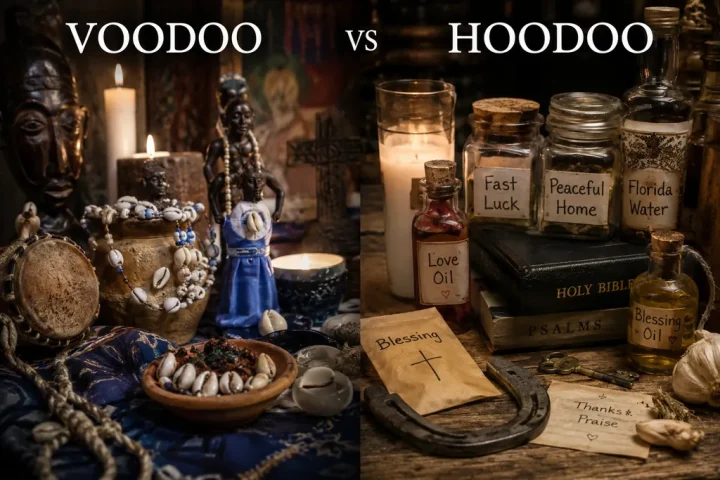
Too many people approach African and African-diasporic spirituality as though Hoodoo, Vodou and the Orisha traditions were interchangeable collections of exotic spells waiting to be stolen from a social-media post. That is ignorance disguised as occultism. These traditions carry history, ancestry, spirit relationships, ritual discipline and communities that survived slavery, persecution and deliberate attempts to destroy them.
If you are serious about Hoodoo and Vodou, then stop consuming diluted fragments and start studying the traditions with the depth they demand. Enter the Occult World Mystery School and learn the history, spirits, ancestral practices, rootwork, protection, ritual technologies and African-diasporic currents that shaped some of the most powerful magical traditions in the world. Learn the difference between Hoodoo, Haitian Vodou, Louisiana Voodoo and the Orisha religions instead of lazily collapsing them into one fantasy. Power begins with knowledge, discipline and respect. Stop standing at the shoreline pretending you understand the ocean. Enter the Occult World Mystery School, go beneath the surface and start doing the work.
CLASSIFICATION:
Orisha
MANIFESTATION:
Olokun may manifest as a mermaid, merman, giant sea snake, male human, female human, or someone so old it’s no longer possible to tell.
ICONOGRAPHY:
Olokun may be represented by a large mirrored box covered with a white cloth.
Feast:
From 31 December until 6 January
ELEMENT
Water
SACRED SITES:
The sea, plus marshes and mangrove swamps where the sea has intruded. Olokun is also sometimes considered ruler of all rivers, which flow into the sea.
OFFERINGS:
Seashells, salt water, things that recall the treasures of the sea
SEE ALSO:
SOURCE:
Encyclopedia of Spirits: The Ultimate Guide to the Magic of Fairies, Genies, Demons, Ghosts, Gods & Goddesses– Written by :Judika Illes Copyright © 2009 by Judika Illes.


Follow