

Red: The Colour of Blood, Witchcraft and Magical Power
Red is one of the most powerful and emotionally charged colours in magic. It is the colour of blood, physical vitality, sexual passion, courage, aggression and danger. Across cultures, it has represented both life and death, protection and destruction, sacred power and forbidden desire.
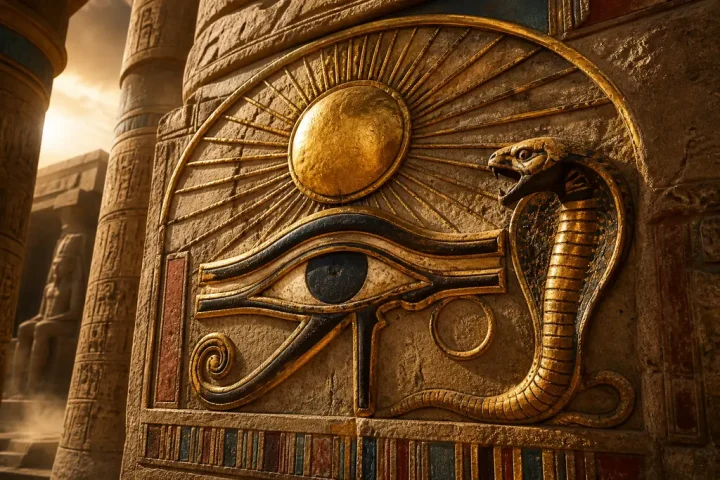
Its magical importance reaches back to the ancient world. In Egypt, red could be associated with death, disorder and the destructive force personified by Typhon. Red-haired men were mocked or ritually singled out during certain ceremonies, possibly because their unusual appearance connected them symbolically with dangerous or chaotic powers.
In the Greek and Roman worlds, red belonged to Priapus, the explicitly sexual god of fertility and masculine potency. It was also associated with Mars, the god of war, violence and martial strength. These connections reinforced red’s reputation as the colour of desire, bloodshed and raw physical force.
The Bible added another layer of meaning. In Isaiah, sin is compared with scarlet: “Though your sins be scarlet…” Red therefore became connected not only with blood but also with temptation, transgression and moral corruption. Because it so closely resembles blood, red has naturally appeared in the clothing, tools and symbolism surrounding ritual blood sacrifice.
Red Hair and the Witch
Red has long been associated with witches.
One reason may simply be that naturally red hair is uncommon. Anything unusual can become the focus of superstition, especially in communities where physical difference is interpreted as a sign of hidden spiritual qualities.
In parts of Scotland and Ireland, fishermen once believed it unlucky to encounter a red-haired woman while travelling to their boats. Such a meeting was thought capable of ruining the day’s catch before the boat had even left the shore.
Old Irish folklore claimed that witches placed red caps upon their heads before flying through the night to attend their Sabbats. Other stories accused them of transforming ordinary pieces of straw into red pigs and selling them at market to unsuspecting buyers.
The illusion would last only until the animals crossed running water. At that moment, the pigs would collapse back into straw, revealing that the buyer had been deceived by witchcraft.
Another curious folk belief claimed that when a witch’s soul temporarily left her body, it emerged from her mouth in the shape of a red mouse. This image links the colour red with the wandering soul, shape-shifting and the secret life of the witch beyond her ordinary human appearance.
Red as Protection Against Witchcraft
Although red was associated with witches, it was also one of the most common colours used to repel them.
This contradiction appears throughout magical tradition. A powerful force can both cause harm and provide protection against that harm. Fire burns, but it also purifies. Blood represents injury, but it also represents life. Red belongs to the witch, yet it can also be used to block her entrance.
Among the Pennsylvania Dutch, red lines were painted around barns as protective boundaries against witchcraft. These markings acted as magical barriers, preventing malicious forces from crossing into the building and harming animals, crops or the people who depended upon them.
In Bohemia, a charm wrapped in red cloth and worn around the neck was believed to protect the wearer from enchantment. Red-painted carts, rowan wreaths tied with red thread and other brightly coloured protective objects were also used to repel witches.
Braided red cords were sometimes hung inside stables. According to folklore, any witch entering the building would be compelled to stop and count every thread before she could attack the animals. This belief resembles other protective practices in which supernatural beings are distracted by seeds, knots, grains or complicated patterns that they must count or untangle.
Red therefore did more than symbolise power. It could trap attention, establish a boundary and turn hostile magic back upon itself.
Red at the Witches’ Sabbat
Christian ideas connecting red with sin, lust and corruption helped shape later stories about witches’ Sabbats and Black Masses.
During the Salem witch trials of 1692, Abigail Williams claimed that witches consumed “red drink and red bread” during their secret gatherings. Whether such descriptions came from genuine belief, religious fear, imagination or pressure from interrogators, the colour was clearly intended to suggest blood, sacrilege and diabolical communion.
In accounts of blasphemous Black Masses, officiating priests were sometimes described as wearing red garments and slippers while reading from books decorated in red and black. These colours created a deliberate inversion of Christian ritual: red for blood and sin, black for death, secrecy and rebellion.
In 1895, Prince Scipio Borghese of Italy was reportedly discovered to possess a private chamber devoted to satanic rites. The room was said to contain crimson-and-gold chairs and curtains of scarlet and black silk. Whether the claims were entirely accurate or enhanced by scandal, the description reveals how strongly red had become associated with forbidden ritual, aristocratic decadence and occult transgression.
Red in Modern Witchcraft
In contemporary Witchcraft and Wicca, red is most commonly associated with vitality, courage, strength, passion, sexuality and physical energy.
It is often used in spells intended to awaken motivation, strengthen desire, increase confidence or restore depleted energy. In healing traditions, red is sometimes called the great energiser because of its symbolic relationship with blood and circulation.
A red candle may be burned when a witch wishes to increase courage, rekindle passion or bring force and determination to a magical working. Red cords may be used in knot magic, particularly when the spell concerns love, physical attraction, health, strength or protection.
Yet red should not be treated as a simplistic symbol with only one meaning.
It may represent romantic love, but it can also represent lust without affection. It may bring courage, but it can also intensify anger. It may strengthen the body, yet it also evokes injury and sacrifice. Its energy is direct, physical and difficult to ignore.
For this reason, red is not always a gentle magical colour. It pushes, awakens, confronts and demands action.
The Witch’s Colour of Life and Danger
Red exists at the threshold between creation and destruction.
It is the blood that sustains life and the blood that reveals a wound. It is the fire that warms the home and the fire that consumes it. It is the colour of the lover, the warrior, the sacrifice and the witch.
This is what gives red its magical power.
It does not belong exclusively to good or evil. It belongs to force itself.
The witch who works with red is not merely choosing a colour. She is invoking vitality, hunger, danger, passion and the power to transform intention into action.
Stop Pretending That Buying Candles Makes You a Witch
You can memorise colour correspondences, decorate an altar and call every emotional impulse “intuition.”
That does not make you a witch.
Witchcraft demands knowledge, practice, discipline and the willingness to understand the forces you are attempting to use. Wicca is more than aesthetic moon imagery. Spellcraft is more than lighting a candle and hoping the universe does the rest.
Inside the Occult World Mystery School, you can move beyond shallow social-media witchcraft and enter the deeper study of Wicca, traditional Witchcraft, candle magick, colour correspondences, spellcraft, ritual practice, protective charms, magical cords, deities, spirits, grimoires, divination and the history of the Craft.
This is not a place for people who only want the appearance of power.
It is for witches and seekers who are prepared to study what symbols mean, understand how rituals are constructed and develop a practice that is more than costume, fantasy and empty repetition.
You can remain outside the circle, collecting pretty images and borrowed spells you barely understand.
Or you can step inside and begin learning the Craft properly.
Join the Occult World Mystery School. Stop playing at Witchcraft. Study it. Practise it. Claim it and become the witch you keep telling yourself you already are.
SEE ALSO:
SOURCE:
The Encyclopedia of Witches, Witchcraft and Wicca – written by Rosemary Ellen Guiley – Copyright © 1989, 1999, 2008 by Visionary Living, Inc.



Follow