
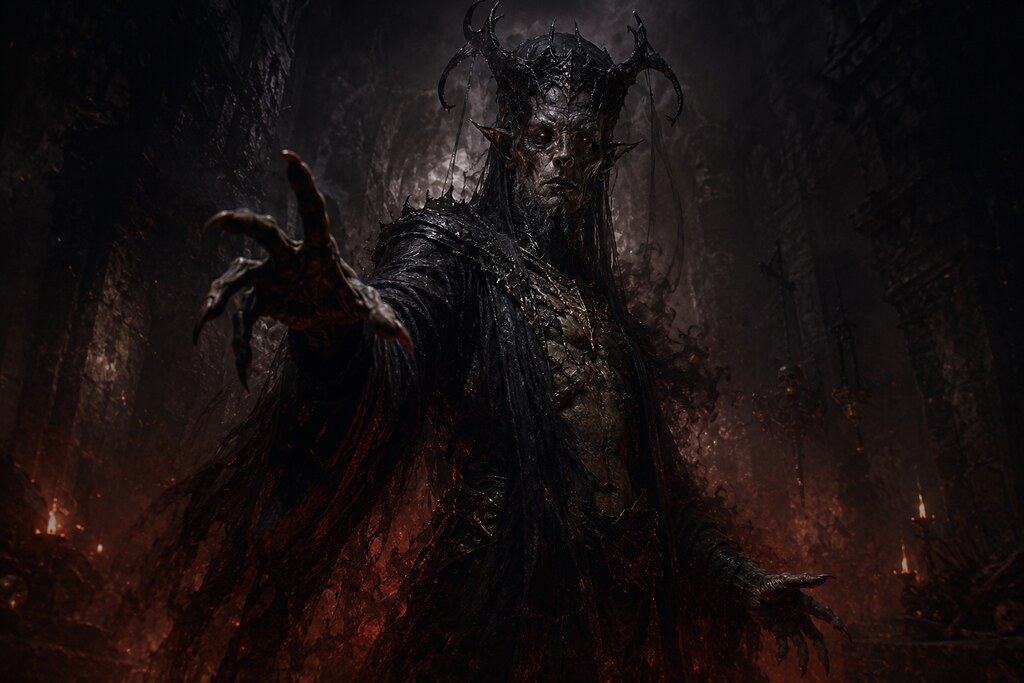
Loriol
Loriol is an obscure demon named in S. L. MacGregor Mathers‘ translation of The Book of the Sacred Magic of Abramelin the Mage, where he appears among the spirits serving the powerful infernal rulers Astaroth and Asmodeus. Unlike the great demons whose names accumulated elaborate legends, appearances and magical offices across centuries of grimoires, Loriol survives almost entirely as a name within an infernal hierarchy. No detailed description of his form is given, no individual power is clearly assigned to him, and no independent mythology surrounds him. His presence is therefore characteristic of the darker depths of ceremonial demonology, where many spirits are known only because their names were preserved for ritual use.
Loriol in the Abramelin Hierarchy
Within the Abramelin system, demons do not exist as isolated supernatural monsters. They are organised beneath greater rulers in a complex hierarchy of authority. Loriol appears in the Second Book among a group of spirits described as serving Astaroth and Asmodeus jointly, placing him beneath two of the most formidable infernal powers in Western ceremonial magic.
This position is important because it tells us almost everything the surviving text securely reveals about Loriol. He is not presented as an independent prince, king or duke of Hell, nor is he assigned a specific domain such as wealth, lust, deception, destruction or hidden knowledge. He belongs instead to the retinue of greater beings whose authority reaches downward through lesser spirits.
The Abramelin operation depends heavily upon this structure. The magician is expected to understand not merely individual spirit names but the relationships of command binding them together. A subordinate demon can be approached through the authority of the powers above it, while the magician’s own authority is ultimately derived from the successful attainment of the Knowledge and Conversation of the Holy Guardian Angel.
Loriol therefore belongs to a magical universe governed by names, ranks and obedience.
Servant of Astaroth and Asmodeus
The two rulers associated with Loriol already give his position a particularly dark character. Astaroth is one of the great infernal names of the Western grimoire tradition, while Asmodeus possesses an even older and more complex history, appearing in Jewish, Christian and magical literature before becoming one of the most recognisable demons of ceremonial tradition.
In Abramelin, these figures are not merely objects of fearful storytelling. They occupy defined positions within an operative magical system. Their names possess authority over the spirits beneath them, and their infernal households form part of the machinery through which the magician attempts to control and direct spiritual forces.
Loriol exists inside this machinery.
Nothing in the Abramelin text suggests that he was worshipped independently or possessed an elaborate cult of his own. His importance comes from belonging to the hidden chain beneath Astaroth and Asmodeus, where lesser names accumulate like shadows beneath greater ones.
The Meaning of Loriol
Mathers attempted to interpret many of the names contained in the Abramelin spirit lists through Hebrew, Greek, Latin and other languages. In his notes he offered a tentative explanation for Loriol:
“Perhaps Hebrew. Unto horror.”
The word perhaps must be preserved because Mathers was not presenting a secure linguistic translation. His proposed etymologies are frequently speculative, and Loriol’s name cannot confidently be translated from Hebrew as “unto horror” on the evidence provided.
Nevertheless, the interpretation became attached to the demon and has been repeated in later occult literature.
Whether the name genuinely bears that meaning or not, the phrase suits the atmosphere surrounding Loriol. He emerges from the grimoire without a face, without a voice and without any surviving story beyond his allegiance to greater infernal powers. In a tradition filled with demons who announce themselves through crowns, weapons, beasts, monstrous forms and promises of forbidden knowledge, Loriol remains little more than a name whose suggested meaning points towards horror.
There is something especially unsettling about a spirit preserved in this way. A demon with a detailed description can be imagined and contained within that description. Loriol offers almost nothing to contain.
A Demon Without a Known Form
No historical description of Loriol’s appearance is provided in Mathers’ Abramelin text. Later artists and occult writers may imagine him with horns, claws, blackened flesh or other infernal attributes, but these are modern interpretations rather than features preserved by the grimoire.
The same caution applies to claims concerning his powers. Loriol is sometimes encountered in modern demonological lists where obscure spirits are assigned elaborate offices that cannot be traced back to the historical source. The Abramelin material does not tell us that Loriol causes fear, produces nightmares, commands shadows or possesses any other individual ability.
For an encyclopedia devoted to occult tradition, this absence matters.
Not every demon needs to be transformed into a fully developed personality. The surviving grimoires contain hundreds of names whose significance lies precisely in their placement within ritual systems. In ceremonial magic, a name can matter even when mythology has forgotten everything else about the being that bears it.
The Power of the Name
Western magic has long attributed unusual importance to true names. Knowing the name of a spiritual intelligence was traditionally connected with identifying, summoning, addressing or commanding it. Grimoires therefore preserve names with extraordinary care, even when the surviving manuscripts provide almost no additional information about the spirits themselves.
Loriol belongs to this world of preserved names.
The magician working within the Abramelin tradition was not expected to invent a personality for every spirit. What mattered was knowing where the spirit belonged, which greater powers commanded it and under what authority it could be brought into obedience.
This is one reason lists of apparently obscure demons are so important within grimoires. To the casual reader, they may look like meaningless collections of strange names. To the ceremonial magician, they map an invisible hierarchy.
Loriol occupies one small place on that map.
Loriol and the Sacred Magic of Abramelin
The Sacred Magic of Abramelin is fundamentally different from a grimoire designed merely to teach the conjuration of demons. Its central objective is spiritual transformation and the establishment of contact with the practitioner’s Holy Guardian Angel. Only after this attainment does the magician confront the infernal powers and compel them to submit.
The demons therefore appear within a larger structure of spiritual authority.
The magician is not supposed to kneel before Loriol, Astaroth or Asmodeus. Within the logic of the system, the magician stands above them through divine authority and forces the infernal hierarchy to acknowledge that authority.
This makes Loriol’s obscurity even more significant. He is not preserved because storytellers were fascinated by him. He is preserved because the ritual system considered his name useful.
The grimoire does not ask whether the reader finds Loriol interesting. It records him because, within the magical worldview of Abramelin, he belongs somewhere in the invisible order and therefore has a place within the operation.
The Shadow Beneath the Greater Demons
Loriol represents a vast class of lesser demons who remain hidden behind the famous names of ceremonial magic. Astaroth, Asmodeus, Belial and other great infernal figures dominate the literature, but beneath them stand ranks of spirits whose names survive only in manuscripts and magical catalogues.
These lesser beings remind us that traditional demonology was never simply a collection of colourful monsters. It was an attempt to organise the unseen world according to rank, authority and function.
Loriol’s darkness therefore comes not from some spectacular legend of blood or destruction, but from his almost complete anonymity. He survives because a magician copied his name, another manuscript preserved it, and Mathers eventually carried it into modern occult literature.
Beyond that, silence remains.
Perhaps this is appropriate for a spirit whose name Mathers associated, however tentatively, with horror. Loriol waits in the margins of Abramelin, beneath Astaroth and Asmodeus, one obscure intelligence among many whose names were never intended as entertainment but as components of a system for confronting, commanding and surviving the powers of the invisible world.
Stop Reading About Power and Start Building It
If demonology is still nothing more to you than collecting frightening names and scrolling through lists of spirits, then you are wasting the very knowledge you claim to want. Enter the Occult World Mystery School and study Demonology, Power, Black Magick, grimoires, spirits and the systems serious occultists have always used to strengthen their will, sharpen their understanding and take conscious command of the direction of their own world. Powerful people do not drift through life waiting for circumstances to decide everything for them, and serious occultists do not remain passive spectators while other forces shape their reality. Learn the hierarchies, understand the ritual systems, develop discipline and stop surrendering control of your life to ignorance, fear and chance. If you want power, then stop admiring it from outside the circle and start doing the work required to possess your own.
SEE ALSO:
SOURCE:
The Dictionary of Demons written by Michelle Belanger.
NOTE:
Edited and revised for the Web by Occult Media, the 22nd of April 2021. We use British English spelling.












Follow