

Aiwass: The Mysterious Entity Behind The Book of the Law
Aiwass, also spelled Aiwaz, is one of the most enigmatic beings in modern occult history. He is best known as the imposing entity who dictated The Book of the Law to Aleister Crowley in April 1904, an event that became the foundation of Thelema and one of the most influential moments in 20th-century Western esotericism.
Crowley regarded The Book of the Law as his most important magical work. He believed that Aiwass was not merely a voice, fantasy, or psychological fragment, but his Holy Guardian Angel: a divine Higher Self or independent spiritual intelligence acting as an intermediary for higher beings such as the Secret Chiefs, the superhuman adepts associated with the Hermetic Order of the Golden Dawn.
From the beginning, occultists have debated the true nature of Aiwass. Was he an external entity? A praeterhuman intelligence? A demon? A god? A manifestation of Crowley’s subconscious? Or a powerful expression of Crowley’s own magical genius?
Crowley himself wrestled with these questions for the rest of his life.
Aiwass or Aiwaz?
Crowley originally spelled the entity’s name Aiwaz. Later, he changed the spelling to Aiwass for numerological reasons. In the magical systems Crowley worked with, especially those involving Qabalah and gematria, names were not treated as arbitrary. A change in spelling could alter the numerical value, symbolic meaning, and occult correspondence of a name.
This change reflects Crowley’s belief that language, number, vibration, and spiritual identity were deeply connected. For him, Aiwass was not simply a name. It was a magical formula, a key to the being who had delivered the message of the New Aeon.
Aiwass and the Holy Guardian Angel
Crowley identified Aiwass with his Holy Guardian Angel. In Western esotericism, the Holy Guardian Angel is often understood as the highest spiritual guide of the magician, the divine self, or the personal spiritual intelligence that leads the initiate toward true will and higher knowledge.
However, Crowley did not reduce Aiwass to a mere psychological symbol. He insisted that the Holy Guardian Angel was a discrete and independent entity, not simply a dissociated part of his own mind.
This is one of the central mysteries of Aiwass. Crowley’s writings repeatedly move between different interpretations. At times, Aiwass appears as divine messenger. At other times, he resembles a god, demon, angel, or praeterhuman intelligence. Crowley considered and rejected the possibility that Aiwass was merely his subconscious, preferring instead to understand him as a real being with an existence beyond ordinary personality.
The Cairo Working of 1904
Aiwass entered Crowley’s life dramatically in April 1904, while Crowley and his wife, Rose Edith Kelly, were on honeymoon in Cairo.
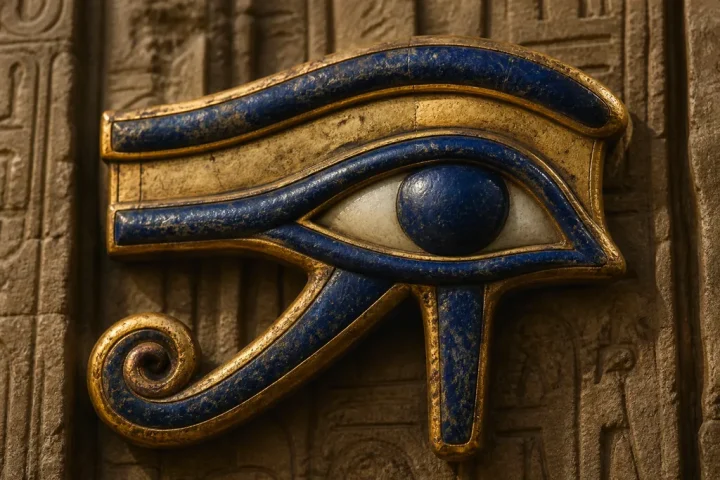
Rose, who was not previously known as a major medium, began to receive messages connected with Horus. She told Crowley that “they are waiting for you,” and eventually identified the communicating force as an emissary of the Egyptian god Horus, son of Isis and Osiris.
Crowley tested Rose’s statements and became convinced that something significant was occurring. The communications led him into what became known as the Cairo Working, the magical event during which The Book of the Law was received.
Rose Crowley and the Message of Horus
Rose described Aiwass as an emissary of Horus. This is important because The Book of the Law announced the arrival of a new spiritual era: the Aeon of Horus.
In Crowley’s system, the Aeon of Horus replaced the previous Aeon of Osiris. It was an age of individual will, magical self-realisation, spiritual force, and the destruction of old religious forms. The central command of the new aeon would become: “Do what thou wilt shall be the whole of the Law.”
Aiwass, therefore, was not merely a private guide for Crowley. He appeared as the messenger of a vast spiritual transition.
Crowley’s Encounter with Aiwass
Crowley experienced Aiwass as a being unlike other entities he had encountered. He found him powerful, remote, commanding, and difficult to understand.
Crowley wrote that Aiwass was:
“. . . a Being whose mind was so different from mine that we failed to converse. All my wife obtained from Him was to command me to do things magically absurd. He would not play my game: I must play His.”
This quote reveals Crowley’s sense that Aiwass was not simply cooperating with him. Aiwass did not behave like a spirit answering questions in the expected way. He commanded. He redirected. He imposed his own agenda.
Crowley, who was accustomed to controlling magical operations, found himself in the position of obedience.
The Temple in Cairo
On 7 April 1904, Aiwass commanded that the drawing room of the Cairo apartment rented by the Crowleys had to be turned into a temple. Crowley was instructed to enter this temple at precisely noon on the next three days and write down exactly what he heard for one hour each day.
Crowley followed the instructions.
On 8, 9, and 10 April, he sat alone at a table facing the southern wall. From behind him came the voice of Aiwass. Crowley did not see a full physical apparition during the dictation, but he heard the voice with extraordinary clarity.
He described it as “a rich tenor or baritone . . . deep timbre, musical and expressive, its tones solemn, voluptuous, tender, fierce, or aught else as suited the moods of the message.”
He also called it “the Speech in the Silence.”
These descriptions suggest that the voice of Aiwass was not monotonous or mechanical. It shifted in emotional tone according to the message being delivered: solemn, sensual, tender, fierce, commanding, and mysterious.
The Minister of Hoor-Paar-Kraat
Crowley later described Aiwass as “the minister of Hoor–Paar–Kraat” or “the Lord of Silence.”
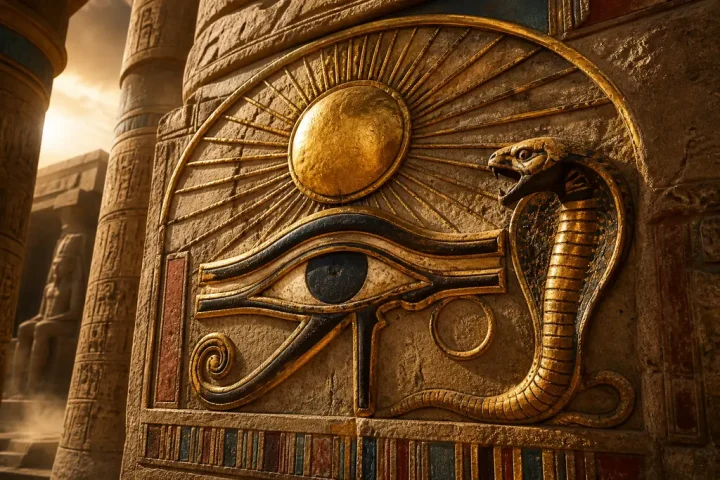
Hoor-Paar-Kraat is an aspect of Horus, equivalent to the Greek Harpocrates, the child Horus and god of silence. This association is significant because Aiwass communicated as “the Speech in the Silence.” He emerged from the silent current of Horus and gave voice to a new magical revelation.
In Thelemic symbolism, silence is not emptiness. It is the hidden source of power. Aiwass speaks from that silence, giving form to the law of the new aeon.
The Appearance of Aiwass
Although Crowley did not see Aiwass physically during the dictation, he did receive a strong mental impression of him. Crowley described Aiwass as having:
“. . . a body of “fine matter”or astral matter, transparent as a veil of gauze or a cloud of incense-smoke. He seemed to be a tall, dark man in his thirties, well-knit, active and strong, with the face of a savage king, and eyes veiled lest their gaze should destroy what they saw.”
Crowley also said that Aiwass appeared to be dressed in Assyrian or Persian garb.
This image is striking. Aiwass is not described as a soft angelic figure, but as a regal, dangerous, veiled, and powerful being. His eyes are hidden because their gaze might destroy what they saw. His body is subtle, made of astral matter, yet his presence is masculine, forceful, and royal.
This combination of refinement and danger is central to the mystery of Aiwass.
The Dictation of The Book of the Law
For three consecutive days, Crowley took dictation from Aiwass for exactly one hour each day. He wrote quickly in longhand, attempting to keep pace with the voice behind him.
The result was 65 pages of handwritten text divided into three chapters. These became The Book of the Law, also known as Liber AL vel Legis.
Each chapter was associated with an Egyptian deity. The first chapter carried the voice of Nuit, goddess of the infinite heavens. The second expressed Hadit, the secret point or solar fire at the centre of being. The third belonged to Ra-Hoor-Khuit, a fierce form of Horus as lord of the new aeon.
Crowley believed that this book announced a new spiritual law for humanity. It became the foundation of Thelema and shaped the rest of his magical career.
Aiwass as Praeterhuman Intelligence
Crowley used several terms for Aiwass over the years. He called him a god, demon, devil, praeterhuman intelligence, minister of the gods, messenger, Holy Guardian Angel, and sometimes considered whether he might be connected to his own subconscious.
The term praeterhuman intelligence is especially important. It suggests a being beyond ordinary human nature, but not necessarily fitting into simple religious categories such as angel or demon. Aiwass was not merely dead, not merely human, and not easily classifiable.
In The Equinox of the Gods, Crowley admitted that he never fully understood what Aiwass truly was. His relationship with the entity remained one of awe, uncertainty, and reverence.
This uncertainty has fuelled occult debate ever since.
Was Aiwass Crowley’s Subconscious?
One of the most persistent interpretations is that Aiwass was a manifestation of Crowley’s own subconscious mind. From this perspective, The Book of the Law may have emerged from Crowley’s deep psyche, shaped by his magical training, knowledge of Egyptology, religious rebellion, poetic imagination, and personal ambition.
Crowley considered this possibility, but ultimately rejected it. He believed that Aiwass possessed a mind and intelligence fundamentally different from his own.
The question remains open for many occultists. If Aiwass was part of Crowley, then he represents an extraordinary case of magical automatism, inspired dictation, or unconscious revelation. If Aiwass was independent, then The Book of the Law becomes a genuine communication from a non-human or praeterhuman intelligence.
Either interpretation is powerful. Both place Aiwass at the centre of modern occult history.
Was Aiwass a Demon?
Crowley sometimes used language that associated Aiwass with demons or devils, though not always in a purely negative sense. In Crowley’s magical worldview, such terms did not necessarily mean evil in the Christian moral sense. They could indicate power, otherness, danger, and spiritual intensity.
However, not everyone viewed Aiwass favourably.
C. S. Jones, who ran the Vancouver lodge of the Ordo Templi Orientalis, later claimed that a series of magical initiations revealed to him that Aiwass was actually an evil demon and the enemy of humanity.
Others considered Jones to have gone mad.
This controversy shows how divided occult opinion could be. Was Aiwass the herald of a new aeon, or a dangerous deceiver? Was he Crowley’s angel, his demon, his higher self, or his undoing?
Study Aiwass, Crowley, Thelema, and Occult Mysteries Inside Occult World Academy
Aiwass is one of the most fascinating figures in modern occultism because he stands at the crossroads of spirit communication, ceremonial magic, Thelema, divine revelation, demonic ambiguity, and the mystery of the Holy Guardian Angel.
Inside the Occult World Academy on Skool, we explore these deeper occult currents with seriousness and depth. You can study demonology, ancient grimoires, ceremonial magic, spirit communication, occult history, Kabbalah, divination, witchcraft, angels, demons, and the strange beings who have shaped magical traditions across the centuries.
If you are fascinated by Aiwass, Aleister Crowley, The Book of the Law, the Secret Chiefs, the Holy Guardian Angel, and the hidden intelligences behind magical revelation, the Occult World Academy gives you a place to go deeper.
Join the Occult World Mystery School and meet fellow occultists, witches, seekers, and practitioners who are serious about exploring the mysteries of the unseen world. Do not stop at reading one article. Step into the Academy, deepen your study, and continue your journey into the powerful, dangerous, and transformative currents of Western esotericism.
Aiwass and the New Aeon
Aiwass is inseparable from the concept of the New Aeon. Through The Book of the Law, he announced a radical spiritual shift centred on will, liberty, force, and the divine nature of the individual.
For Crowley, the reception of the book marked the beginning of the Aeon of Horus. This new age would not be governed by the same religious and moral structures as the past. It would demand a new magical consciousness and a new understanding of human purpose.
Whether one accepts Crowley’s claims or not, the influence of this event is undeniable. The Book of the Law became one of the most important texts in modern occultism. Aiwass became the mysterious voice behind it.
The Enduring Mystery of Aiwass
Aiwass remains unresolved, and that is part of his power. He cannot be comfortably reduced to angel, demon, god, subconscious complex, fictional construct, or external intelligence.
He is all of these possibilities at once, depending on the lens through which he is viewed.
To believers in Thelema, he is the messenger of the New Aeon and the Holy Guardian Angel of Aleister Crowley. To sceptics, he may be a product of Crowley’s own extraordinary mind. To some occultists, he is a dangerous praeterhuman force. To others, he is one of the most important spiritual intelligences to appear in modern magical history.
Aiwass speaks from behind the magician, from the silence, from the hidden place where voice and vision meet. He is not easily seen, not easily understood, and not easily dismissed.
He remains the veiled king of Crowley’s revelation, the voice of The Book of the Law, and one of the great enigmas of the occult world.
SEE ALSO:
FURTHER READING:
- Sutin, Lawrence. Do What Thou Wilt: A Life of Aleister Crowley. New York: St. Martin’s Griffin, 2000.
SOURCE:
The Encyclopedia of Magic and Alchemy Written by Rosemary Ellen Guiley Copyright © 2006 by Visionary Living, Inc.









Follow