

Anat: The Girl, Lady of Heaven and Mistress of All Spirits
Anat is one of the fiercest and most complex goddesses of the ancient Near East. She is Queen of Heaven, Lady of Love and War, Mistress of All Spirits, Strength of Life and Lady of Mercy. Her power stretches across love, sexuality, war, battle, fertility, maternity and death itself.
Anat is not a gentle goddess in the modern sentimental sense. She is life-force in its most untamed form. She is passion, fury, blood, birth, protection and destruction. She can give life, defend life and annihilate anything that threatens what she loves.
The Goddess Who Can Slay Death
One of Anat’s most extraordinary qualities is her dominion over death. In her mythology, she does not merely confront death; she is capable of defeating it.
She is the spirit who can slay the Grim Reaper. In some interpretations, she cleaves Death with a sickle, possibly even Death’s own weapon. When Death harms her brother, Anat responds with terrifying force. She kills him, grinds his bones and scatters them to the winds.
This is not symbolic softness. Anat’s mythology is raw, violent and absolute. She is the goddess who proves that even Death can be challenged.
Ancient Ugaritic Origins
Much of Anat’s mythology survives through fourteenth-century BCE Ugaritic cuneiform tablets. The people of Ugarit were closely related to the Canaanites, and their religious texts preserve some of the most important surviving myths of the ancient Levant.
Through these tablets, Anat emerges as a central divine figure in the spiritual world of the ancient Western Middle East. She was venerated by Amorites, Canaanites, Egyptians, Hebrews, Phoenicians and Syrians. Her presence crossed borders, cultures and languages.
In a region now so often associated with spiritual and political conflict, Anat stands as a fierce reminder of an older shared religious landscape. The irony is striking: perhaps peace might once have been imagined through the shared veneration of a war goddess.
Lady of Love and War
Anat embodies the union of opposites. She is a goddess of reproduction and battle, maternity and bloodshed, sexuality and death. Her myths do not separate love from violence or birth from danger. Instead, they reveal a world where life and death are intimately connected.
She is not only a war goddess who leads others into battle. Anat delights in combat. She exults in bloodshed. Ancient descriptions present her wading through blood, slaying enemies on every side, unstoppable once her rage is awakened.
To call Anat violent is almost too weak. She is like a storm surge, a wildfire, a blade in motion. Once provoked, she is nearly impossible to restrain.
The Unstoppable Rage of Anat
Anat’s anger is legendary. Her rage is never far from the surface, and her myths are filled with scenes of destruction, vengeance and divine violence. She muzzles sea monsters. She destroys enemies. She kills to the left and slays to the right.
In this way, Anat belongs beside other terrifying warrior powers such as Kali or Ogun. These are spirits who do not represent polite, controlled strength. They represent force that breaks obstacles, destroys oppression and refuses to submit.
Anat is not a goddess to approach lightly. She is fierce, easily provoked and filled with tremendous wells of frustration and fury. Yet her rage is not random. It is the rage of protection, vengeance, sovereignty and cosmic force.
Anat in Ancient Egypt
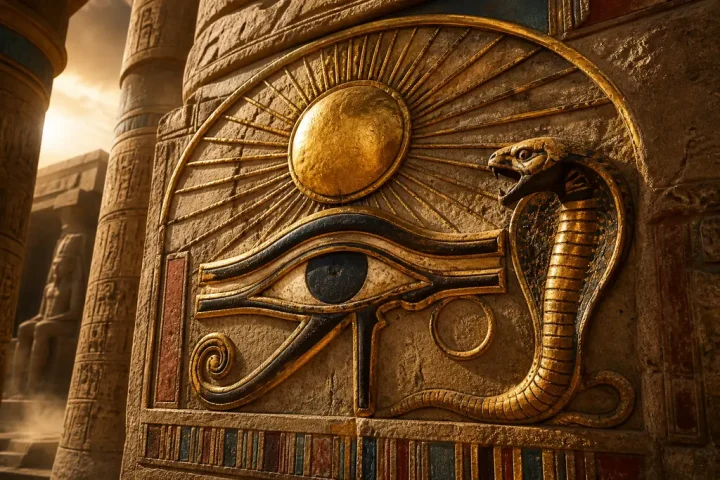
In ancient Egypt, Anat was honoured as a powerful protector. She was considered a spiritual bodyguard of the Pharaoh, and her ferocity was deeply respected.
Pharaohs named their dogs after Anat to emphasise their strength and aggression. They also named racehorses after her, seeking her favour and blessing. To carry Anat’s name was to invoke victory, speed, power and fearlessness.
Anat does not lose. Those who called upon her hoped to stand beneath the protection of a goddess who could not be defeated.
Anat and Astarte
Anat is often discussed in relation to Astarte. Some traditions perceive Anat and Astarte as distinct goddesses, while others understand Astarte as a title or aspect of Anat. In this view, Astarte is the title, while Anat is the proper name.
The ancient Egyptians, however, recognised Anat and Astarte as two separate but closely related spirits, possibly sisters. When they are treated as distinct goddesses, Astarte is usually perceived as the milder of the two.
Using the language of modern Vodou as a comparison, Anat would be the fierce, fiery Petro force, while Astarte would be closer to the calmer, cooler Rada current. Anat is the hotter flame, the sharper blade, the storm that does not ask permission.
Fierce Love and Absolute Protection
Anat may be bloodthirsty, but she is also profoundly loyal. She will go to hell and back for those she loves. Nothing stands in her way when she has chosen to protect, avenge or defend.
There is no obstacle she cannot pulverise. There is no enemy too great. She has already proven that she can defeat Death itself.
For this reason, Anat may be petitioned in moments of extreme danger, fear or confrontation. Those who feel trapped, threatened or powerless may turn to her for courage, strength and victory. She is not a soft comforter, but a fierce defender.
Anat as a Fertility Goddess
Despite her terrifying warlike nature, Anat is also a goddess of fertility, reproduction and maternity. This is one of the great paradoxes of her being. She rules both the battlefield and the womb.
Anat may be petitioned for fertility, conception, protection during pregnancy and the prevention of miscarriage or stillbirth. She is a guardian of life because she knows how fragile life is. She fights for birth as fiercely as she fights in war.
Her fertility is not passive or gentle. It is primal, protective and powerful. Anat guards the threshold between life and death, and she does so with weapons in her hands.
Working with the Energy of Anat
Anat is not a goddess for casual curiosity. Her energy is intense, ancient and uncompromising. She is best approached with respect, clarity and emotional honesty.
Those drawn to Anat may seek courage, victory, protection, fertility, survival strength or the power to overcome fear. She may be called upon when one needs to face something terrifying, end a cycle of helplessness or reclaim personal power after trauma, oppression or betrayal.
Yet Anat should never be treated as a simple “love goddess” or a decorative warrior archetype. She is love sharpened into a blade. She is motherhood armed for battle. She is the force that says: life will continue, and I will destroy what tries to prevent it.
Join the Occult World Community
If you are fascinated by Anat, ancient goddesses, war spirits, forbidden feminine power, Near Eastern mythology and the deeper mysteries behind ancient religions, you are warmly invited to join the Occult World Mystery School.
Inside the community, we explore mythology, goddess traditions, demonology, spirits, grimoires, occult history, divination, ancient magic and the hidden symbolic layers behind the world’s spiritual traditions.
Anat is not a goddess who belongs on the surface. She belongs in the deep places: the battlefield, the womb, the storm, the bloodline and the threshold between life and death. To understand her is to enter a world where love and war are not opposites, but twin forces of survival and sacred power.
Join us inside the Occult World Mystery School and continue exploring the fierce, forbidden and forgotten powers of the ancient world.
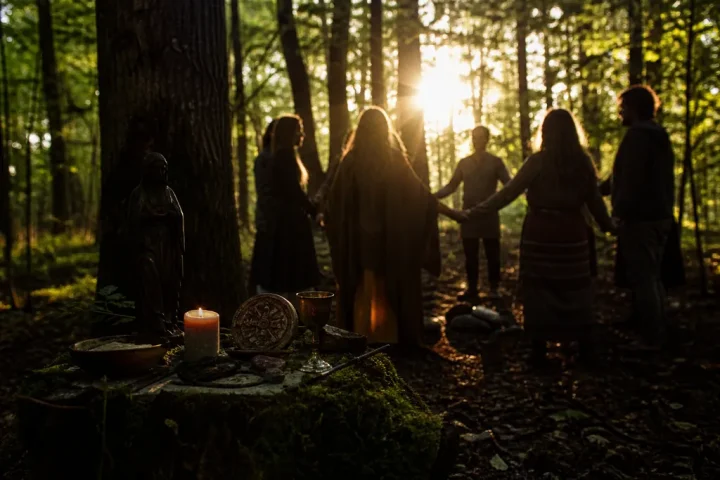
Enter the circle. Face the storm. Learn the mysteries that were never meant to be forgotten.
ALSO KNOWN AS:
Anath; Anta; maybe Astarte
ORIGIN:
Semitic
ICONOGRAPHY:
Phoenicia: Anat is depicted as a beautiful woman in a chariot drawn by seven lions. She wears a crown of myrtle leaves and is accompanied by doves. Both Phoenicians and Hebrews depict her with cow horns and a Hathor-style hairdo.
Syria: Anat is depicted as a cow.
Egypt: Anat is depicted as a naked woman riding bareback, brandishing weapons or robed in flames, armed with a sword and bow. She may wear a belt of severed hands. She is often portrayed caressing or blessing a young child with her left hand.
ATTRIBUTES:
Battle shield; frame drum; sickle; bow and arrows; sword
Parents:
Asherah and El, according to Ugaritic myth
Consorts:
This depends on tradition: Baal (Ugaritic); Set (Egyptian); YHWH (Jewish)
Sacred animals:
Cows, doves, deer, dogs, dolphins, gazelle, horses, lions, vultures
Trees:
Acacia, myrtle
Planets:
Moon, Venus. She personifies Venus as the morning and evening star. In the daytime, Anat leads her followers to war. At night she inspires them sexually.
Petitions:
Anat loves gambling passionately and may attempt to cajole you into a game. Never gamble with her. Ever. Not even in dreams. She never loses. Ever.
Anat plays a frame drum and can be communicated with through drumming.
OFFERINGS:
Call Anat with the fragrance of coriander. She likes weapons. Give her hand-shaped Milagros. (See the Glossary entry for Milagros.) She accepts offerings of sweet baked goods, like cookies or small cakes, particularly if you make them yourself. Create them in her image, in the image of her attributes or a lunar shape. She likes statues of herself. Ancient devotees decorated her image with rouge and hennaas a substitute for blood, adorning their own hands and feet with henna in her honour. Make sure to give her constant, ongoing respect, loyalty, and devotion. She is a hot-tempered, insecure, albeit extremely loyal spirit; you will have to reassure her of your devotion on a regular basis.
SEE ALSO:
SOURCE:
Encyclopedia of Spirits: The Ultimate Guide to the Magic of Fairies, Genies, Demons, Ghosts, Gods & Goddesses– Written by: Judika Illes Copyright © 2009 by Judika Illes.






Follow