
Yewá: The Reclusive Orisha of the Graveyard, Purity and Sacred Silence
Yewá is one of the most mysterious and shadowed orishas. She is reclusive, severe and deeply connected with death, silence, purity and the hidden processes that take place after the body has left the world of the living.
She resides in the graveyard, where she works in close partnership with her sister Oya, the powerful Cemetery Queen. While Oya rules the winds of the cemetery and the passage between life and death, Yewá guards the dead in their most vulnerable state. She is Queen of Cadavers, watching over bodies from the moment of death through the funeral rites and burial.
In some traditions, Yewá presides over the body as it decays and returns to bone. Only after this transformation does Oya fully take over. In this sense, Yewá governs one of the most hidden stages of death: the quiet reduction of the physical form, the sacred mystery of the body returning to the earth.
Yewá’s Origins as a Marine Orisha
Yewá did not always live in the cemetery. Before she became associated with death and graves, she was a marine orisha and one of the most beautiful daughters of Olokun.
She was linked with lagoons and deep waters, ruling alongside Olosa. Her worship was once connected with a sacred cave that could only be reached by swimming across the lagoon. This detail reflects her original nature as a hidden water spirit: remote, beautiful, inaccessible and surrounded by mystery.
Her later association with the cemetery did not erase her watery origins. Instead, Yewá became a figure who carries both the depth of the lagoon and the silence of the graveyard. She belongs to places that are difficult to enter and impossible to approach casually.
The Tragedy of Yewá and Shango
One of the most important myths of Yewá tells of her youth, innocence and heartbreak.
According to legend, when Yewá was still a very young virgin, Shango secretly seduced her. She conceived a child. In some versions of the story, Boromu discovered what had happened and persuaded her to drink an herbal potion that caused her to miscarry or abort the pregnancy.
Devastated, ashamed and completely alone in her suffering, Yewá buried the remains beneath a tree. Overwhelmed by what had happened to her, she exiled herself from the world of beauty, water and youth, and withdrew into the cemetery, the realm of death.
This myth explains much about Yewá’s severity. Her rejection of vulgarity, promiscuity and careless sexuality is not simply a moral rule. It is rooted in grief, trauma, sacred withdrawal and the desire to protect purity from violation.
Boromu, Olokun and the Child Borosia
In some versions of the myth, Boromu later went to Olokun and revealed what had happened. He brought Olokun to the tree where the remains had been buried. The child, named Borosia, was resurrected at least in spirit and now serves as a guardian in Olokun’s court.
The role of Boromu varies depending on the tradition. In some stories, he becomes Yewá’s husband. In others, the relationship is more complex. Some interpretations suggest that Boromu loved Yewá and acted out of concern, while others imply that the marriage may have been arranged to preserve her honour after the scandal.
Like many myths surrounding the orishas, the story is not simple. It contains sorrow, secrecy, social judgement, spiritual transformation and the painful consequences of desire.
The Severe Nature of Yewá
Yewá is not an easy orisha to approach. She is strict, reserved and deeply intolerant of vulgarity.
In Africa, her devotees were traditionally expected to be celibate. She was attended by eunuchs under the supervision of Logunedé. In the Western Hemisphere, her restrictions may be somewhat less severe, but she remains an orisha of modesty, restraint and sacred discipline.
Yewá dislikes promiscuity, crude sexual humour, explicit sexual discussion, innuendo, foul language and cursing. These things should never be brought near her altar. Anyone who approaches Yewá must do so with dignity, silence, cleanliness and respect.
One should always be fully dressed in her presence. She is not an orisha for casual devotion or careless behaviour. Yewá demands reverence.
Yewá and the Black Madonna of Montserrat
Yewá is sometimes syncretised with the Black Madonna of Montserrat, a sacred Marian image associated with mystery, darkness, hidden power and deep devotion.
This syncretism reflects Yewá’s own qualities: sorrow, sacred femininity, spiritual dignity, silence and the presence of divine power within darkness.
Through this association, Yewá becomes not only a guardian of the dead, but also a figure of hidden sanctity. She teaches that the graveyard is not merely a place of endings. It is also a place of transformation, purification and spiritual truth.
The Spiritual Meaning of Yewá
Yewá represents the mysteries most people prefer not to face: death, decay, grief, sexual shame, silence, isolation and the hidden consequences of desire.
Yet she is not merely a dark or frightening figure. She is also a guardian. She protects the dead. She protects sacred boundaries. She protects purity, dignity and the unseen processes of transformation.
To study Yewá is to enter a world where beauty and sorrow meet. She reminds us that death is not chaos, but a sacred passage. She teaches that silence can be holy, withdrawal can be powerful, and the graveyard can be a place of deep spiritual order.
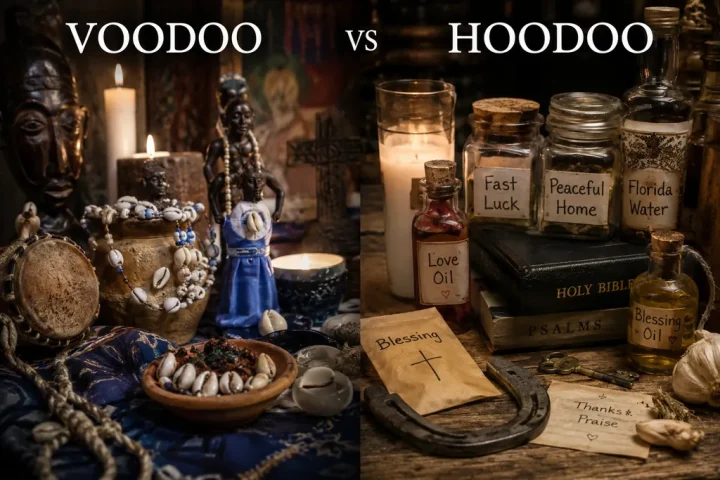
Learn More About Orishas, Voodoo and Hoodoo Inside the Occult World Mystery School
If Yewá fascinates you, the Occult World Mystery School is the perfect place to continue your studies.
Inside the community, you can explore the deeper worlds of African and Afro-diasporic spirituality, including orishas, ancestral reverence, spirit work, Voodoo, Hoodoo, ritual practice, magical history and sacred symbolism. These traditions are powerful, complex and often misunderstood, which is why serious study matters.
The Occult World Mystery School gives you a structured place to go beyond scattered online information. You can learn through courses, discussions, historical material and deeper occult teachings, while connecting with others who are also drawn to spirits, magic, mythology and the hidden traditions of the world.
Join the Occult World Mystery School and step into a deeper level of occult learning. Discover the mysteries of the orishas, explore the foundations of Voodoo and Hoodoo, and learn how death, ancestry, ritual and spirit work are woven into some of the most powerful magical traditions on earth.
If you are ready to move beyond curiosity and enter serious study, the Occult World Mystery School is waiting for you.
ALSO KNOWN AS:
Yeggua; Yeguá; Ewá
CLASSIFICATION:
Orisha
MANIFESTATION:
She has a regal, queen-like bearing.
Elements:
Water, earth
COLOURS:
Pink, scarlet
Numbers:
7, 9, 11
Creatures:
Doves, owls, goats
Day:
Friday
Plant:
Turnea ulmifolia (yellow alder or marilope), Phyllanthus augustifolia (Panatela)
OFFERINGS:
Offer her the most fragrant flowers (to cover up the stench of the corpses she now guards). Don’t get her just one pink rose or carnation: get lots to maximize their fragrance.
SEE ALSO:
SOURCE:
Encyclopedia of Spirits: The Ultimate Guide to the Magic of Fairies, Genies, Demons, Ghosts, Gods & Goddesses– Written by : Judika Illes Copyright © 2009 by Judika Illes.


Follow