

Iron is one of the most powerful protective substances in folklore. Across Europe and beyond, it has long been regarded as a charm against witches, sorcerers, demons, fairies, ghosts, and other harmful spirits.
In traditional belief, iron does not merely protect: it repels. It creates a boundary that hostile supernatural beings cannot cross.
Iron Against Witches and Evil Spirits
European folklore holds that witches cannot pass over cold iron. For this reason, iron objects were often placed at thresholds, doorways, windows, cradles, stables, and bedsides.
One common charm involved burying an iron knife beneath the doorstep of a house. This was believed to prevent any witch from entering. Iron nails, iron horseshoes, iron keys, knives, scissors, and other metal tools were also used as protective charms.
In some rural communities, iron was not only used to protect individuals or homes, but entire villages. Pieces of iron might be placed at boundaries or hidden in strategic places to keep witchcraft, demons, and wandering evil away from the settlement.
Iron and Fairies
Iron is especially famous as a protection against fairies.
In Scotland, Ireland, and other parts of Europe, cold iron was believed to keep away mischievous, dangerous, or malicious fairies. Fairy beings were often thought to dislike iron intensely. A piece of iron placed near a child’s cradle could protect the child from being stolen and replaced by a changeling.
Iron tools were also used to protect cattle, horses, barns, and milk from fairy interference. Since fairies were often blamed for illness, spoiled milk, vanished children, and strange misfortunes, iron became one of the simplest and most trusted household protections.
Iron Against Ghosts and the Restless Dead
In some traditions, iron also keeps ghosts away.
A blade, nail, or iron object might be used to prevent the dead from troubling the living. Iron could be placed in graves, near corpses, or at the entrance of a home to keep wandering spirits from returning.
However, not every culture used iron in this way. Among the ancient Saxons, iron rune wands were not placed in cemeteries because it was feared that the iron would frighten away the spirits of the dead. This shows the double nature of iron in folklore: it protects the living, but it may also disturb or repel spirits who are not necessarily evil.
Iron from Heaven
In some ancient cultures, iron was considered sacred because it was believed to come from heaven.
The Babylonians, Egyptians, and Aztecs associated iron with the celestial realm, possibly because meteorites contain iron and other metals. Before iron smelting became common, meteoric iron was rare, mysterious, and powerful. It quite literally fell from the sky.
This heavenly origin gave iron a supernatural quality. It was not just a metal of the earth, but a gift from the heavens.
Iron in Ancient Religion
Iron was not always welcomed in sacred spaces.
In ancient Greece and Rome, iron was forbidden inside certain temples and was not used by priests in ritual contexts. This may have been because iron was associated with violence, weapons, bloodshed, or earthly force rather than divine purity.
Bronze, gold, silver, and other metals were often preferred for sacred objects. Iron, by contrast, belonged to warriors, smiths, tools, ploughs, chains, blades, and boundaries.
Yet this very association with strength and cutting power helped make iron one of the most effective magical protections in popular belief.
Iron Amulets
Iron has been used throughout history to make amulets against danger, bad luck, the Evil Eye, witches, demons, and harmful spirits.
Babylonian and Assyrian men wore iron amulets in the belief that they enhanced virility. Women rubbed themselves with iron powder in order to attract men.
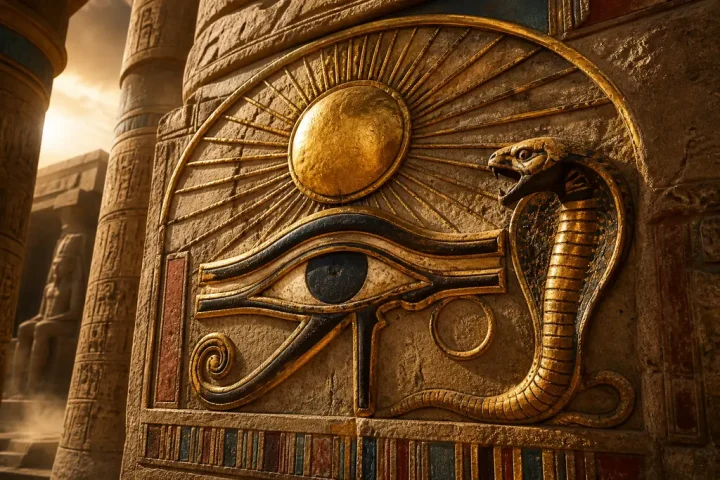
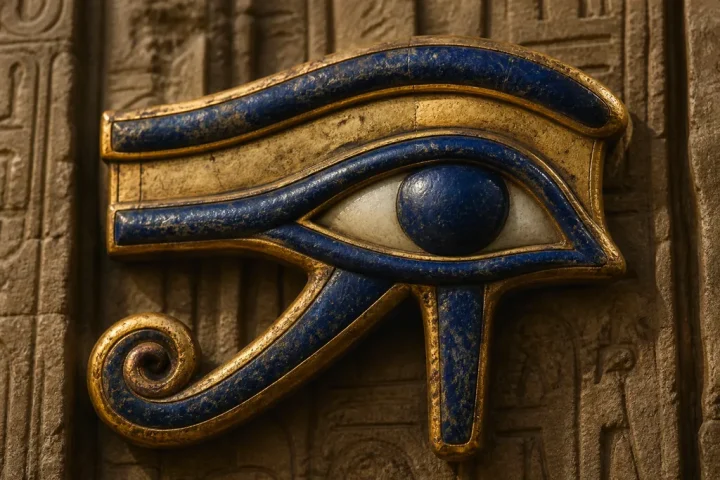
Ancient Egyptians inserted iron amulets into the linen wrappings of mummies to invoke the protection of the Eye of Horus. In this context, iron helped protect the soul on its journey beyond death.
In parts of Burma, river men have worn iron pyrite amulets as protection against crocodiles. The amulet did not simply protect against supernatural danger, but against very real physical threats as well.
Iron, Healing, and Animal Magnetism
Iron also appears in the history of occult healing.
The 18th-century magnetist Franz Anton Mesmer used iron in his attempts to heal illness. His patients sat in tubs filled with water and iron filings, with iron rods protruding from them. Mesmer believed that iron helped conduct animal magnetism, the vital energy he believed existed in every human body.
Although Mesmer’s theories are no longer accepted as medical science, his work deeply influenced later occult, spiritual, and psychological ideas about invisible forces, magnetism, healing, trance, and energy.
The Magical Meaning of Iron
Iron is a metal of strength, boundaries, resistance, and protection. It belongs to the forge, the blade, the nail, the key, the horseshoe, and the gate.
Magically, iron represents the power to cut, seal, defend, repel, and command. It is not a soft or gentle charm. It is a firm barrier. It says: this far, and no further.
This is why iron appears so often in protective magic. It guards thresholds, protects children, repels hostile spirits, breaks enchantments, and keeps the unseen world at a distance.
Iron in Practical Folk Magic
In folk magic, iron may be used in many simple protective ways.
An iron nail can be placed near a doorway to guard the home. A knife may be laid beneath a bed to repel nightmares or spiritual attack. A horseshoe may be hung above a doorway for luck and protection. Iron scissors may be placed near a cradle to protect an infant from fairy interference. Iron keys may be carried as charms for protection, authority, and safe passage.
These customs vary from place to place, but the underlying belief is the same: iron has the power to hold back what should not enter.
Join the Occult World Mystery School
If you want to go deeper into the hidden history of magical protection, folk charms, witchcraft, demons, fairies, spirits, amulets, and ritual practice, join us inside the Occult World Mystery School.
Inside the community, you can follow courses on magic, tarot, demonology, witchcraft, Hoodoo, Vodou, angels, ancient grimoires, Kabbalah, necromancy, mythology, and much more. You will also find a growing occult library, practical lessons, ritual templates, worksheets for your Book of Shadows, tarot exercises, magical correspondences, protection practices, and study materials to support your personal path.
Whether you are just beginning your occult studies or already walking a magical path, the Occult World Mystery School gives you a place to learn, practise, ask questions, and deepen your craft.
Join us inside Occult World Skool and continue your journey into the mysteries.
SEE ALSO:
FURTHER READING:
- Leach, Maria, ed., and Jerome Fried, assoc. ed. Funk & Wagnall’s Standard Dictionary of Folklore, Mythology and Legend. New York: Harper & row, 1972.
- Opie, Iona, and moira Tatem. A Dictionary of Superstitions. New York: Oxford University Press, 1989.
SOURCE:
The Encyclopedia of Witches, Witchcraft and Wicca – written by Rosemary Ellen Guiley – Copyright © 1989, 1999, 2008 by Visionary Living, Inc.



Follow