
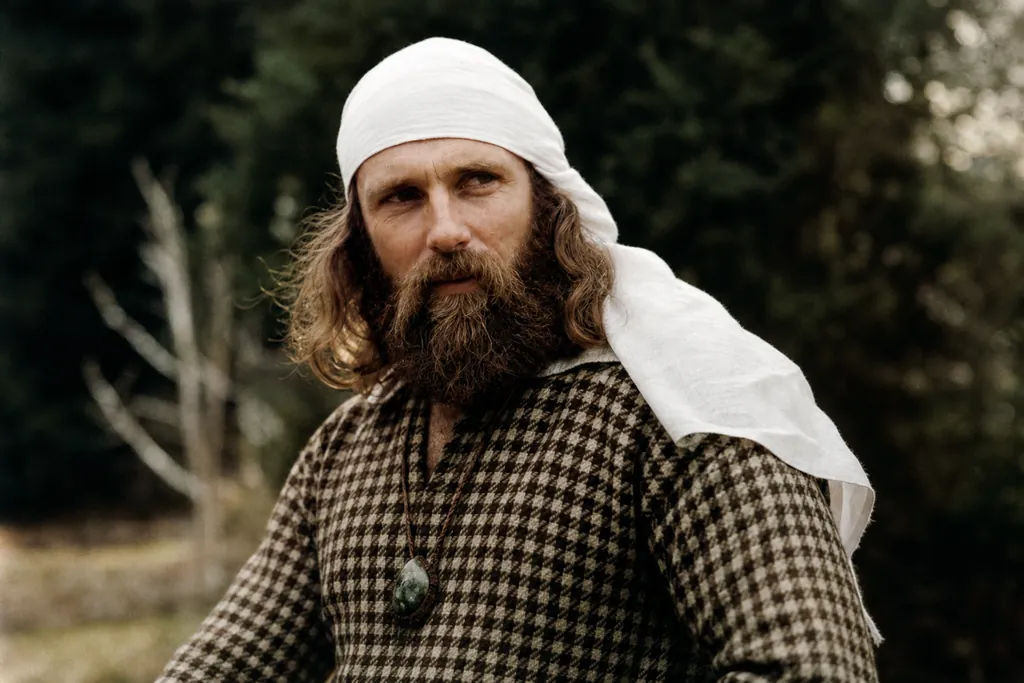
Gwydion Pendderwen (1946–1982) was a Celtic bard, poet, musician, ritualist and influential figure in the rise of contemporary Paganism in the United States. His legacy includes a body of writings, rituals, songs, music and poetry, as well as his role in the development of the Faery, or Feri, Tradition of Witchcraft. He was also associated with the founding of Nemeton, an early Pagan networking organisation, and Forever Forests, a reforestation initiative that joined ecological action with Pagan spirituality.
Pendderwen devoted much of his life to spiritual exploration, artistic expression and the recovery of bardic consciousness within modern Pagan practice. He was remembered as witty, eloquent and charismatic, deeply respected by those who admired his creativity and vision. At the same time, he could be difficult in close relationships, and his temperament was sometimes marked by sharp outbursts and emotional intensity. In his later years he lived for periods in relative solitude in Mendocino County, California, on a homestead called Annwfn, which later became associated with Pagan retreat work. Before his death, he was also active in the Pagan antinuclear movement.
Pendderwen was born in Berkeley, California, on 21 May 1946. At the age of thirteen he met Victor Anderson, a witch, seer and poet who would become one of the central influences on his spiritual life. Together, Pendderwen and Anderson helped shape the liturgical and poetic material of the Faery Tradition of Witchcraft. Pendderwen studied with Anderson into his early twenties, learning about Witchcraft, Celtic folklore and other spiritual systems, including Hawaiian Huna and Haitian and West African Vodun. He was especially influenced by Robert Graves’ ideas concerning the Goddess as muse and the poet as a sacred or inspired figure.
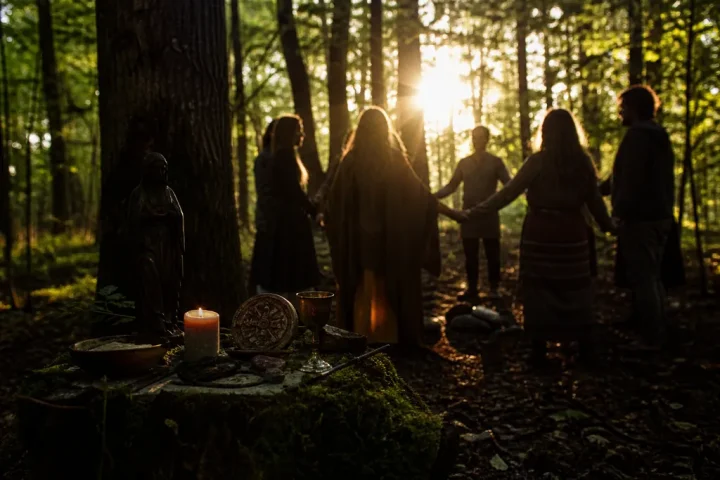
Pendderwen’s magical practice was rooted in trance, poetry, ritual drama and communication with nature spirits and fairies. His spirituality was not merely intellectual or symbolic; it was experiential, artistic and deeply tied to the land. He was known to withdraw early from company and spend much of the night alone in trance or contemplation. For Pendderwen, poetry, song and ritual were not separate arts. They were different expressions of sacred communication.
He attended California State University at Hayward, where he majored in theatre and earned a Bachelor of Arts degree. He later enrolled in a Master of Fine Arts programme, though he apparently did not complete it. His interest in theatre was not primarily modern or commercial. He was drawn instead to dromenon: drama in its older form as religious action, mystery performance and ritual enactment. He also learned Welsh, which led to a long correspondence with a friend in Wales and deepened his interest in Celtic nationalism, language and cultural identity. Pendderwen was active in historically oriented groups, including the Society for Creative Anachronism, where he served as Court Bard for the Kingdom of the West.
In 1970, with Alison Harlow, an initiate of the Faery Tradition and fellow member of the Society for Creative Anachronism, Pendderwen founded Nemeton in Oakland. The word Nemeton means “sacred grove” in Welsh, and the organisation was originally intended as a Pagan networking body. In 1974, Nemeton published three issues of Nemeton magazine before the publication ceased. The wider organisation, however, had influence beyond the magazine itself. Regional secretariats of Nemeton spread across the United States and played an important role in early Wiccan and Pagan networking. In 1978, Nemeton merged with the Church of All Worlds and became its publishing arm.
Pendderwen’s first recording, Songs of the Old Religion, appeared in 1972 and brought him recognition within the Pagan community. The recording included songs for the Sabbats, the seasons and devotional love songs to the Goddess. Through this work, Pendderwen helped give modern Paganism a musical and bardic voice. His songs were not merely entertainment; they functioned as ritual material, devotional poetry and communal memory.
He was briefly married and later divorced. For a time he earned his living through federal employment, working for the Internal Revenue Service and the Department of Health, Education and Welfare. He did not, however, find the restrictions of bureaucratic life compatible with his temperament or spiritual calling. A journey to the British Isles became a turning point. There he met his Welsh correspondent, Deri ap Arthur, and encountered figures involved in the British Wiccan movement, including Alex Sanders and Stewart Farrar. It is likely that material from the Alexandrian tradition reached Pendderwen through this contact, and some Alexandrian elements were later incorporated into the developing Faery Tradition by Pendderwen and Anderson.
During his time in Wales, Pendderwen attended the Eisteddfod, the traditional gathering of bards devoted to Welsh music, poetry and drama. He was deeply moved when he was honoured onstage as a foreigner of Welsh descent. In Ireland, on Tara Hill, he experienced a powerful and frightening vision of the Morrigan, associated with the ancient Irish war goddess Badb. This vision strengthened his identification with the archetype of the sacred king, a figure who joins poetic inspiration, sovereignty, sacrifice and responsibility to the land.
Upon returning to the United States, Pendderwen left his federal job and moved to Annwfn in Mendocino County. There he lived in a simple cabin without electricity, with only a cat for company. He learned carpentry, gardened, wrote, composed and pursued a life that was both austere and visionary. During this period he increasingly identified with the Green Man, the figure of wild fertility, vegetation and ecological renewal. He began holding winter tree plantings on his own land and neighbouring land. This practice eventually developed into Forever Forests, founded in 1977 to sponsor annual tree plantings and encourage ecological awareness as a magical process in harmony with Mother Earth.
In 1980, Pendderwen emerged from seclusion to appear in concert and ritual at the first Pagan Spirit Gathering. During the final two years of his life, he became more publicly active again, organising Pagan gatherings, sponsoring tree plantings and participating in antinuclear demonstrations. In 1982, he was arrested for civil disobedience with members of Reclaiming, including activists connected with Starhawk, during a demonstration at Lawrence Livermore Laboratory in California.
Pendderwen attempted to create an extended family and spiritual community at Annwfn, but financial hardship and personal tensions made this difficult. His vision of Pagan community was ambitious, land-based and emotionally demanding. It required not only shared belief, but shared labour, loyalty and endurance. In the autumn of 1982, Pendderwen was killed in an automobile accident. He was only thirty-six years old.
Pendderwen’s published works, all issued through Nemeton, include Wheel of the Year (1979), a songbook of music and poems produced with the assistance of P. E. I. Isaac Bonewits, Craig Millen and Andraste; The Rites of Summer (1980), two musical fantasies performed at the 1979 Summer Solstice gathering at Coeden Brith, a 200-acre wilderness property owned by Nemeton and adjacent to Annwfn; and The Faerie Shaman (1981), a collection of songs centred on trees, rural life, British Isles history and Pendderwen’s love for Wales.
Much of his poetry, ritual writing and liturgical material remains unpublished. His influence, however, survived through those who sang his songs, used his rites, remembered his presence and carried forward the bardic and ecological dimensions of modern Paganism. Pendderwen represents a distinct kind of Pagan founder: not only a teacher or organiser, but an artist-priest whose work joined music, myth, land, language and spiritual experience.
In 1978, Forever Forests merged with the Church of All Worlds. In 1987, the Church of All Worlds took over the magical and ritual dimensions of the work, while Forever Forests became more narrowly focused on tree planting, environmental work and reforestation projects.
For students of modern Witchcraft, Pendderwen remains significant because his life illustrates the importance of art within magical tradition. His work shows that contemporary Paganism was not shaped only by books, covens and ritual systems, but also by songs, poetry, gatherings, ecological action and the longing to restore sacred relationship with the land.
Continue Your Path in the Occult World Community
If the life and work of Gwydion Pendderwen speak to you, it may be because modern Witchcraft is not only about spells. It is also about myth, land, poetry, ritual, ancestry, transformation, and spiritual discipline.
Inside the Occult World Mystery School, you are invited to go deeper into the living current of magical practice. This is a space for those who want more than surface-level occult content.
Here, you can explore Witchcraft, Paganism, ritual work, spiritual protection, symbolism, magical history, and the inner development required to walk this path with seriousness and power.
Join the Occult World Mystery School and begin building your own practice with structure, depth, and spiritual focus.
This is where study becomes devotion, and devotion becomes a living path.
See also :
Further Reading :
- Adler, Margot. Drawing Down the Moon. revised ed. New York: Viking, 1986.
SOURCE:
The Encyclopedia of Witches, Witchcraft and Wicca – written by Rosemary Ellen Guiley – Copyright © 1989, 1999, 2008 by Visionary Living, Inc.

Follow