

Maria Padilha: Queen of Pomba Gira
In the sixteenth century, Portugal became the first European nation to deport Roma people, often historically referred to as Gypsies, first to its colonies in Africa and later to Brazil. With them travelled the legend and spirit-current of Maria de Padilla, the powerful Spanish figure whose name would eventually transform in Brazil into Maria Padilha, one of the most famous and commanding manifestations of Pomba Gira.
In Brazilian spiritual traditions, Maria Padilha emerges as a queenly, seductive, dangerous and deeply magnetic spirit. As an Exua, she is often described as the bride or female counterpart of Exu, a powerful spirit of crossroads, communication, desire, movement and spiritual exchange. In Catholic-influenced interpretations, Exu has sometimes been identified with Satan, and because of that association, Maria Padilha has also been viewed through a controversial and often demonised lens.
Yet, like many powerful female spirits, Maria Padilha cannot be reduced to one simple image.
She evokes strong and contradictory reactions. Some devotees worship her as a queen, goddess and protector. Others fear her as a diabolical seductress or identify her with Satan in the form of a beautiful woman. Still others embrace precisely that dangerous, transgressive persona and venerate her all the more because she stands outside polite religious boundaries.
From Maria de Padilla to Maria Padilha
The Portuguese spelling Padilha corresponds to the Spanish Padilla, and both are pronounced in the same way: pa-DEE-yah.
The historical Maria de Padilla was associated with royal love, scandal, denied status and powerful feminine presence. In Brazil, her image underwent a dramatic transformation. She became Rainha Maria Padilha, Queen Maria Padilha, a spirit who no longer waits for recognition from kings, priests or society. She claims her throne openly.
Whatever rage, longing or denied dignity may have surrounded the original Maria de Padilla is fully expressed in her Brazilian spiritual form. Maria Padilha is not meek, silent or submissive. She is commanding, sensual, volatile and regal. She expects to be treated with honour, beauty, elegance and consistency.
Her behaviour is often said to depend on how she is perceived and invoked. If approached as a devilish figure, she may reflect that expectation with fierce theatricality. If approached with respect, devotion and sincerity, she may reveal herself as a protective and generous spirit of tremendous power.
A Goddess of Desire, Crossroads and Power
Maria Padilha is strongly associated with sexuality, beauty, pleasure, luxury, seduction and desire. She is often described as a sex goddess or Tantric-style goddess, not in the sense of sexuality for procreation, but sexuality as power, pleasure, magnetism and sovereignty.
Although she can bless devotees with fertility, her primary sphere is erotic force, attraction, confidence, glamour and the power to command attention. She rules over the kind of desire that changes destinies, opens doors, breaks taboos and exposes hidden truths.
As a crossroads goddess, Maria Padilha is also a spirit of direction and opportunity. She is invoked by devotees seeking help with love, sex, money, protection, influence and the removal of obstacles. Her power is not gentle in the sentimental sense. She is believed to cut through stagnation, expose weakness, punish disrespect and force movement where life has become trapped.
She is also invoked for protection in matters of sexuality, including protection from unwanted pregnancy, disease and sexual abuse. In this aspect, she is not merely a spirit of seduction, but a guardian of bodily sovereignty, sexual power and feminine survival.
The Temperament of Maria Padilha
Maria Padilha is generous, but she is not patient. She is protective, but she is not passive. She may be loving, but she is never weak.
She expects offerings, promises and respect to be taken seriously. Devotees often describe her as a queen who responds well to beauty, elegance, confidence and clear petitions. She dislikes carelessness, empty promises and disrespect. If a devotee asks for her help and promises to return with offerings, the promise should not be forgotten.
Her colours are traditionally red and black, expressing passion, night, sexuality, blood, fire, danger and the crossroads. She is associated with beautiful clothing, perfumes, champagne, roses, cigarettes, mirrors, jewellery and other symbols of sensual power and queenly pleasure.
Offerings and Traditional Devotion
Maria Padilha may be venerated at a domestic altar, but offerings are traditionally brought to three-way crossroads, especially T-shaped or Y-shaped crossroads, after dark. Since most modern crossroads are ordinary traffic intersections, offerings are often placed safely at the side of the road rather than in the road itself. In some traditions, offerings may also be left at the foot of the large cross in a traditional cemetery.
Traditional offerings may include red and black cloths, red candles, champagne, anisette, cigarettes or cigarillos, fresh matches or a lighter, and beautiful red roses. Seven is an important number in many offerings to her, especially seven red candles or seven roses.
The roses are traditionally long-stemmed and red, with the thorns removed by hand. If roses are unavailable or too expensive, red carnations may be given instead. The important element is not only the object itself, but the attitude behind it: beauty, respect, effort and sincerity.
Devotees petition Maria Padilha directly and clearly. She is not a spirit for vague requests. She is traditionally told exactly what is desired, and the devotee may promise to return with more luxurious offerings when the petition is fulfilled. Because she is known for impatience, it is customary to be specific and respectful when making promises.
In places where it is unsafe, illegal or socially unacceptable to leave burning candles outdoors, devotees may stay until the candles burn out, use smaller candles, or respectfully explain why the candles must be extinguished and relit safely elsewhere.
The Power of Maria Padilha
Maria Padilha represents the power of the woman who refuses to disappear. She is the lover, the queen, the witch, the crossroads spirit, the seductress, the protector and the avenger. She is glamour and danger, generosity and wrath, pleasure and command.
Her myths speak to those who have been denied dignity, silenced, shamed or told to make themselves smaller. She embodies the force that rises anyway, crowned in red and black, laughing at fear, demanding respect and opening the roads for those brave enough to approach her properly.
To study Maria Padilha is to enter the world of Pomba Gira: a world of crossroads, sexuality, spirits, offerings, ancestral memory, feminine power and magical negotiation. She is not a spirit to be trivialised. She is a queen, and she expects to be honoured as one.
ALSO KNOWN AS:
Maria of the Seven Crossroads
ORIGIN:
Brazil
FAVOURED PEOPLE:
Women, cross-dressers, prostitutes, sex workers
MANIFESTATION:
A beautiful, glamorous woman. She may be crowned or in various states of undress.
ICONOGRAPHY:
Maria Padilha is portrayed as a beautiful Gypsy or a naked, red-horned devil-woman.
Consort:
Officially Exu, but she is often paired with the orisha Ogun, at least in magic spells.
Bird:
Black pigeon ideally with red legs
Days:
Monday, Friday
COLOURS:
Black, red
Incense:
Dragon’s blood
Number:
7
OFFERINGS:
Seven red roses, seven red carnations, anisette, champagne, cigarillos, Nat Sherman red or black cigarettes, perfume, ornaments and hand mirrors fit for a queen, sex toys
Enter the Occult World Mystery School
If Maria Padilha fascinates you, the Occult World Mystery School is where you can go deeper into the living mysteries of witchcraft, spirit work, folk magic and occult power.
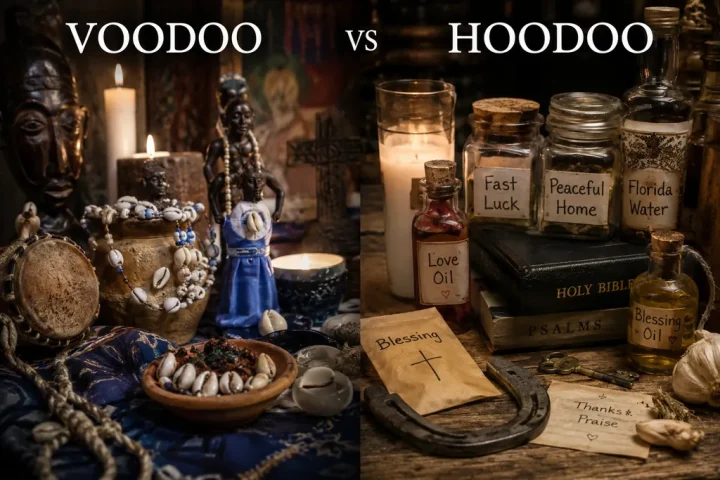
Inside the community, you can study witchcraft, explore Voodoo and Hoodoo, enter the Demonology course, study Black Magick, and work through the Ancient Grimoires Course. You can learn about spirits, crossroads magic, offerings, protection, ritual practice, magical traditions and the hidden forces that shape the occult world.
This is a place for serious seekers, practising witches, students of spirit work and occultists who want more than surface-level information. You can meet fellow occultists, ask questions, study powerful traditions and deepen your understanding of figures such as Maria Padilha, Pomba Gira, Exu, Baron Samedi and other spirits of the crossroads and the unseen.
Join the Occult World Mystery School and step deeper into witchcraft, spirit work, crossroads magic, ancient grimoires, black magick and living occult knowledge.
SEE ALSO:
- Exu
- Ogun
- Maria de Padilla
- Pomba Gira
SOURCE:
Encyclopedia of Spirits: The Ultimate Guide to the Magic of Fairies, Genies, Demons, Ghosts, Gods & Goddesses – Written by Judika Illes Copyright © 2009 by Judika Illes.




Follow