
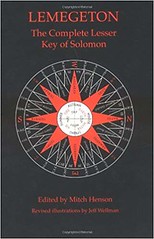
The Ars Theurgia is the second book of the Lemegeton, also known as the Lesser Key of Solomon. The word theurgia comes from a Greek root meaning “sacramental rite” or “mystery.” Theurgy is a form of magick that involves the invocation of beneficent spirits and was originally practised by the Neo-Platonists.
During the Renaissance, theurgy came to be associated with white magick, in contrast to the Goetic arts, which were usually regarded as black magick.
The Spirits of the Compass
The Ars Theurgia contains an extensive list of demons and spirits associated with the points of the compass. These spirits are arranged in hierarchies, with each hierarchy connected to one of the cardinal directions.
Each cardinal direction is ruled by an infernal emperor. Beneath these emperors are demonic princes, kings and dukes who rule over more specific directions, such as northwest or south-by-southeast.
The spirits of the Ars Theurgia are believed to govern the portion of the compass assigned to them. When called, they are thought to be found in that direction. Their positions are considered fixed.
Wandering Spirits
In addition to the spirits connected with fixed directions, the Ars Theurgia also names wandering spirits. These are described as princes and dukes who are not bound to one specific point of the compass.
Instead, they move from place to place with their courts.
This gives the Ars Theurgia a more complex spirit geography than a simple list of demons. Some spirits are fixed rulers of direction; others are mobile powers, travelling with their attendants through the airy regions.
Spirits of the Air
The demons of the Ars Theurgia are presented as spirits of the air.
Because of their airy and subtle nature, they are not thought to be clearly visible to the naked eye. For this reason, they are usually invoked into a scrying glass or a specially prepared crystal known as a show-stone.
This is an important detail, because Dr John Dee also used a crystal show-stone in his work with the Enochian spirits. The use of a crystal or glass reveals the visionary and scrying-based nature of this type of spirit communication.
Elemental and Temporal Associations
Although the spirits of the Ars Theurgia are generally associated with air, many of them also have connections with other elements.
They are also often bound to specific hours of the day or night. Most courts include spirits connected with both daylight and nocturnal hours, suggesting a carefully organised system of timing, hierarchy and ritual approach.
This means that the Ars Theurgia is not merely a catalogue of names. It is a structured magical system based on direction, rank, timing, elemental nature and method of manifestation.
Date and Origins
The exact date of the material in the Ars Theurgia is unknown.
Within the Lemegeton, only the book known as the Almadel contains an internal date that helps establish when at least one version was copied. The Almadel in the Sloane collection at the British Museum is dated to 1641.
Of the five books traditionally included in the Lemegeton, the Goetia is arguably the oldest. There are also strong connections between the Goetia and the Ars Theurgia, especially in their use of demonic seals or sigils for the invocation of spirits.
Connection with Trithemius
One of the most important facts about the Ars Theurgia is that all of its major spirits appear in Johannes Trithemius’s Steganographia.
The descriptions of many of these spirits, including their directional associations and the numbers of their dukes and sub-dukes, are very similar, and in some cases almost identical, in both texts.
This places the establishment of this spirit system at least as early as the late fifteenth century, if not earlier.
The Ars Theurgia therefore stands at a fascinating crossroads between Solomonic magic, Renaissance occultism, spirit hierarchies, angelic and demonic classification, scrying practice and the magical geography of the unseen world.
Why the Ars Theurgia Matters
The Ars Theurgia is important because it shows a different side of the Lemegeton.
While the Goetia is famous for its seventy-two demons, the Ars Theurgia presents a more directional and atmospheric system. Its spirits are airy, subtle and often approached through vision rather than direct physical manifestation.
It also demonstrates how carefully older magical systems organised the invisible world. Spirits were not imagined as random forces. They had ranks, directions, courts, seals, hours, elemental qualities and methods of contact.
To study the Ars Theurgia is to study a map of the invisible atmosphere: a world of emperors, princes, kings, dukes and wandering spirits moving through the compass of occult power.
Continue Your Study Inside the Occult World Mystery School
The Ars Theurgia is not a subject for shallow curiosity. It belongs to the deeper architecture of ceremonial magick, Solomonic spirit work, grimoires, scrying, demonic hierarchy and the hidden geography of the unseen world.
Inside the Occult World Mystery School, you can go further into the Lemegeton, the Goetia, Ars Theurgia, ancient grimoires, demonology, black magick, witchcraft, Luciferian currents, spirit communication, sigils, seals, protection work and ritual practice.
This is where serious occultists meet.
You can study structured courses, access the Occult World Library, ask questions, connect with fellow witches, Luciferians, demonology students and magical practitioners, and explore these old systems with more depth and discipline.
The Ars Theurgia maps spirits by direction.
The Skool community gives you direction in your study.
Join the Occult World Mystery School and continue your path into grimoires, demonology, witchcraft, black magick, Solomonic spirits and the deeper mysteries of occult power.
SEE ALSO:
SOURCE:
The Dictionary of Demons: Names of the Damned by Michelle Belanger


Follow