
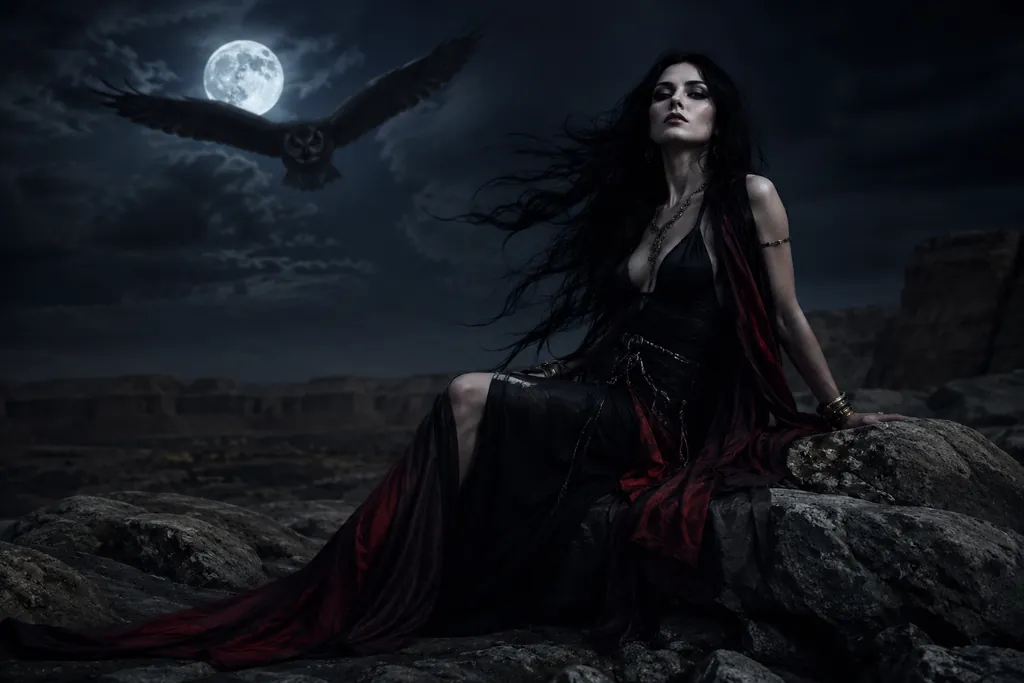
Lilith : Screech Owl; Beautiful Maiden; Dark Maid; Flame of the Revolving Sword; Maid of Desolation; Night Demon; Hand of Inanna; The Night Witch; The Howler
Lilith: First Woman, Night Demon and Queen of the Wilderness
Few supernatural beings possess a history as ancient, contradictory and continually evolving as Lilith. Across thousands of years, she has appeared as a wind spirit, a night demon, a seductress, a strangler of children, a queen of demons, a guardian of women and a symbol of uncompromising freedom.
She belongs simultaneously to Mesopotamian mythology, Jewish folklore, Kabbalah, demonology, magic, witchcraft and modern occultism. Yet no single religion, culture or magical tradition has ever succeeded in defining her completely.
Among her many names and titles are the Screech Owl, the Beautiful Maiden, the Dark Maid, the Maid of Desolation, the Night Demon, the Night Witch, the Howler, the Hand of Inanna, the Lady of the Beasts and the Flame of the Revolving Sword. Each title reveals a different aspect of a spirit who exists between beauty and terror, fertility and death, sexuality and destruction, exile and divine power.
Lilith is frequently described as a female demon of the night and a succubus who flies through the darkness searching for sleeping men to seduce. She is also said to enter homes in pursuit of women in childbirth and newborn infants. In some traditions, she strangles children, drinks from their breasts or navels and attacks the young of animals.
Yet Lilith is far more than a simple demoness. She is one of the most primordial and powerful spirits in occult tradition, and she remains one of the most modern. She refuses submission, breaks boundaries and escapes every attempt to classify, control or contain her.
For some, she is a terrifying supernatural enemy who must be driven away with charms and amulets. For others, she represents the wild feminine, sexual sovereignty and the courage to leave any place where equality is denied.
The Ancient Origins of Lilith
The roots of Lilith’s mythology reach back to ancient Mesopotamia. Spirits known as lilû, lilītu and ardat lilî appear in Babylonian and Assyrian magical traditions. These beings were associated with the wind, the night, erotic dreams, illness, infertility and dangers surrounding childbirth.
Later occult interpretations also connected Lilith with the Sumerian goddess Inanna and the myth of the Huluppu Tree. In this story, Inanna cares for a sacred tree, intending eventually to use its wood to create a throne and a bed. However, supernatural beings make their homes within it. A serpent settles among its roots, a strange bird nests in its branches and a female spirit takes residence in its trunk.
This female being is often identified in later writings as Lilith, although the precise translation and historical identification remain debated.
When the tree is cut down, Lilith abandons her dwelling and flees into the wilderness. The episode reflects a theme that follows her throughout history. As human beings move towards agriculture, cities, hierarchy and regulated sacred spaces, Lilith remains connected with forests, deserts, caves, wild animals and the uncultivated places beyond civilisation.
She is described as a wind spirit, but her associations extend far beyond the air. She inhabits trees, ruins, wells, latrines, doorways and lonely places. Lilith belongs to the threshold where the familiar world ends and the wilderness begins.
Lilith in the Hebrew Bible
Lilith’s name appears only once in the Hebrew Bible, in Isaiah 34:14. The passage describes a ruined and desolate landscape inhabited by wild creatures and beings of the night.
The exact meaning of the Hebrew word is uncertain. It has been translated as a night creature, a night monster or a screech owl. Later Jewish tradition interpreted the word as the name of a specific female demon.
Her association with the screech owl became one of Lilith’s defining characteristics. The numerical value of her name was connected with the Hebrew word for “screech”, leading to titles such as the Demon of Screeching and the Princess of Screeching.
Lilith was sometimes imagined as an owl-like creature that could not tolerate daylight. In other accounts, she appeared as a beautiful woman whose true demonic or animal nature remained concealed.
Her appearance in Isaiah is brief and ambiguous, but later folklore transformed her into one of the most recognisable figures in Jewish demonology. She became the spirit who moves through darkness, enters bedrooms, disturbs sleepers and threatens those who are most vulnerable.
Lilith as Adam’s First Wife
Lilith is best known as Adam’s first wife, although this story does not appear in Genesis itself. It developed through later Jewish folklore and became especially influential through the medieval work known as the Alphabet of Ben Sira.
The story attempts to reconcile two descriptions of the creation of humanity found in Genesis. In one passage, male and female appear to be created together. In another, Eve is created later from Adam’s rib.
According to the Lilith tradition, the first woman was created simultaneously with Adam. Some versions say that Adam and Lilith were created as twins joined together at the back before being separated. Others state that both were formed independently from the same earth.
A darker variation claims that although Adam was made from pure dust, Lilith was formed from filth and impure sediment. This difference was later used to explain her supposedly rebellious and demonic nature.
Adam and Lilith were in conflict from the beginning. Lilith refused to accept Adam’s authority, particularly during sexual intercourse. She would not continually lie beneath him because she believed their common origin made them equals.
When Adam insisted upon dominance, Lilith refused to submit. She pronounced the ineffable name of God, rose into the air and flew away from Eden.
Her departure has sometimes been described as the first divorce. Lilith chose exile rather than remain in a paradise where she was expected to accept an inferior position.
Adam complained to God that his wife had deserted him. Three angels were sent to find her and command her to return. Their names appear in different forms, including Sanvi, Sansanvi and Semangelaf.
The angels eventually found Lilith near the Red Sea, where she had made her home among demons and spirits. They threatened her with severe punishment if she refused to return to Adam. According to the legend, one hundred of her demonic children would die every day.
Lilith still refused.
She accepted exile and the death of her children rather than surrender her independence. In response, she vowed to attack women during childbirth, newborn infants and men who slept alone.
However, she was compelled to swear that she would leave a mother or infant unharmed whenever she saw an amulet displaying the names or images of the three angels.
This legend made Lilith both a terrifying demoness and a powerful figure of resistance. Traditional demonology emphasised the violence and vengeance that followed her rebellion. Modern occult interpretations often focus instead on the refusal itself: Lilith would not accept domination, even when the price of freedom was exile.
The Queen of the Desert
After leaving Eden, Lilith became associated with the Red Sea, the desert and the wilderness beyond the boundaries of human civilisation. Some traditions call her the Queen of Zemargad, while others simply describe her as the Queen of the Desert.
There she was believed to unite sexually with demons and produce countless supernatural offspring. These beings became known as the lilim.
The daughters of Lilith were said to practise sorcery, seduction and strangulation. They entered dreams, preyed upon sleeping men and threatened women and infants. Some accounts describe them as hairy beings whose faces and bodies were covered with hair, although their heads were strangely bare.
Lilith’s connection with the wilderness reflects her resistance to domestication. Eden represented divine order, marriage and hierarchy. The desert offered danger, freedom and the absence of human authority.
She became Lady of the Beasts, ruling over wild animals and the animal side of human nature. She governs hunger, instinct, sexuality, rage and the impulses that society attempts to suppress.
Lilith and Samael
Lilith eventually became the bride of Samael, a powerful angelic adversary associated with death, accusation and the Devil. In other traditions, her partner is named Ashmodai or Asmodeus.
Their union was supposedly arranged by a mysterious being known as the Blind Dragon. This entity was said to have been castrated so that its own offspring could not multiply and overcome the world.
Lilith and Samael form a dark counterpart to Adam and Eve. Where Adam and Eve represent the human couple within the order of creation, Lilith and Samael embody the forces that exist beyond or beneath that order.
In a text preceding the Zohar, Lilith and Samael are described as androgynous twins born joined together from an emanation beneath the throne of glory. They are the lower or shadowed reflection of another androgynous pair: Adam and Eve.
Yet Lilith’s position in mystical tradition is never entirely consistent. Although she is often described as Samael’s demonic consort, another extraordinary tradition places her beside God following the exile of the Shekhina.
In this interpretation, Lilith becomes God’s temporary consort and therefore one of the most powerful intercessors imaginable. She sits close enough to the divine throne to whisper directly into God’s ear.
The image is deeply paradoxical. Lilith can be the bride of the Devil and the companion of God, the queen of demons and a heavenly intercessor. She belongs to the lowest shadow of creation while remaining capable of approaching its highest throne.
Lilith in the Zohar
The Zohar, one of the foundational works of Jewish mysticism, presents Lilith as a being connected with the Kelippot, the shells or husks that surround and conceal divine light.
She arises from an evil shell created during the waning of the Moon. According to a Kabbalistic legend, the Sun and Moon were originally equal in power. Rivalry developed between them, and God resolved the conflict by diminishing the Moon and giving it dominion over the night.
Lilith emerged from the resentment, darkness and imbalance of the diminished Moon. Her power is therefore strongest during the dark lunar phase, when the Moon’s visible light has disappeared.
She is described as having the upper body of a beautiful woman and a lower body composed of fire. She waits beneath doorways, near wells and in unclean or abandoned places, watching for men whom she can seduce.
The Zohar describes her beauty in elaborate detail. Her hair is long and red like a rose, her cheeks are pale and flushed, and she is decorated with jewellery, cords and ornaments from the East. Her mouth is narrow and attractive, her lips are red and sweet, but her tongue is sharp like a sword.
She is dressed in scarlet and adorned with thirty-nine ornaments. Her words are smooth like oil, and her appearance conceals the destructive nature beneath her beauty.
Men who sleep alone are considered especially vulnerable to her.
Lilith and Leviathan
The Zohar also describes Lilith as a female aspect of Leviathan. She is the Tortuous Serpent, while the male Leviathan is the Slant Serpent.
In this serpent form, Lilith becomes associated with the temptation of Eve and the forbidden fruit of knowledge. Some traditions claim that Lilith herself was the serpent in Eden who persuaded Eve to eat the fruit.
She is also accused of encouraging Eve to seduce Adam while menstruating and therefore ritually impure. These stories place Lilith at the centre of the Fall, transforming her into the hidden feminine force behind the loss of paradise.
As serpent, woman and demoness, Lilith becomes the guardian of forbidden knowledge. She offers revelation, but that revelation carries consequences. Knowledge may free, awaken or transform, yet it can also destroy innocence and separate the seeker permanently from the world they once knew.
Seductress of Sleeping Men
As a succubus, Lilith enters the dreams of sleeping men and arouses them sexually. Nocturnal emissions were sometimes interpreted as evidence that she had visited during the night.
The resulting seed was believed capable of producing demons rather than human children. Any seed spilled outside its intended reproductive purpose, even within marriage, was considered vulnerable to capture by Lilith and the creation of lilim.
After the Fall, Adam is said to have spent 130 years separated from Eve. During this period, Lilith visited him in his sleep and satisfied him sexually. One curious legend claims that they produced a son who became a frog.
These beliefs reflect ancient fears surrounding sexuality, dreams, involuntary bodily experiences and the perceived loss of reproductive power. Lilith became the personification of desire that operated beyond conscious control.
In later occultism, her sexual aspect was interpreted in a different way. Rather than being seen solely as a predator, Lilith became a spirit of erotic power, sacred sex and freedom from sexual shame.
She is said to despise sanctimonious people and punish the prudish, especially those who publicly condemn desires they secretly pursue. She ensnares hypocrites because they deny the very instincts over which she rules.
Lilith demands honesty. She exposes the desires, fears and contradictions hidden beneath respectable appearances.
The Enemy of Mothers and Infants
One of Lilith’s most feared roles was that of a demon who attacked women during childbirth and threatened newborn children. She was blamed for miscarriage, stillbirth, infertility, crib death and unexplained illnesses affecting mothers or babies.
Some traditions claimed that she sucked the breasts or navels of children. Others described her drinking from the udders of goats or preying upon young animals.
Male infants were considered especially vulnerable during the first week after birth, while girls remained at risk for the first three weeks.
Families therefore surrounded mothers and children with protective charms. A magic circle might be drawn around the lying-in bed, while amulets were placed in every corner of the room. These inscriptions frequently included the names of Adam, Eve and the three angels who had confronted Lilith near the Red Sea.
A common charm instructed the spirit directly, declaring that Adam and Eve were present and that Lilith must remain outside. Another requested that the newborn child be protected from all harm.
If a child laughed while sleeping, it could be interpreted as a sign that Lilith was nearby. Lightly tapping the child on the nose was believed to make her disappear.
Knives, bells, iron objects and magical hands inscribed with protective words were also used. Frogs were sometimes regarded as protective creatures capable of driving Lilith away.
Lilith and the Prophet Elijah
According to another Jewish magical tradition, Lilith once encountered the Prophet Elijah. Elijah immediately recognised her and demanded to know where she was going.
Lilith admitted that she intended to enter a house and harm a woman during childbirth or attack her newborn baby. Elijah confronted her and compelled her to reveal the names and magical methods that could protect families from her influence.
Lilith disclosed a series of secret names and promised that she would not cause harm wherever these names were written, displayed or spoken.
Some traditions claim that she revealed thirteen names, while others give seventeen. Because the story circulated through different manuscripts, languages and communities, the spellings vary greatly.
Names attributed to Lilith include Abeko, Abito, Abnukto, Amizo, Ayil, Batna, Bituah, Elio, Ik, Ils, Ita, Izorpo, Kali, Kea, Kakash, Matruta, Odam or Odem, Prtsa, Partsha, Partashah or Partasah, Prta, Patrota or Petrota, Podo, Raphi, Strina and Tlto.
These names were written on protective amulets and incorporated into incantations. Their purpose was not necessarily to summon Lilith but to demonstrate knowledge of her hidden identity and remind her of the promise she had made to Elijah.
In traditional magic, learning the secret names of a spirit could give the practitioner authority over it. Naming exposed what was hidden and transformed an invisible danger into something that could be recognised, addressed and bound.
Protection Against Lilith
Lilith herself was believed to have revealed the methods capable of restraining her. This makes her mythology especially ambiguous. She is both the source of danger and the source of the knowledge needed to escape it.
Rue and iron were believed to repel her. The Seal of Solomon, particularly when made from iron or fine silver, protected against Lilith and the diseases or misfortunes attributed to her.
Another traditional protective practice involved drawing a charcoal circle upon a wall. Inside the circle were written words commanding her to leave: “Adam and Eve. Out, Lilith!”
Amulets bearing the names of Sanvi, Sansanvi and Semangelaf were placed beside beds, attached to walls or carried by mothers and children. Some included bells, knives, hands or sacred symbols.
Incantation bowls were also used throughout parts of the ancient Near East. These earthenware bowls were inscribed with spiralling magical texts intended to trap, repel or bind dangerous spirits. They were commonly buried upside down beneath floors, thresholds or corners of homes.
The Seal of Solomon was considered particularly powerful because of Solomon’s legendary authority over demons. Its six-pointed form was believed to restrain spirits that ordinary human beings could not command.
Lilith was expected to honour these signs because of the promises she had made to the three angels and to Elijah. She was dangerous, but not entirely lawless. She could be confronted through sacred names, magical knowledge and reminders of the agreements she had sworn to obey.
Destroyer and Giver of Life
Lilith’s relationship with childbirth is not completely destructive. Although feared as a killer of infants and a cause of infertility, she is also described as an angel or demoness of conception.
She can prevent fertility, but she may also bestow it. She can close the womb or open it, threaten a birth or protect it. Like many ancient spirits associated with childbirth, she governs both sides of the boundary between life and death.
This ambiguity is essential to understanding her. The same power that destroys can also create. The same spirit that threatens children can become a guardian of those she accepts as her own.
Modern devotees sometimes approach Lilith as a fierce maternal protector. She is believed to guard people who have been rejected, silenced, abused or treated as inferior, particularly those she recognises as her spiritual daughters.
Her protection is not gentle. Lilith is imagined as a spirit who will fearlessly eliminate any evil that threatens those under her care.
This interpretation does not erase the darker traditions surrounding her. Instead, it reflects the way supernatural figures evolve as cultures reconsider the meanings of femininity, motherhood, authority and power.
Lilith as the Queen of Sheba
Later legends sometimes identify Lilith with the Queen of Sheba. In one account, she attempts to seduce King Solomon.
Solomon suspects that his visitor may not be entirely human and orders the Djinn to construct a throne room with a floor made from glass. Lilith mistakes the transparent surface for water and raises her garments to cross it.
The reflection reveals that her legs are hairy and bestial.
The story reflects the ancient belief that supernatural women could present a beautiful human appearance above the waist while concealing animalistic or demonic features below. Beauty becomes a glamour that hides the wilderness beneath it.
Lilith has also been associated with Helen of Troy and other legendary women whose beauty led men towards obsession, conflict or destruction.
In medieval Europe, she was sometimes described as the wife, concubine or grandmother of Satan. Similar female night spirits appear in Iranian, Persian, Arabic, Canaanite, Teutonic, Greek, English, Asian, Mexican and Native American folklore, although these figures should not automatically be treated as identical to Lilith.
The similarities reveal how widely cultures have imagined dangerous women of the night who seduce, consume, enchant or threaten the boundaries of the household.
Lilith and the Black Madonna
Some modern occult writers have suggested that Lilith may survive within Christianity under the disguised form of certain Black Madonnas.
This connection remains speculative and should not be treated as established history. Nevertheless, it reflects the recurring image of a dark, powerful feminine presence who cannot be fully suppressed.
The Black Madonna often embodies mystery, fertility, suffering, sovereignty and the hidden face of the sacred feminine. Lilith similarly represents a female power that continues to return even after being condemned, banished or erased.
She is the suppressed goddess who refuses to disappear. When she is not honoured, she is feared. When she is excluded from the sacred story, she returns as its demon.
The Screeching Queen
Lilith’s association with the screech owl connects her with howling, lamentation and the frightening cries of nocturnal birds.
On the Day of Atonement, she is said to engage in a screeching battle with Mahalath, another female spirit and concubine of Samael. Their taunts are so violent that the earth itself trembles beneath them.
Another legend describes Lilith going into the desert on the Day of Atonement accompanied by 420 legions of demons. They march through the wilderness while she screams and howls.
Other traditions state that Lilith commands 480 hosts of destroying angels and dangerous spirits. This number is derived from calculations based on the numerical value of the letters in her name.
These stories reveal that Lilith was not considered a minor household demon. She was a cosmic queen who commanded armies and occupied an important position within the shadowed structure of creation.
Yet thirteenth-century Spanish Kabbalists also described Lilith as a ladder upon which a mystic could ascend towards prophecy.
Even within traditions that feared her, she could become a path to revelation.
Danger may become initiation. Darkness may conceal knowledge. The demon at the threshold may also be the guardian who decides whether the seeker is prepared to enter.
Lilith as Witch, Vampire and Succubus
Lilith resists every attempt to place her within a single category. Her name has become almost synonymous with the witch, yet she is also portrayed as a vampire, a succubus, an angel, a serpent and a queen of demons.
She is called the Angel of Prostitution because she rules sexuality outside conventional religious and social boundaries. She embodies desire that refuses permission and femininity that cannot be domesticated.
At the same time, she is not merely an erotic fantasy. Lilith’s sexuality is inseparable from danger, power and autonomy. Those who approach her only through desire risk failing to understand the force they invoke.
She is both seducer and devourer, the beautiful maiden and the howling creature, the lover in the dream and the flame beneath the body.
Lilith does not exist to satisfy. She confronts the seeker with hidden appetite, shame, anger and the fear of losing control.
Lilith in Modern Occultism
Modern occultism has transformed Lilith into one of the most recognisable symbols of the dark feminine.
She is invoked in witchcraft, Luciferian practice, demonolatry, sex magic, shadow work and spiritual traditions centred on personal sovereignty. For many modern practitioners, her departure from Eden represents not a fall into evil but a refusal to accept inequality.
Lilith chooses the wilderness over a paradise built upon submission.
However, reducing her to a simple feminist heroine is as limiting as reducing her to a child-killing demon. Her mythology is ancient, layered and frequently disturbing.
She represents freedom, but also vengeance. She governs fertility, but also infant death. She embodies sexuality, but also predation. She may sit beside God or sleep beside Samael. She may protect the rejected while terrifying the household.
Lilith refuses to become safe, comfortable or easily inspirational.
She forces the seeker to confront the parts of femininity, sexuality and power that society has historically feared, demonised or attempted to suppress. At the same time, she warns that liberation without awareness can become destruction.
Lilith is not simply the woman who left Adam. She is the nocturnal wind outside the walls, the cry from the wilderness, the serpent beneath the sacred tree and the presence waiting at the threshold between desire and terror.
Read Lilith – Eros and Evil Inside the Occult World Mystery School
The complete thesis Lilith – Eros and Evil has now moved to the Occult World Mystery School.
It is no longer available as hidden members-only content on this page. Members of the community can now read the thesis inside the Occult World Library and explore Lilith’s relationship with eroticism, transgression, demonology, sexuality and the darker dimensions of the sacred feminine in far greater depth.
This extensive study offers an opportunity to move beyond simplified modern interpretations and engage with the difficult, provocative and often contradictory nature of Lilith.
Continue Your Study of Lilith
Lilith cannot be understood through a single legend, an inspirational quotation or a romantic image of feminine rebellion.
Her story stretches from ancient Mesopotamia and Jewish demonology into Kabbalah, incantation magic, protective amulets, childbirth folklore, witchcraft, sexuality and contemporary occult practice.
To study Lilith is to enter a world of forbidden knowledge, spiritual exile, erotic power, rage, protection, seduction, independence and transformation.
But an article is only the beginning.
Inside the Occult World Mystery School, you can explore Lilith and the traditions surrounding her through serious occult study. You will find structured courses, an expanding digital library and a welcoming space where witches, occultists, demonology students, Luciferians, magical practitioners and seekers can exchange knowledge without reducing the occult to entertainment.
Go deeper into demonology, black magick, ancient grimoires, Luciferian currents, witchcraft, spirit work, shadow work, angels, Hoodoo, Vodou, Kabbalah, necromancy, Tarot, Lenormand, mythology and the hidden traditions that shaped the darker side of the sacred feminine.
Ask questions, share discoveries and meet others who understand the call of the unseen.
Lilith stands outside the gate.
She does not ask for permission. She does not kneel, and she cannot be confined within the boundaries others create for her.
She calls to those who are ready to confront the darkness, reclaim forbidden knowledge and explore the deeper mysteries of spiritual sovereignty.
Join the Occult World Mystery School and read the complete thesis Lilith – Eros and Evil inside the Occult World Library. Continue your journey into Lilith, demonology, witchcraft, black magick and the hidden traditions of the occult.
ALSO KNOWN AS:
Lilitu (Sumeria); Lilis (Yiddish)
ORIGIN:
Sumeria
MANIFESTATIONS:
Lilith possesses many forms, appearing as an old crone or beautiful young woman. She may appear as a woman from head to waist; flame underneath. Lilith dresses in crimson. She wears forty ornaments less one. Her hair may be black or red but it will be distinctive, either because it is beautiful or because it is disheveled or both. Amid cultures where women’s hair is traditionally bound and/or covered, Lilith’s is loose and long. She manifests in animal form too, typically as a large black cat, black dog or owl. Even when in human form, Lilith may display bird’s feet, claws or wings.
A seventh century BCE tablet from what is now Northern Syria depicting Lilith as a winged sphinx is accompanied by an incantation in a Phoenician-Canaanite dialect intended to assist birthing women: Oh, Flyer in a dark chamber, Go away now, oh Lili!
ICONOGRAPHY:
The Sumerian Burney Plaque, (circa 2300 BCE) is generally identified as Lilith. It depicts her as a winged naked bird woman holding the ring and rod of power and flanked by owls. Her taloned feet stand atop reclining lions.
ATTRIBUTE:
A flaming sword; Lilith’s myth contains mysterious references to hands:
• In Sumeria, Lilith is the Hand of Inanna.
• In the Kabbalah, Lilith is known as the Handmaid.
Decorate her altar with images of hands, especially the hand-shaped amulet called hamsa.
COLOURS:
Black, red
PLANET:
The moon is Lilith’s lantern; her power increases with the waning moon. Lilith is also the name given to three distinct space phenomena: Earth’s hypothetical second moon (Dark Moon Lilith); the apogee of the moon’s orbit (the furthest point from Earth) and an asteroid
STAR:
Algol, known in traditional Jewish astrology as “Lilith’s Star”.
ELEMENT
Lilith has associations with air, water, earth and fire. Hebrew myth has her created from earth. In Sumeria, she began her incarnation as a wind spirit. She manifests as fire. The Zohar, holy book of the Kabbalists, explains that Lilith is nourished by water while the south wind spreads her influence. Lilith is as frequently found living in wells as she is in trees.
CREATURES:
Lilith loves all wild animals but has a special affinity for jackals, hyenas, wild cats, black cats, black dogs, ostriches, snakes, dragons, spiders, and unicorns.
BIRD:
The owl is her sacred bird and messenger.
MOUNT:
Lilith rides a dragon in which form she may also manifest.
TIME:
Lilith rules solstices and equinoxes and is associated with the zodiac sign Scorpio.
FLOWER:
Lily
PLACES:
Lilith is happiest in desolate wilderness, far removed from civilization. She loves forests, crossroads, seacoasts and especially the desert. When Lilith fled from Adam, she went to dwell in a cave in the desert on the shores of the Red Sea, reputedly still her favourite place. When she approaches people, she makes homes for herself in trees and wells. Provide them for her to keep her close.
It is difficult to imagine a spirit with more media presence than Lilith. Her appearances are too innumerable to list: Lilith herself or characters named in her honour appear on stage, screen and television. She appears in poems and novels as disparate as Goethe’s Faust or Marie Corellis The Soul of Lilith. Lilith is a constant presence in comic books, most famously as Marvel Comics’ Lilith, Daughter of Dracula, which emphasizes her vampiric reputation. Lilith is also Vampirella’s mother. The television series Supernatural features a vicious killer Demon named Lilith. The subject of many paintings, she was a great favourite of Pre-Raphaelites like John Collier and Dante Gabriel Rossetti. Lilith Magazine, the feminist Jewish magazine, was founded in 1980.
OFFERINGS:
Frankincense; plates of jam; tea; doll babies and images of the animals she loves; trees; create a wilderness for her. Offerings may be placed on an altar or outside.
SEE ALSO:
SOURCES:
Encyclopedia of Spirits: The Ultimate Guide to the Magic of Fairies, Genies, Demons, Ghosts, Gods & Goddesses– Written by Judika Illes Copyright © 2009 by Judika Illes.
The Encyclopedia of Demons and Demonology – Written by Rosemary Ellen Guiley – Copyright © 2009 by Visionary Living, Inc.




Follow