
Possession is the takeover and control of a person’s mind, body, personality, or behaviour by an outside influence, such as a demon, condemned soul, ghost, spirit, deity, god, or the spirit of the dead. It is one of the oldest and most universal beliefs in religion, magic, folklore, witchcraft, mediumship, and demonology.
Possession is not always understood in the same way. In Christianity, especially in Catholic demonology, possession is usually associated with malevolent spirits under the authority of the Devil. In other traditions, possession may be temporary, sacred, voluntary, healing, prophetic, or even a sign of divine favour.
Possession must also be distinguished from obsession. Obsession is a strong influence or attachment by a spirit, but not a complete takeover. Possession is more extreme: the possessing entity dominates the victim’s behaviour, speech, body, and sometimes appearance.
Forms of Possession
Possession appears in three major forms.
First, there is involuntary possession, in which a spirit, god, demon, ghost, dead person, or other entity takes over a person or animal and causes them to act in certain ways for the entity’s own purposes.
Second, there is possession through witchcraft or sorcery, in which a person or animal is believed to be cursed, bewitched, or spiritually attacked, resulting in illness, misfortune, madness, or strange behaviour.
Third, there is voluntary possession, in which a spirit or deity is invited through ritual, trance, mediumship, prophecy, channeling, magical invocation, or religious practice. In these cases, the possession is usually temporary and ends when its purpose has been fulfilled.
Most forms of possession are not demonic. Mediums, trance prophets, shamans, channelers, priests, priestesses, and devotees in spirit-based religions may enter temporary possession states in order to communicate with spirits, receive divine messages, heal illness, prophesy, or obtain spiritual power.
Possession in Ancient Belief
Since ancient times, people have believed that gods, spirits, ancestors, ghosts, and demons can interfere in human affairs. These entities may enter or influence the body, mind, voice, emotions, or actions of a person.
Anything could be blamed on, or credited to, a possessing entity: illness, strange behaviour, sudden strength, prophetic speech, madness, inspiration, divine power, sexual desire, misfortune, addiction, or religious ecstasy.
Most possessions are temporary. They end when the possessing spirit has accomplished its goal. However, some possessions are believed to become dangerous, prolonged, or destructive. In such cases, exorcism, banishing, prayer, ritual, magical cleansing, or the intervention of a trained spiritual practitioner may be required.
Demonic Possession
Demonic possession is the takeover of a person by a demon or evil spirit. In Christian belief, the demon takes up residence in the body and influences or controls the victim’s thoughts, words, actions, and behaviour.
A possessed person may appear normal for periods of time, then suddenly enter episodes of bizarre, uncontrolled behaviour attributed to the demon. During these episodes, the victim may be entranced, violent, mocking, obscene, blasphemous, or physically altered. When the episode ends, there is usually a transition back to ordinary awareness.
In many accounts, possessed people are believed to be under the influence of more than one demon. If the demons are not expelled, they may cause extreme deterioration of health, madness, self-harm, or even death.
According to Catholic theology, demons cannot possess a person’s soul. They may possess or influence the body and mind, and they may tempt the person into actions that endanger the soul’s salvation, but the soul itself remains beyond direct demonic ownership.
The souls of the damned are also believed, in some traditions, to be capable of possessing the living in a similar way to demons.
Christian History of Possession
There are relatively few references to evil spirits in the Old Testament. When they appear, they are sometimes described as being sent by God to punish or torment people.
One example appears in 1 Samuel 16:14–16, when Saul is tormented by an evil spirit and soothed by David’s harp:
“Now the Spirit of the LORD had departed from Saul, and an evil spirit from the LORD tormented him. Saul’s attendants said to him, ‘See, an evil spirit from God is tormenting you. Let our lord command his servants here to search for someone who can play the harp. He will play when the evil spirit from God comes upon you, and you will feel better.’”
In the New Testament, demons and possession become much more prominent. The Gospels and Acts describe Jesus casting out “unclean spirits,” a practice common among healers of the time. Demons were believed to cause illness, madness, muteness, deformity, convulsions, and other afflictions.
The possessed were not usually blamed for their condition. The emphasis was on healing and liberation rather than moral guilt.
Legion and the Swine
One of the most famous possession stories is the case of the man possessed by demons who identify themselves as Legion, after a Roman military unit of about 6,000 soldiers.
When Jesus confronts the demons, they beg not to be destroyed but to be sent into a nearby herd of swine. Jesus allows it, and the pigs rush over a cliff and drown.
Luke 8:30 records the exchange:
“Jesus asked him, ‘What is your name?’
‘Legion,’ he replied, because many demons had gone into him.”
This story became one of the foundational Christian images of demonic possession: multiple spirits inhabiting a person, recognising divine authority, and being expelled through spiritual command.
Biblical Possession and Illness
Several New Testament passages connect possession with physical or mental affliction.
Luke 9:38–43 describes a boy who suffers convulsions, a condition that today may resemble epilepsy but was understood in the text as demonic affliction.
Luke 11:14 describes a person rendered mute by a demon:
“Jesus was driving out a Demon that was mute. When the Demon left, the man who had been mute spoke, and the crowd was amazed. But some of them said, ‘By Beelzebub, the prince of Demons, he is driving out Demons.’”
Luke 13:10–13 tells of a woman crippled for eighteen years by a spirit:
“On a Sabbath Jesus was teaching in one of the synagogues, and a woman was there who had been crippled by a spirit for eighteen years. She was bent over and could not straighten up at all. When Jesus saw her, he called her forward and said to her, ‘Woman, you are set free from your infirmity.’ Then he put his hands on her, and immediately she straightened up and praised God.”
Matthew 15:21–28 tells of a Canaanite woman whose daughter is suffering from demon possession:
“Leaving that place, Jesus withdrew to the region of Tyre and Sidon. A Canaanite woman from that vicinity came to him, crying out, ‘Lord, Son of David, have mercy on me! My daughter is suffering terribly from Demon-possession.’ Jesus did not answer a word. So his disciples came to him and urged him, ‘Send her away, for she keeps crying out after us.’
He answered, ‘I was sent only to the lost sheep of Israel.’
The woman came and knelt before him. ‘Lord, help me!’ she said.
He replied, ‘It is not right to take the children’s bread and toss it to their dogs.’
‘Yes, Lord,’ she said, ‘but even the dogs eat the crumbs that fall from their masters’ table.’ Then Jesus answered, ‘Woman, you have great faith! Your request is granted.’ And her daughter was healed from that very hour.”
The Devil, Demons, and Early Christian Theology
By the end of the New Testament period, demons were increasingly equated with the fallen angels cast out of heaven with Lucifer. Early Christian theologians interpreted possession as part of the Devil’s campaign against humanity.
Demons were believed to plague saints, deceive the innocent, tempt sinners, torment the weak, and use the body as a battlefield between good and evil. Prayer, charms, amulets, holy objects, and ritual protections were used to keep the Devil at bay.
Early Christians often felt that evil forces were personally active in the world. The Devil was not an abstract symbol, but a living enemy constantly seeking unsuspecting victims.
Possession in the Middle Ages
In the Middle Ages, demonic possession became a major concern of the Church. Unusual behaviour, personality change, seizures, violent outbursts, altered speech, strange illness, sexual behaviour, or rejection of religion could all be interpreted as signs of possession.
The possessed person was sometimes called an energumenus, or energumen.
During the Inquisition and witch hunts, possession became entangled with heresy, witchcraft, sorcery, and accusations of diabolical activity. A possessed person might be seen as a victim, but a suspected witch could be accused of sending the demon.
The Devil was believed to enter a person either directly or through the actions of witches and wizards. Witches were said to transmit demons through charms, philtres, amulets, potions, cursed objects, or food.
Witchcraft, Food, and Demonic Entry
Food was one of the most feared vehicles for possession. A witch could allegedly hide demonic influence in something ordinary and harmless, allowing the demon to enter the victim through eating.
Pope Gregory the Great, in his Dialogues, tells of a servant girl who became possessed after eating lettuce leaves from a garden. A devil had supposedly been sitting on one of the leaves when she ate it. The demon complained that it had been innocently swallowed, but it was exorcised anyway.
Apples were considered especially dangerous because of their symbolic connection with the Fall of Adam and Eve. The French demonologist and witch judge Henri Boguet regarded apples as a favourite hiding place for the Devil.
In Discours des sorciers, published in 1602, Boguet wrote:
“In this, Satan continually rehearses the means by which he tempted Adam and Eve in the earthly paradise,”
He also described a case in Annecy, Savoy, in 1585, where townspeople became alarmed by an apple that gave out a “great and confused noise.” Believing the apple was full of demons, they pushed it into a river.
Witch Hunts and Social Margins
During the witch hunts, many people accused of causing possession were old, poor, socially marginal, physically deformed, argumentative, or simply disliked. Women, midwives, widows, and those on the edges of village life were especially vulnerable.
Julio Caro Baroja observed in The World of the Witches:
“there is a deep-rooted belief in various parts of Europe in the existence of people who quite involuntarily bring ‘bad luck’ (mal fario) . . . or have the ‘Evil Eye.’ . . . panish writers of the 16th and 17th centuries worked out theories that the ‘Evil Eye’ was the result of the presence of certain harmful properties in the eye or in other parts of the body of certain types of people . . . more particularly through those of elderly spinsters, cripples and certain types of sick people.”
Such people were not always thought to be deliberately evil. Sometimes they were believed to carry harmful power involuntarily. Facial deformity, disability, illness, or old age could be interpreted as marks of the Devil. The article compares this fear to the way the Elephant Man of nineteenth-century London was mocked and feared.
Every time a child sickened, livestock died, crops failed, or someone had seizures, communities often searched for a witch to blame.
Possession Epidemics
From the fifteenth through eighteenth centuries, epidemics of demonic possession appeared in Europe and the American colonies. Many famous cases involved nuns or children.
Modern scholars often interpret some of these episodes through hysteria, repression, social pressure, trauma, group psychology, or repressed sexuality. In earlier centuries, however, they were usually interpreted as attacks by demons, often sent by witches.
Famous possession cases include:
Nicole of Laon, whose possession by Beelzebub was used to attack French Huguenots
The possessions at Aix-en-Provence
The possessions at Louviers
The possessions at Lille
The possessions at Loudun
The Warboys Witches
The Salem witchcraft hysteria of 1692
The Salem witch trials were triggered partly by the fabricated stories and strange behaviour of “possessed” children.
The famous Loudun possession case, involving Jeanne des Anges and Urbain Grandier, later became a subject of controversy. Some supposed holy relics that triggered convulsions were found to be ordinary objects, and ten years after Grandier’s death, a visitor named Monconys claimed that the “blood” of Jeanne des Anges’s stigmata was merely red paint.
The Rituale Romanum
In 1614, the Catholic Church issued the Rituale Romanum, standardising ritual procedures, including the formal rite of exorcism for demonic possession.
This rite framed exorcism as a spiritual battle between the forces of good and evil. Revisions have been made over time, but the Roman ritual continues to influence Catholic exorcism practice.
Only a priest, preferably one trained in exorcism and authorised by the Church, may perform the formal Catholic rite.
The Protestant Reformation rejected some Catholic ideas about possession and exorcism, but in the sixteenth and seventeenth centuries, possession cases became part of Catholic-Protestant conflict. Exorcisms could serve as public demonstrations of religious power, used to sway believers and win converts.
Causes of Demonic Possession
According to Catholic teaching, the chief causes of demonic possession include:
Making a pact with the Devil or demons
Participating in occult or spiritualist rites
Using divination devices such as a Ouija board
Dedicating or offering a child to Satan
Being the victim of witchcraft, a spell, or a curse
Leading a deliberately sinful life
Such actions are believed to give demons a right or license to take up residence.
Modern occultists have also warned that people may become vulnerable to evil spirits by “toying with the supernatural,” especially through uncontrolled automatic writing or reckless spirit contact.
Mental illnesses such as schizophrenia or dissociative identity disorder are not officially considered by the Catholic Church to be caused by possession. The Church distinguishes between mental illness and true demonic possession, though this distinction has often been difficult in practice.
Catholic theology teaches that God may allow possession for various reasons, including to demonstrate the truth of the faith, punish sinners, confer spiritual lessons, or produce teachings for humanity.
Signs of Demonic Possession
The Catholic Church traditionally identifies several major signs of true possession:
Superhuman strength
Levitation
Fits, convulsions, or contortions
Knowledge of the future or secret information
Understanding or speaking languages unknown to the victim
Extreme revulsion toward sacred objects, prayers, holy texts, or religious symbols
The possessed person may scream insults, blasphemies, obscenities, and profanities at exorcists and witnesses. Their voice may change into a deep, mocking, guttural, rasping, or menacing tone. Their eyes may roll back into the head. They may show terrible facial expressions, contorted features, rapid weight loss, emaciation, foul smells, or sulphurous odours.
Other signs include vomiting strange objects, obscene acts, sexual thoughts, violent behaviour, animal-like movements, hatred of life, suicidal impulses, and complete lack of memory after the episode.
In Rouen in 1644, after the possession of nuns at Louviers, a treatise listed eleven signs that might alert a priest to look for stronger evidence of possession:
- To think oneself possessed.
- To lead a wicked life.
- To live outside the rules of society.
- To be persistently ill, falling into heavy sleep and vomiting strange objects.
- To blaspheme.
- To make a pact with the Devil.
- To be troubled by spirits.
- To show a frightening and horrible countenance.
- To be tired of living.
- To be uncontrollable and violent.
- To make sounds and movements like an animal.
Animal-like movements were especially significant in medieval belief. Some sufferers believed they were wolves and ran on all fours or attacked with their teeth, feeding into legends of lycanthropy and werewolves.
Types of Possessing Demons
Some exorcists classify possessing demons into three types: clausus, apertus, and abditus.
Clausus, meaning “shut,” refers to a demon that can resist prayer for a time before revealing itself. The possessed person may enter a trance with rolled-back eyes, but may not move or speak.
Apertus, meaning “open,” refers to a demon that keeps the victim’s eyes open, laughs at the exorcist, mocks the ritual, and claims the condition is merely psychological.
Abditus, meaning “hidden,” refers to a demon that hides deep within the person and may show no signs for hours during an exorcism.
In all cases, the possessed person typically does not remember what occurred during the possessed state.
Stages of Demonic Possession
Demonic possession is often described as progressing through stages.
The first stage is infestation. This is the entry point, when the demon first enters the victim’s environment or life. Strange phenomena, disturbances, unpleasant manifestations, or spiritual oppression may begin.
The second stage is oppression or vexation. The victim weakens and begins making serious mistakes, immoral decisions, or destructive choices. The person may gradually yield control to the invading force, even while recognising that it is alien to the ordinary personality.
Malachi Martin, in Hostage to the Devil, described stages of possession that include the entry point, erroneous judgements in vital matters, voluntary yielding of control to the invading spirit, and finally perfect possession. Although he acknowledged the original innocence of the victim, he stressed that possession cannot occur without some form of consent, even if subliminal.
The final stage is full possession. At this point the demon attempts to cause extreme destruction, such as murder, suicide, obscenity, blasphemy, rage, self-harm, spiritual ruin, and physical deterioration.
Remedies for Demonic Possession
Exorcism may be performed at different stages. Sometimes an entity can be expelled before full possession develops. In other cases, repeated exorcisms may be required over months or even years.
A Catholic exorcism is performed by a priest in the name of God, commanding the Devil and his demons to depart. The possessed person and family are usually expected to pray, repent, restore spiritual discipline, and return to religious life.
Once demons are expelled, they are believed to remain out unless the person invites them back through relapse into sin, destructive behaviour, or renewed spiritual vulnerability.
Dangers of Exorcism
Severe possession can be dangerous and even fatal. A possessed person may die from deterioration, suicide, violence, starvation, or exhaustion.
According to Catholic teaching, if a possessed person dies before the demons are expelled, they are not automatically condemned to hell. If they die in a state of grace, they may still go to heaven. Once the victim is dead, the demons depart.
Exorcists, assistants, and witnesses are also considered at risk. Departing demons may attempt to seize a new host. They may also attack those present by revealing their secret fears, sins, weaknesses, or vices.
Exorcists and demonologists sometimes report strange accidents and misfortunes during cases. Good health, spiritual discipline, prayer, and moral conduct are considered important protections.
Exorcists warn that amateurs should not interfere in possession cases. Untrained paranormal investigators attracted by danger may expose themselves and their families to serious spiritual and psychological problems.
Possession of Animals
In Catholic tradition, animals can potentially become possessed, although reported cases are uncommon.
The best biblical example is the story of Jesus sending demons into a herd of swine, which then rush into the sea and drown. Mark 5:1–13 and related Gospel accounts preserve this image.
Possessed animals are said to behave strangely, violently, or self-destructively. They may run into danger, act unnaturally, or show behaviour that seems beyond ordinary animal instinct. If the animal dies or is sacrificed, the demon departs.
Djinn Possession in Islam
In Islamic belief, possession by djinn has different causes and rules. Djinn may possess a person out of desire, love, lust, capriciousness, trickery, whim, or mischief. The vulnerable, weak, and mentally unstable are especially at risk. Madness may be described as being “under Satan’s touch.”
Such possession may sometimes be permitted by the victim, but it is still forbidden by Allah. Without permission, it becomes a grave act of oppression. The djinn must be rebuked and informed that it has violated divine law.
Djinn may also possess a person out of revenge if they believe they have been injured. A human may accidentally urinate on them, pour water on them, or kill them without knowing. In such cases, the djinn should be told that the harm was accidental and that they are not permitted to occupy the person’s body, home, or property.
Djinn possession may cause unintelligible speech, supernormal strength, unnatural speed, blows, fits, and violent disturbances.
Minor djinn called zar are said to possess women and cause sickness, marital discord, and rebelliousness.
Hindu and Other Non-Christian Possession Beliefs
Beliefs in negative, interfering spirits are universal. In Hinduism, possession can permeate daily life and is often linked to illness, domestic conflict, grief, infertility, miscarriage, menstrual pain, abuse, the death of children, or a husband’s infidelity.
The victim is often a woman. Exorcism techniques may include blowing cow-dung smoke, pressing rock salt between the fingers, burning pig excrement, beating or hair-pulling, offering copper coins, reciting prayers or mantras, and giving candy or other presents.
In Japanese tradition, fox spirits are associated with possession-like conditions. These spirits may communicate what they require in order to depart, often demanding special foods.
In some cultures, possession by spirits may actually increase a person’s status. The possessed may receive attention, gifts, privileges, and recognition as someone chosen by unseen powers.
Possession by the Holy Ghost
Not all possession is considered evil. In Christianity, voluntary possession by the Holy Ghost or Holy Spirit is accepted as a divine religious state.
The word enthusiastic originally meant being filled with God or with the Holy Spirit. After the Crucifixion and Resurrection of Jesus, the apostles were filled with the Holy Ghost at Pentecost. Acts describes flames appearing above their heads and the apostles speaking in languages previously unknown to them.
Glossolalia, or speaking in tongues, was part of early Christian worship. By the Middle Ages, however, similar phenomena could be interpreted as signs of the Devil.
In modern Christianity, Pentecostalism revived interest in ecstatic spiritual experience. The movement began on January 1, 1901, at Bethel College in Topeka, Kansas, when worshippers reportedly received the Holy Spirit.
Pentecostal worship may include speaking in tongues, long prayer revivals, faith healing, falling, rolling, writhing, trembling, or ecstatic states.
Such voluntary and temporary possession states are religious altered states of consciousness. Some phenomena resemble demonic possession: rigidity of limbs, speaking in foreign languages or tongues, pupil dilation, visions, insomnia, fasting, self-inflicted pain, burning sensations, catatonia, and forty-day cycles echoing Jesus’s forty days in the desert.
Voluntary Spirit Possession
In many non-Western and shamanic traditions, voluntary possession is central to worship and healing. Spirits or deities are invited to enter the devotee in order to heal illness, solve problems, divine the future, restore harmony, provide protection, or grant spiritual knowledge.
Possession by a god may show that the person is worthy of the deity’s notice, favour, and protection.
The possessed person may become the deity’s “horse,” while the spirit “mounts” them. Under possession, the devotee may take on the spirit’s facial expressions, gestures, body posture, food preferences, colours, perfumes, speech patterns, profanity, smoking habits, and personality.
The possessed may endure heat or cold, dance for hours without exhaustion, suffer cuts or bruises without pain, tear the heads from sacrificial chickens with their teeth, issue prophecies, or deliver pronouncements about local affairs.
When possession ends, the special treatment ends, and the person returns to ordinary life.
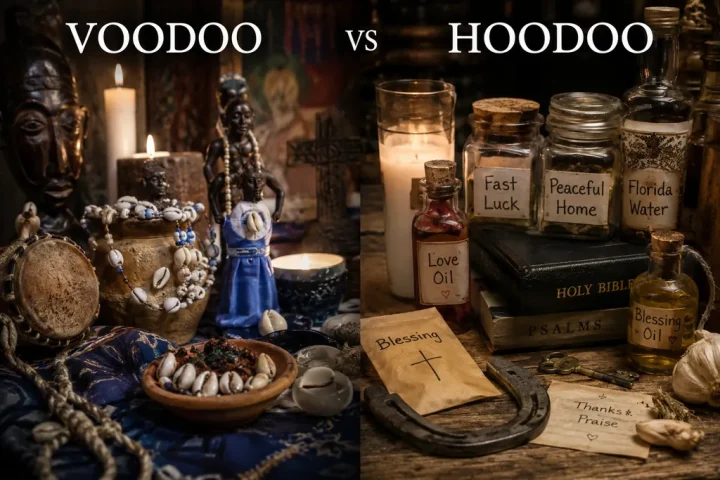
Vodun
Vodun entered the Caribbean, especially Jamaica and Saint-Domingue, now Haiti and the Dominican Republic, through enslaved Africans from groups including the Bambara, Foula, Arada or Ardra, Mandingue, Fon, Nago, Iwe, Ibo, Yoruba, and Congo.
White slaveholders often feared these practices and punished enslaved people severely for gathering, preserving fetishes, or practising African religion. Punishments could include mutilation, sexual disfigurement, flaying alive, burial alive, imprisonment, hanging, or death.
To avoid persecution, enslaved Africans outwardly practised Catholicism while secretly preserving their ancestral gods through saints, songs, prayers, forest rites, and hidden ritual.
Vodun possession involves the loas or mystères, the old gods and ancestral spirits. The priest is called a houngan, and the priestess a mambo. They summon the spirits and help them depart when their work is done.
The possessed lose ordinary consciousness and become the loa, taking on its desires, personality, age, strength, gestures, and expressions. A frail person possessed by a vigorous spirit may dance without regard to disability, while a young woman possessed by an old spirit may appear decrepit.
Possession is sacred but can also be frightening and dangerous. It may cause mental imbalance or deterioration of health if not handled properly.
Santeria
Santeria is similar in practice to Vodun and centres on the worship of ancient African gods, mostly Yoruban, blended with Catholic saints. The word Santeria comes from the Spanish santo, meaning “saint.” Practitioners are called santeros and santeras.
The orishas who possess devotees have complex personalities, desires, preferences, tempers, and powers. When possessed, devotees may perform feats of strength, eat and drink large quantities, and divine the future with accuracy.
Santeros are believed to hold enormous power. They possess knowledge that can change lives, either through their own skill or with the help of the orishas. Whether that power is used for good or evil rests with the santero.
Candomblé
Candomblé closely resembles ancient Yoruba practices from Africa. The term likely derives from candombe, a celebration and dance performed by enslaved people on coffee plantations.
The first candomblé centre was organised in 1830 in Salvador, the old capital of Brazil and now the capital of Bahia, by three former slave women who became high priestesses. These women inherited ceremonial duties because enslaved men were often forced into field labour.
The priestesses, called Mothers of the Saints, trained other women known as Daughters of the Saints, excluding men from major responsibilities.
Candomblé ceremonies involve invocations, prayers, offerings, healing, and voluntary possession. Devotees believe the greatest spiritual healing occurs when a person becomes one with their orisha during initiation.
Such possession may be intense. Other worshippers must assist constantly, and the priest may beg the orisha to treat the initiate gently, offering a pigeon or other sacrifice in return for mercy. The stronger the orisha, the more violent the possession may be.
Umbanda
Umbanda was founded in 1904 and has roots in African tribal religions, Hinduism, Buddhism, Brazilian Indigenous beliefs, Catholic saint veneration, and spiritism.
The term umbanda probably derives from aum-gandha, a Sanskrit description of the divine principle. Umbanda incorporates Catholic saints and Brazilian Indigenous spiritual traditions. The orishas often appear under Catholic names and personae.
In addition to orishas, possessing entities include exus, pomba giras, caboclos, pretos velhos, and criancas.
Exus are spirits of the wicked and dangerous dead, including suicides. Their female counterparts are pomba giras. Outsiders sometimes equate them with demons, but they are more accurately understood as trickster or morally ambiguous spirits rather than purely evil beings.
Caboclos are spirits of dead Indigenous people. They possess herbal knowledge, pride, strength, and decisiveness.
Pretos velhos are spirits of dead Afro-Brazilian slaves. They are gentle and helpful in personal matters and healing, especially with herbal remedies.
Criancas are spirits of children who died between ages three and five. They are consulted for personal matters and healing.
Quimbanda, formerly called Macumba, involves black magic and contact with lower spirits.
Mediumship and Channeling
In the nineteenth century, belief in diabolical possession declined in the West, while belief in spirit possession increased through mediumship and spiritualism.
Mediumship involves communication with the dead or other spirits. In physical mediumship, the medium allows a form of temporary possession, permitting spirits to use the body and voice. In mental mediumship, the communication is impressed upon the medium’s thoughts.
Mediums enter altered states ranging from light dissociation to deep trance. In deep trance, they may have no awareness of what occurs. When the trance ends, there is usually a transition period back to normal awareness.
Mediumship can take a physical and mental toll and may adversely affect health.
Though mediumship is voluntary, it sometimes begins involuntarily, with spirits taking over a person before the medium learns control. Trance may be induced through drugs, fasting, meditation, prayer, or other techniques.
Channeling is essentially similar to mediumship but is a newer term. It is usually applied to contact with highly evolved human spirits, nonhuman spirits, angels, extraterrestrials, or spiritual teachers rather than ordinary dead people.
Religious critics argue that the true identities of these spirits may be demons seeking deception and possession. Catholics and other religious groups often warn believers not to consult psychics or mediums.
Spiritualism and Spiritism
Spiritualism is a religious movement that began in the mid-nineteenth century and spread across both sides of the Atlantic. Its central belief is that spirits survive death and can communicate through mediums.
Spiritualism teaches belief in an immanent God active in nature, the essential goodness of human beings, the denial of the need for salvation, and the rejection of Hell. Instead, the dead are believed to go to Summerland, a place of perpetual summer where departed spirits spend eternity.
Spiritism developed from spiritualism in the mid-nineteenth century. Its chief proponent was Hippolyte-Léon-Denizard Rivail, a French writer and physician who wrote under the name Allan Kardec.
Kardec believed that some illnesses have spiritual causes and can be treated through communication with spirit guides. He argued that epilepsy, schizophrenia, and multiple personality could sometimes show signs of spirit interference or possession, either by the dead or by remnants of the patient’s past lives.
He theorised that each person contains “subsystems” from past lives inherited through reincarnation. Sometimes these dominate the present personality, blocking reality and controlling the body. Treatment requires communication with these spirits, understanding their presence, and persuading them to depart.
Kardec’s ideas became fashionable in France for a time but were most enthusiastically received in Brazil.
Possession in Ritual Magic and Wicca
In ritual magic, voluntary possession can occur when gods or spiritual powers are invoked. In high magic, the magician may seek infusion with divine energy, consciousness, and enlightenment, as in work connected with the Holy Guardian Angel.
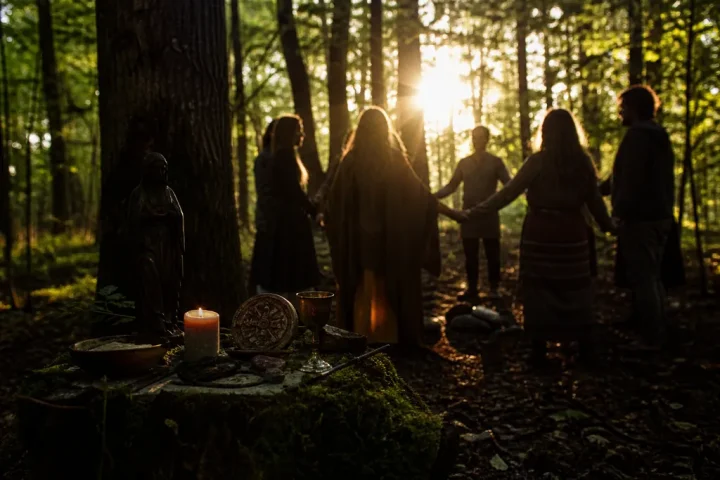
In Wicca, Drawing Down the Moon is a ritual in which the High Priestess enters a trance state and channels an inspirational message from the Goddess. This is a form of temporary sacred possession, not demonic takeover.
Possession as Illness
In ancient times, demons and spirits were often blamed for physical and psychological illness. However, sceptical and medical explanations are also ancient.
The oldest surviving text on epilepsy, On the Sacred Disease, attributed to Hippocrates or his students, argues that behaviours and sensations commonly blamed on demonic possession are caused by brain disease.
Modern medicine has suggested that many historical possession cases may have involved epilepsy, Tourette’s syndrome, schizophrenia, dissociative identity disorder, hysteria, trauma, or other psychological and neurological conditions.
Epileptic seizures can involve unconsciousness, violent movement, vomiting, and visual, auditory, or olfactory hallucinations. Some epileptics report the presence of God, angels, spirits, or the dead. They may smell terrible stenches resembling brimstone or rotting flesh.
Tourette’s syndrome can involve facial contortions, upward eye rolling, growls, barks, grunts, and sexual, blasphemous, or scatological outbursts — all traits once associated with demonic possession.
Schizophrenia may involve hallucinations, altered states, and the projection of parts of the personality as external voices, demons, or spirits.
Some theories of multiple personality or dissociative identity disorder have suggested that extreme trauma may create an opening through which spirit influences enter. This remains controversial, but it has appeared in psychiatric and spiritual literature.
Psychiatrists and Spirit Possession
Several modern researchers and psychiatrists have explored the possibility of spirit influence in mental disturbance.
Dr. James Hervey Hyslop, an American psychologist known for his research into obsession cases, argued in Contact with the Other World, published in 1919, that if telepathy is possible, then invasion of personality at a distance may also be possible. He believed it was unlikely that only sane and intelligent spirits could influence the living.
Hyslop suggested that people diagnosed with hysteria, multiple personality, dementia praecox, or other disturbances sometimes showed signs of invasion by discarnate entities, and he called on medical practitioners to consider this possibility.
The psychiatrist M. Scott Peck claimed that two of his patients suffered from possession in addition to multiple personality symptoms. In People of the Lie, published in 1983, he described patients who were aware of an alien presence from the beginning. During exorcism, their faces were said to transform into masks of malevolence.
One patient became serpent-like, with writhing body, hooded reptilian eyes, and attempts to bite members of the exorcism team. Peck said that what overwhelmed him most was not the performance but the feeling of an ancient, evil heaviness in the room, relieved only when the exorcism succeeded.
Dr. Ralph Allison, a California psychiatrist trained at UCLA and Stanford Medical Center, also argued that some cases of multiple personality may involve spirit possession, both harmless and demonic. In Minds in Many Pieces, published in 1980, he described patients with paranormal phenomena and striking psychic abilities in at least one personality.
One case involved a young man who began hearing a voice after being struck on the head. He suffered unexplained convulsive seizures, and the voice told him he was going to die. Under hypnosis, the voice claimed to be the Devil and said it had entered him during military service in Japan after an explosion blew him from a burning house. A religious expert concluded that the spirit was not the Devil but a stupid, evil entity that believed it was the Devil. After an exorcism, the man’s symptoms disappeared.
In the 1920s and 1930s, Dr. Titus Bull, a New York physician and neurologist, treated some patients spiritually as well as physically with the help of a medium using the pseudonym Mrs. Carolyn Duke. Like Carl A. Wickland before him, Bull believed that possessing spirits were not always evil but often confused. With help, they could pass to the proper plane, bringing peace to both the spirit and the victim.
Bull believed spirits entered through the base of the brain, the solar plexus, or the reproductive organs. He also thought some pains suffered by the living might actually come from the obsessing dead spirit, especially if that spirit suffered in life.
Legacy
Possession remains one of the most complex subjects in demonology, witchcraft, religion, anthropology, psychology, and occult history.
It may be feared as demonic takeover, honoured as divine communion, used in healing, interpreted as mediumship, understood as spirit contact, or explained as illness. It appears in Christian exorcism, Islamic djinn lore, Hindu and Japanese spirit beliefs, Vodun, Santeria, Candomblé, Umbanda, shamanism, Spiritualism, Spiritism, ritual magic, and Wicca.
Its meaning depends entirely on context.
In one tradition, possession is a horror to be expelled.
In another, it is a god’s blessing.
In another, it is a medical condition.
In another, it is a doorway to the dead.
Possession endures because it speaks to a profound human fear and fascination: that the self may not be closed, that the body may be entered, that the voice may be used, and that unseen powers may move through human life.
Continue Your Path with Occult World
Possession is one of the most serious and misunderstood subjects in occult study. It stands at the crossroads of demonology, witchcraft, spirit work, religion, trance, mediumship, exorcism, ritual magic, and altered states of consciousness.
Inside the Occult World Mystery School, you can explore these subjects with structure, depth, and discernment. We study demonology, protection work, spirit traditions, witchcraft, black magick, ritual practice, haunted phenomena, mediumship, secret societies, Tarot, Lenormand, and the hidden forces that shape occult history.
This is not shallow fear-based content. It is serious occult study for seekers who want to understand the difference between spirit contact, possession, obsession, invocation, mediumship, and dangerous spiritual interference.
Join the Occult World Mystery School and continue your journey into demonology, witchcraft, black magick, protection, ritual power, and the deeper mysteries of the unseen world.
See Also
- Demonic Possession
- Exorcism
- Spirit Possession
- Djinn
- Zar
- Vodun
- Santeria
- Candomblé
- Umbanda
- Mediumship
- Channeling
- Spiritualism
- Spiritism
- Holy Ghost
- Drawing Down the Moon
- Holy Guardian Angel
- Witchcraft
- Sorcery
- Curses
- Evil Eye
- Lycanthropy
- Salem Witches
- Aix-en-Provence Possessions
- Loudun Possessions
- Louviers Possessions
- Warboys Witches
- Anneliese Michel
- St. Louis Exorcism Case
FURTHER READING:
- Blai, Adam. “Demonology from a Roman Catholic Perspective.” Available online. URL: https://www.visionaryliving. com/ghosts.html. Downloaded August 14, 2006.
- Crabtree, Adam. Multiple Man, Explorations in Possession and Multiple Personality. New York: Praeger, 1985.
- Ebon, Martin. The Devil’s Bride, Exorcism: Past and Present. New York: Harper & Row, 1974.
- Eliade, Mircea. Shamanism. Princeton, N.J.: Princeton University Press, 1964.
- Fortea, Fr. José Antonio. Interview with an Exorcist: An Insider’s Look at the Devil, Diabolic Possession, and the Path to Deliverance. West Chester, Pa.: Ascension Press, 2006.
- Goodman, Felicitas D. The Exorcism of Anneliese Michel. Oreg.: Garden City, N.Y.: Doubleday, 1981.
- ———. How About Demons? Possession and Exorcism in the Modern World. Bloomington: Indiana University Press, 1988.
- Ibn Taymeeyah’s Essay on the Jinn (Demons). Abridged, annotated and translated by Dr. Abu Ameenah Bilal Philips. New Delhi: Islamic Book Service, 2002.
- Kapferer, Bruce. A Celebration of Demons. Bloomington: Indiana University Press, 1983.
- Kelly, Henry Ansgar. The Devil, Demonology, and Witchcraft: The Development of Christian Beliefs in Evil Spirits. Eugene, Oreg.: Wipf & Stock, 1974.
- Martin, Malachi. Hostage to the Devil. New York: Harper & Row, 1987.
- Oesterreich, T. K. Possession: Demonical and Other among Primitive Races, in Antiquity, the Middle Ages and Modern Times. New Hyde Park, N.Y.: University Books, 1966.
- Peck, M. Scott. Glimpses of the Devil: A Psychiatrist’s Personal Accounts of Possession, Exorcism and Redemption. Detroit: Free Press, 2005.
- ———. People of the Lie. New York: Simon & Schuster, 1983.
- Wickland, Carl. Thirty Years among the Dead. 1924. Reprint, N. Hollywood, Calif.: Newcastle, 1974.
- Wilkinson, Tracy. The Vatican’s Exorcists: Driving Out the Devil in the 21st Century. New York: Warner Books, 2007.
- Zaffis, John, and Brian McIntyre. Shadows of the Dark. New York: iUniverse, Inc., 2004.
SOURCES:
- The Encyclopedia of Demons and Demonology – Written by Rosemary Ellen Guiley – Copyright © 2009 by Visionary Living, Inc.
- The Encyclopedia of Witches, Witchcraft and Wicca – written by Rosemary Ellen Guiley – Copyright © 1989, 1999, 2008 by Visionary Living, Inc.
- The Encyclopedia of Magic and Alchemy Written by Rosemary Ellen Guiley Copyright © 2006 by Visionary Living, Inc.



Follow