
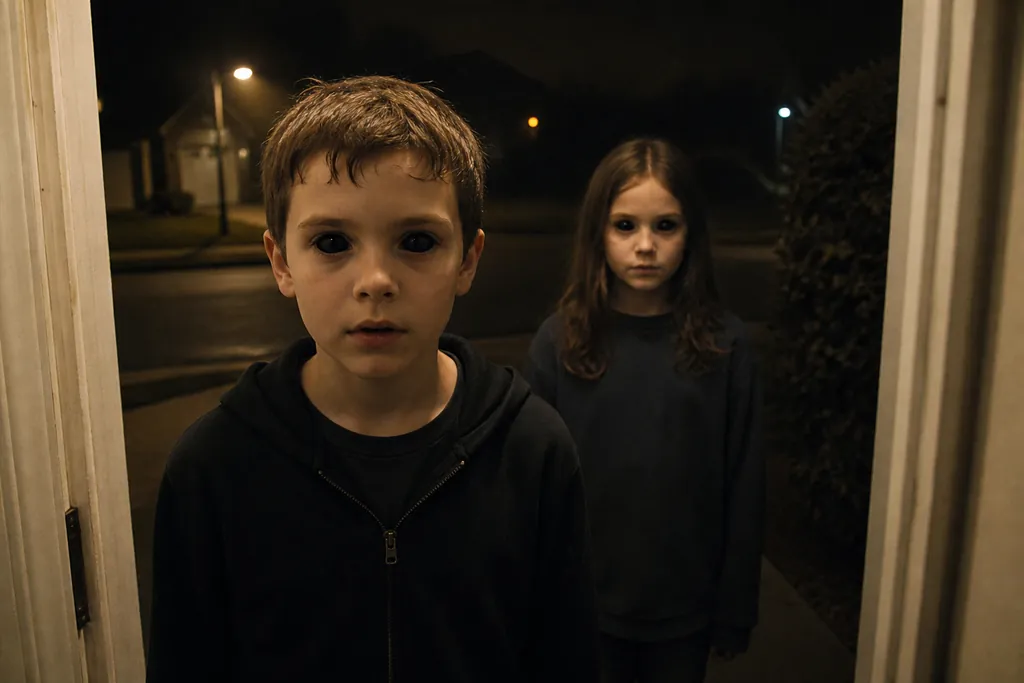
Black-Eyed People, more commonly known as Black-Eyed Kids or BEKs, are mysterious figures reported in modern paranormal folklore. They are usually described as children, teenagers, or occasionally adults whose most disturbing feature is their entirely black eyes. Witnesses describe the eyes as having no visible white, no normal iris, and no human warmth. The encounter often begins in an ordinary setting — a knock at the door, a request for a lift, a child standing beside a car, or a stranger appearing unexpectedly at a window or in a quiet street. What begins as a simple request quickly becomes a deeply unsettling experience.
The Black-Eyed Kids phenomenon is relatively modern in its current form, but its themes are much older. Stories of strange beings asking for entry, spirits unable to cross thresholds without permission, and inhuman entities disguised in human form are found throughout folklore, demonology, vampire lore, faerie traditions, and ghost stories. The BEK legend can therefore be understood as a contemporary expression of a very ancient fear: the fear that something outside the human world may ask to be invited in.
Appearance
Black-Eyed People most often appear as children or young teenagers, usually pre-teen or adolescent. They may be seen alone, but many accounts describe them appearing in groups of two or three. In these cases, one usually does the speaking while the others remain silent. Their clothing varies from account to account. Some are described as wearing hoodies or ordinary modern clothing, while others appear in strangely outdated garments, old-fashioned dresses, school-like clothing, or plain, forgettable outfits.
The most important feature is always the eyes. Witnesses often report that the beings appear almost normal at first. The fear may begin before the eyes are noticed, as if the body senses something wrong before the mind can identify it. Then the witness sees the eyes: completely black, empty, and unnatural.
This moment is usually the turning point of the encounter. The person who was being approached no longer feels that they are dealing with an ordinary child, stranger, or lost traveller. Instead, they feel that something inhuman is standing before them.
Although they are usually called Black-Eyed Kids, not all of them are described as children. Some reports involve adults with the same black eyes and the same unsettling behaviour. These adults may wear business clothes, casual clothing, or ordinary streetwear. The term Black-Eyed People is therefore more accurate when referring to the wider phenomenon.
Behaviour and Encounters
A typical Black-Eyed People encounter follows a recognisable pattern. The witness is usually alone, isolated, or in a vulnerable position. The being appears suddenly and asks for something. The request is often simple and ordinary: to use the telephone, to be let inside, to get a lift, to be helped, or to have the witness accompany them somewhere.
At first, the request may seem reasonable. A child asking to use the phone or a young person asking for help would normally inspire concern. But in BEK encounters, the witness almost always reports a growing sense of dread. The voice of the Black-Eyed Kid is often described as flat, emotionless, monotone, or strangely persuasive. Some witnesses describe it as hypnotic, as though the being is trying to influence their will.
If the witness hesitates or refuses, the being often becomes more insistent. The request may be repeated. The tone may become firmer. The pressure increases. The witness may feel confused, guilty, frightened, or mentally overwhelmed.
This insistence is one of the most disturbing parts of the legend. The beings rarely begin with open violence. They do not usually force their way in. Instead, they ask. They pressure. They wait for permission.
The Importance of Permission
One of the strongest themes in Black-Eyed People accounts is the need for entry. They want to come into a house. They want to enter a car. They want the witness to open the door, roll down the window, or allow them into a private space. This detail connects the BEK phenomenon to much older traditions of supernatural boundary-crossing.
In many forms of folklore, the threshold is sacred. A doorway is not merely an architectural feature; it represents the line between the safe inner world and the unknown outside world. In magical and spiritual traditions, the home is often understood as a protected space. The same can be said of a vehicle, which functions as a small personal enclosure, especially at night or in an isolated place.
For this reason, the request made by Black-Eyed People carries symbolic weight. They are not simply asking for help. They are asking for access.
This has led some researchers and paranormal writers to compare them with spirits, vampires, faerie beings, and demonic entities that cannot fully enter unless invited. Whether this is understood literally, spiritually, or symbolically, the pattern remains powerful. The Black-Eyed Person stands at the boundary and attempts to persuade the human being to open it.
The Feeling of Dread
Many paranormal beings are described as frightening because of what they do. Black-Eyed People are frightening because of what they make people feel. Witnesses often report an immediate and overwhelming sense of danger. This fear is usually described as stronger than ordinary discomfort. It may include pressure in the chest, frozen movement, mental fog, nausea, panic, or the sudden certainty that something terrible will happen if the being is allowed closer.
This dread is one of the defining features of the phenomenon. The witness may not understand why they are afraid. The situation may not appear dangerous on the surface. A child asking for help should not trigger terror. Yet the fear is often described as instinctive and absolute.
In occult interpretation, this reaction is sometimes seen as the body or spirit recognising a hostile presence before the conscious mind can explain it. In psychological interpretation, it may be understood as the human survival instinct responding to subtle abnormalities: unnatural speech, unusual stillness, strange timing, or the contradiction between a childlike appearance and an emotionally empty presence.
In either case, the emotional signature of a BEK encounter is central to the legend. The witness does not merely see something strange. The witness feels invaded, pressured, and endangered.
Possible Explanations
There is no agreed explanation for Black-Eyed People. The phenomenon exists in the uncertain territory between urban legend, paranormal testimony, folklore, psychology, and spiritual interpretation. Several theories are commonly suggested.
Some believe Black-Eyed People are a form of predatory spirit or energy-feeding entity. According to this view, they create fear and confusion in order to weaken the witness and gain access to their space or energy.
Others interpret them as demonic or hostile spiritual beings. The black eyes, emotional emptiness, unnatural presence, and need for permission are all features that fit certain older ideas about invasive spirits and negative entities.
Another theory suggests that they are interdimensional beings: intelligences that can imitate the human form but do not fully understand human behaviour. Their almost-human appearance, strange speech, and sudden arrival or disappearance are often used to support this idea.
Some connect the phenomenon to extraterrestrial or hybrid lore, especially because of the black eyes and emotionless manner. However, BEK encounters usually feel less technological than alien-abduction reports. They are more intimate, more folkloric, and more concerned with entry, permission, and personal boundaries.
A sceptical interpretation views Black-Eyed Kids as a modern urban legend. From this perspective, BEKs express contemporary fears about strangers, unsafe spaces, manipulation, children who do not behave like children, and the vulnerability of being alone at night. Even if approached as folklore rather than literal fact, the phenomenon remains significant because it reveals powerful cultural anxieties.
Folkloric Meaning
The Black-Eyed People legend is effective because it combines innocence with threat. A child is supposed to represent vulnerability, trust, and the need for protection. In BEK stories, that expectation is reversed. The child becomes the danger. The request for help becomes a trap. The human instinct to be kind is turned into a possible weakness.
This reversal gives the phenomenon its emotional power.
Black-Eyed People also represent the fear of false humanity. They look human, speak human words, and understand human social behaviour well enough to make a request. Yet something essential is missing. Their eyes reveal the absence of ordinary human feeling. The witness is confronted with a form that resembles a person but does not feel like one.
In this sense, BEKs belong to the wider family of liminal beings: figures that stand between categories. They are child and predator, human and inhuman, helpless and threatening, physical and possibly supernatural. They appear at thresholds because they themselves are threshold beings.
What Do They Want?
The purpose of Black-Eyed People remains unknown. Most accounts agree on one point: they want something from the witness. They want entry, movement, attention, access, or obedience. Their requests are rarely random. They are directed toward crossing a boundary.
They may want to enter the home.
They may want to enter the car.
They may want the witness to follow them.
They may want the witness to surrender control through fear, guilt, or confusion.
Whether this is interpreted as literal supernatural hunger, psychological manipulation, spiritual testing, or symbolic folklore, the deeper meaning remains the same. Black-Eyed People challenge the human boundary. They force the witness to decide whether compassion should override instinct.
The repeated warning in BEK lore is clear: do not ignore the feeling of danger.
Protection and Response
In both practical and spiritual terms, the advice surrounding Black-Eyed People is simple. Do not allow them into your home, vehicle, or private space. Do not follow them. Do not open the door if every instinct tells you not to. Do not allow guilt to silence your intuition.
If the encounter is understood in ordinary safety terms, this is common sense. A stranger appearing unexpectedly and insisting on entry should be treated with caution. If the encounter is understood spiritually, the same principle applies. Boundaries matter.
After a frightening encounter, some people choose to cleanse their space, pray, perform a banishing ritual, use protective symbols, burn cleansing herbs or incense, or reinforce the energetic boundary of the home. In occult practice, the important point is not panic but sovereignty. The home must be treated as one’s protected domain, and permission should never be given lightly.
Interpretation
Black-Eyed People occupy a strange place in modern paranormal belief. They are not quite ghosts, not quite demons, not quite aliens, and not quite ordinary urban legend. Their power lies in their ambiguity. They appear in the shape of the familiar, but they carry the atmosphere of the unknown.
The stories continue because they touch a very old human fear: the fear that evil may not always arrive violently. Sometimes it knocks politely. Sometimes it asks for help. Sometimes it waits at the door and asks you to invite it in.
The most frightening part of the Black-Eyed People phenomenon is not only their black eyes. It is the moment of decision they create. The witness must choose whether to trust appearance or instinct.
In these stories, survival often depends on one simple act:
Refusing to open the door.
Continue Your Path on Occult World
If you are fascinated by Black-Eyed People, this subject belongs to a much larger world of spirit encounters, hostile entities, hauntings, possession lore, threshold magic, and spiritual protection. On Occult World, you can continue exploring related subjects such as apparitions, shadow people, demons, exorcism, haunted places, spirit attachment, and protection magic.
Black-Eyed People are not merely a creepy internet legend. They are part of a deeper conversation about boundaries, fear, invitation, and the unseen forces that may attempt to enter human space.
If this article disturbed you, that is exactly why protection work matters.
Join the Digital Coven
Reading about the unknown is one thing.
Learning how to protect yourself from it is another.
Inside the Digital Coven, you are guided into a more serious path of spiritual awareness, protection, energy work, intuition, and occult discipline. This is not random superstition. It is structured training for people who want to understand the hidden world without becoming passive, frightened, or spiritually unprepared.
The Black-Eyed People legend teaches one essential lesson: not everything that asks for access should be allowed in.
Inside the Digital Coven, you learn how to strengthen your own threshold — spiritually, mentally, and energetically.
You learn how to recognise warning signs.
You learn how to cleanse your space.
You learn how to protect your energy.
You learn how to stand in your own authority.
Because when something knocks, you should not be confused about your power.
You should already know who you are.
Go Deeper: Protection, Spirits, and the Hidden World
If you want to go beyond fear and into knowledge, continue your studies through Occult World’s courses, members-only lessons, and spiritual training paths.
Recommended next steps:
Study protection techniques for shielding, cleansing, and banishing.
Explore the Demonology course for a deeper understanding of hostile spiritual forces.
Enter the Digital Coven for structured spiritual development and practical occult training.
Read further in the Occult World encyclopedia on spirits, hauntings, apparitions, demons, and exorcism.
Do not only collect frightening stories.
Learn what they are teaching you.
The unseen world does not only respond to curiosity. It responds to weakness, fear, obsession, and permission.
So protect your space.
Strengthen your energy.
And never open the door just because something asks nicely.



Follow