Grimoires

A

Arbatel of Magic
The Arbatel of Magic is a slim text written in Latin and published in Basel, Switzerland, in 1575. It was translated into German in 1686. The authorship is not known, but it is speculated the person may have been Italian, because of several obscure references to Italian history. The book refers to “Theophrastic Magic,” indicating influences of Paracelsus. It has no connection to the Solomonic writings and does not even mention Solomon; rather, it has ...

Ars Notoria – The Notary Art of Solomon
One of the lengthier grimoires of the medieval period, the Ars Notoria, commonly referred to as the Notary Art of Solomon, promises the reader a series of orations, prayers, and invocations, which may be used to secure the favour of the christian god, enhancing the memory, eloquence, and general academic capability of the one performing such rituals. Originally its own text, based on even older sources not yet fully documented, this text is commonly wrapped ...
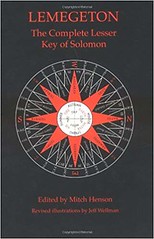
Ars Theurgia
Ars Theurgia: The second book of the work known as the Lemegeton, or Lesser Key of Solomon. The word theurgia comes from a Greek root meaning "sacramental rite" or "mystery" Theurgy itself is a type of magick that involves the invocation of beneficent spirits. It was originally practiced by the neo-Platonists. During the Renaissance, theurgy came to have the connotation of white magick, as opposed to the Goetic arts, which were generally viewed as black ...
B
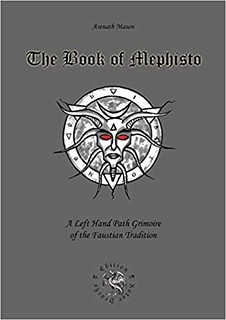
Book of Mephisto: A Left Hand Path Grimoire of the Faustian Tradition – Asenath Mason
Read Online : THIS CONTENT IS SHOWN ONLY TO AUTHORIZED MEMBERS. IT IS HIDDEN FROM EVERYONE ELSE. Book of Mephisto: A Left Hand Path Grimoire of the Faustian Tradition END OF HIDDEN CONTENT BOOKS FOR YOU TO READ IN OUR LIBRARY: ...
F

Forth Book
Fourth Book Authorship is attributed to the occultist Henry Cornelius Agrippa, but the book, supposedly the fourth volume of Agrippa’s monumental three-volume Occult Philosophy, was written by an unknown author. It is also known as the Liber Spirituum and is in the opening of the Lemegeton. The Fourth Book appeared after the death of Agrippa in 1535 and rehashes in an informal way much of the material in Occult Philosophy. Weyer, a student of Agrippa, ...
G

Galdrabok: An Icelandic Grimoire – Stephen E. Flowers
As a historical document, the Galdrabok is Stephen Flowers' account of an incredible survival of a Pagan era. It illuminates the Icelandic citizen's mindset in an era where mainland Europeans were being put to the sword for their beliefs in the Runes and the Old Ways. The naivete of some of the Galdrabok's spells (galdr) combining elements of Christian prayer and Pagan magic strikes one as charming. Here was a country where galdrmenn (sorcerers) mixed ...
Grand Grimoire
Grand Grimoire This French grimoire was probably authored in the 17th or 18th century. The earliest edition of it bears no date or place of publication. One version of it claims to date to 1522. Its full title is The Grand Grimoire, with the Powerful Clavicle of Solomon and of Black Magic; or the Infernal Devices of the Great Agrippa for the Discovery of all Hidden Treasures and the Subjugation of every Denomination of Spirits, ...
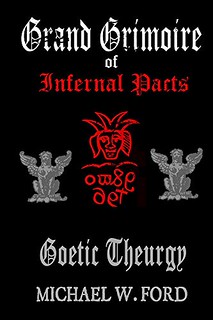
Grand Grimoire of Infernal Pacts – Michael Ford
Grand Grimoire of Infernal Pacts is a modern interpretation of Goetic Theurgy (self-transformation via demonic powers) from a Luciferian approach. The aim of Goetic Theurgy is to utilize spirits and primal forces to attain insight and fulfill short and long term goals. The myth of “selling your soul” to the devil is revealed to be nothing more than a fantasy created by fearful minds, the true nature of the infernal pact is to enter a ...
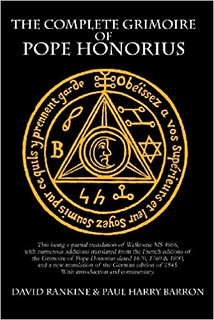
Grimoire of Honorius
Grimoire of Honorius : Also called the Constitution of Honorius, this text may have been authored in the 16th century but was first published in Rome in 1629. It gained wide circulation during the 17th century. The authorship is attributed to Pope Honorius III (r. 1216–27), who is credited with rites of exorcism. The book shows influences from the Lemegeton and claims to be based on the practical Kabbalah, but this connection is tenuous. Rather, ...

Grimoires : A History of Magic Books – Owen Davies
No books have been more feared than grimoires, and no books have been more valued and revered. In Grimoires: A History of Magic Books, Owen Davies illuminates the many fascinating forms these recondite books have taken and exactly what these books held. At their most benign, these repositories of forbidden knowledge revealed how to make powerful talismans and protective amulets, and provided charms and conjurations for healing illness, finding love, and warding off evil. But ...

Grimorium Verum
Grimorium Verum: Drawn from the Greater Key of Solomon and written in French, this book probably was written in the mid-18th century. Claims were made that it was translated from Hebrew by a Dominican Jesuit named Plaingiere and was published by “Alibeck the Egyptian” in 1517. Its full title is Grimorium Verum, or the Most Approved Keys of Solomon the Hebrew Rabbin, wherein the Most Hidden Secrets, both Natural and Supernatural, are immediately exhibited, but ...
Grimorium Verum – Joseph H. Peterson
Grimorium Verum is one of the most notorious handbooks of black magic -- one of the few that deals openly with spirits of darkness. People have long sought the aid of non-physical beings; the biblical king Solomon, in particular, had a reputation since ancient times for commanding demons. There are many texts purporting to reveal Solomon's methods, but most are extremely complicated and difficult. Grimorium Verum is one of the easier texts, but also one ...
H
Heptameron
The Heptameron is also called Magical Elements, this book is attributed to Peter of Abano, an Italian physician who died in 1316 after being condemned to death by the Inquisition. Abano is not believed to be the author. The Heptameron probably was written in the 16th century and may have been intended as a supplement to the Fourth Book. The grimoire is a composite work of white and black magic that deals with finding treasure, procuring ...
J
John Fian’s Grimoire – Dr Thor Templar, Dr Robert Blanchard
Be directly connected to the ancient Stream of John Fian witchcraft power with Guild Sigil system. By just viewing the Sigils in this occult tool book you are initiated into the Stream of Scottish/English witchcraft. No matter what system of magic you practice. Using the Sigils in this book for only a minute or two a day will connect you to more power than years of daily practice. No need to do any of the ...
K
Key of Solomon
The most important grimoire is the Key of Solomon, also called the Greater Key of Solomon and the Clavicle of Solomon. This text is the source for most other grimoires. The book is attributed to the legendary King Solomon, who asked God for wisdom and commanded an army of Demons (Djinn) to do his bidding and build great works. In the first century C.E., the Jewish historian Josephus mentioned a book of incantations for summoning ...
L
Lemegeton ( Lesser Key of Solomon )
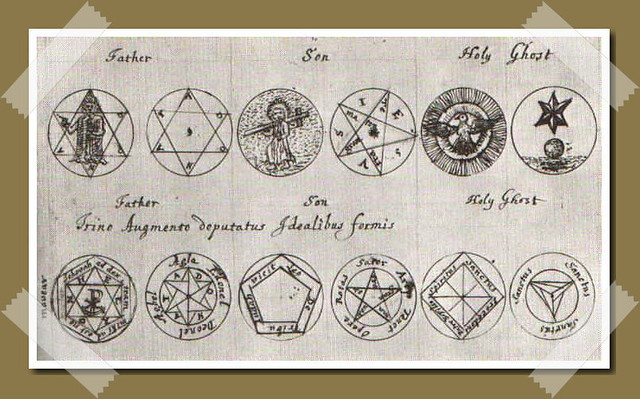
Another grimoire attributed to Solomon is the Lemegeton, or Lesser Key of Solomon. The origin and meaning of Lemegeton are not known. The book also was known as Liber Spirituum and Liber Officiorum. Claims were made that the Lemegeton was originally written in Chaldean and Hebrew, but these are doubtful. The earliest perfect examples of it are in French. The material probably is derived in part from the Testament of Solomon and also the apochryphal ...
M
Munich Handbook
Munich Handbook: A fifteenth-century Latin manuscript kept at the Bavarian State Library in Munich, filed under the designation CML 849. Because the first folio of the manuscript has been lost over time, there is no way to know the name of the author or the original title (if any) of the book. Its exact date of publication is also unknown. The book is a miscellany of magick with spells devoted mainly to illusion, divination, and ...
N
Necronomicon
The Necronomicon is a fictitious black magic GRIMOIRE, the idea of which was created by the American occult and horror fiction writer, H. P. Lovecraft (1890–1937). Lovecraft wrote about the book in his fiction and acquired a cult of followers who believe that it actually exists and that it is based, at least in part, on fact. The Necronomicon was born of Lovecraft’s fertile imagination in his 1936 essay, “A History of The Necronomicon.” He ...
S

Secrets of the Magickal Grimoires: The Classical Texts of Magick Deciphered – Aaron Leitch
The magickal methods and esoteric knowledge of medieval Europe (476 to 1453 C.E.) form the ancestral backbone of modern ceremonial magick. To understand medieval magick, it's necessary to know the primary repositories of this knowledge―the grimoires of spells, incantations, and ritual instructions for working with angels and conjuring spirits. And to understand the grimoires, you must delve into the life and times of the magicians who wrote them. Scholar and magician Aaron Leitch sheds light ...

Sworn Book of Honorius
Sworn Book of Honorius: Also known as the Liber Juratus, or simply the Sworn Book. This book was supposedly written by Honorius, son of Euclid, and inspired by the angel Hochmel. The name of the angel is almost certainly derived from the Hebrew word hochmah (sometimes also transliterated as chochmah), meaning "wisdom." Hochmah is also one of the ten Sephiroth on the Qabbalistic Tree of Life. It is called the Sworn Book because those individuals ...
T
Testament of Solomon
The Testament of Solomon is a Greek text in the pseudepigrapha written between the first and third centuries C.E. It tells the story of how King Solomon built the Temple of Jerusalem by commanding Demons. The text is rich in Demonology, angelology, and lore about medicine, astrology, and magic. The author probably was familiar with the Babylonian Talmud. The text says that stellar bodies are Demonic, wielding destructive power over the affairs of humanity. The ...
The Black Pullet
First surfacing in France in the 18th century, The Black Pullet is a guide to the construction and use of magical talismanic rings. With the use of these rings, people attained extraordinary powers. Perhaps the most wonderful secret revealed is the power to produce the Black Pullet, otherwise known as the "Hen with the Golden Eggs." Unlimited wealth was granted to the person who achieved the creation of this incredible Hen. Includes complete instructions for ...
The Complete Grimoire of Pope Honorius
"I conjure thee, Oh BOOK to be useful and profitable unto all those who shall read thee for success in their affairs." ~ Conjuration for the Book, Grimoire of Pope Honorius The Grimoire of Pope Honorius is the first and most important of the French 'black magic' grimoires which proliferated across Europe in the 17th-19th centuries. Combining a grimoire of conjurations to demons of the four directions and seven days of the week with a ...

The Devil’s Dozen: Thirteen Craft Rites of the Old One -Gemma Gary
The operations of magic and witchcraft deal with the hidden worlds of spirit and the powers innate within the natural world; within plant, stone and magical loci. The 'Old One', who in folk tradition is often named 'The Devil' embodies both the 'rend in the veil' and the spanning bridge between the worlds of the material and spiritual, the revealed and the hidden. It is through union with this entity that witches and folk magicians ...

The Goetia of Dr. Rudd – Dr Stephen Skinner, David Rankine
This manuscript was owned by Dr. Thomas Rudd, a practicing scholar-magician of the early seventeenth century who knew Dr. John Dee. There are many editions of the Goetia, of which the most definitive is that of Joseph Peterson, but this volume shows how the Goetia was actually used by practicing magicians in the sixteenth and seventeenth centuries, before the knowledge of practical magic faded into obscurity. For example, to evoke the seventy-two demons of the ...
The Grimoire of St. Cyprian – Clavis Inferni (Sourceworks of Ceremonial Magic) – Dr Stephen Skinner, David Rankine
There have been many grimoires attributed to St. Cyprian of Antioch due to his reputation as a consummate magician before his conversion to Christianity, but perhaps none so intriguing as the present manuscript. This unique grimoire addresses the summoning and use of the four Archangels, Michael, Raphael, Gabriel and Uriel as well as their opposite numbers, the four Demon Kings, Paymon, Maimon, Egyn and Oriens. The latter are shown in their animal and human forms ...
The Sworn Book of Honorius
The Sworn Book of Honorius (in Latin, Liber Iuratus Honorii) is one of the oldest as well as one of the most influential existing medieval grimoires, or works of mediaeval magic. It was prepared from two British Museum Manuscripts. The oldest preserved manuscript, Sloane MS 3854, dates to the 14th century; other Sloane MS 313 dates to the late 14th or early 15th century. This edition is Daniel J. Driscoll's version of this old and ...
Theosophia Pneumatica
Theosophia Pneumatica Also known as The Little Keys of Solomon, this grimoire was published in 1686 in German. It possibly was included in the German edition of the Arbatel of Magic, a work it follows closely. Of anonymous authorship, the Theosophia Pneumatica makes no claims to ancient origins. Like the Arbatel, it is Christian in orientation and holds that the exaltation of prayer is the end of the Mystery. The Hebrew term Talmud—derived from the ...
Theurgia Goetia
The Theurgia Goetia is one of the five books that make up the Lesser Key of Solomon, also known as the Lemegeton. This grimoire, which dates back to the 17th century, is a compilation of occult texts that focus on the summoning and control of spirits. The Theurgia Goetia specifically deals with the evocation of spirits associated with the points of the compass and the zodiac, making it distinct from the other books in the Lemegeton, such as the Ars Goetia, which focuses ...
True Black Magic
Also called The Secrets of Secrets, this black magic grimoire purportedly was written in the 1600s by a magician named Toscraec, who claimed that it was based on a centuries-old manuscript written in an unknown language. Toscraec said he was only able to translate the manuscript with the help of an angel. It probably was written in the 18th century. True Black Magic is a goetic adaptation of the Key of Solomon. In the book, ...
