

Ogun: Spirit of Iron, War, Labour, Technology, and Transformational Power
Ogun is the West African spirit of iron, metal, tools, labour, technology, war, protection, and raw creative force. He is not merely associated with iron; in a mystical sense, he is iron. Hold a knife, a horseshoe, a chain, a blade, a nail, or a piece of worked metal in your hand, and you are holding something that belongs to Ogun’s domain.
In Yoruba tradition, Ogun is one of the great orishas, a powerful spirit whose presence is felt wherever metal cuts, builds, protects, repairs, or destroys. He is the patron of metalworkers, blacksmiths, warriors, hunters, surgeons, drivers, mechanics, police officers, soldiers, chefs, jewellers, engineers, and everyone whose work depends upon metal tools or technology.
Ogun is ancient. His veneration is at least as old as the Iron Age in Africa, which began around 500 BCE. Yet he is not only a spirit of the distant past. Ogun is also intensely modern. Every machine, vehicle, weapon, blade, computer, engine, railway line, and surgical instrument carries something of his power.
Ogun in Yoruba Creation Myth
According to Yoruba creation myth, Ogun led the orishas to Earth and helped them survive in the physical world. He cleared the way through dense forest, cutting paths through thickets and obstacles with his machete.
This image of Ogun cutting the path is central to understanding him. He is the force that breaks through resistance. He opens roads where there are none. He clears wilderness, removes barriers, and makes civilisation possible.
Ogun is a culture hero. He taught humanity the mysteries of ironworking, hunting, warfare, magical ritual, and spiritual practice. Although he is not primarily an agricultural spirit, he made agriculture possible by forging the tools needed to cut, dig, cultivate, and harvest. Without Ogun, the field cannot be opened. Without Ogun, the blade does not cut. Without Ogun, the path remains blocked.
The Spirit of Iron and Metalworkers
Ogun is the patron of blacksmiths and all who work with metal. Traditionally, metalworkers were not merely craftsmen; they were also spiritual specialists. In many cultures, the blacksmith stood between worlds. He worked with fire, earth, ore, force, breath, and transformation. He took raw material from the ground and turned it into tools, weapons, ornaments, and sacred objects.
For this reason, metalworking has often been surrounded by magic. The forge is a place of transformation. Fire changes matter. Iron becomes useful through heat, pressure, discipline, and skill. Ogun rules this mystery.
He is present wherever raw power is shaped into form. He is the energy of the forge, the hammer, the anvil, the blade, the surgical instrument, the machine, the engine, and the weapon.
Ogun the Path-Cutter
Ogun is often invoked as the remover of obstacles. His machete cuts away what blocks progress. He does not always remove obstacles gently. His energy is direct, forceful, and uncompromising.
When Ogun clears a path, he does so with the blade. He is not the spirit of soft persuasion. He is the spirit of decisive action.
This makes him especially important for those who need courage, strength, discipline, protection, employment, survival, or the power to move forward after stagnation. Ogun teaches that sometimes the path does not appear by waiting. Sometimes it must be cut.
Ogun as Protector and Warrior
Ogun is a fierce protector. He defends those under his care, especially the vulnerable, the orphaned, the displaced, and those who need shelter. He is a patriarchal force in the sense of guarding, providing, defending, and taking responsibility.
Yet Ogun’s protection is inseparable from danger. He protects with the same instruments that can kill. Knives, swords, guns, machetes, tanks, engines, vehicles, and industrial machines all belong to his sphere.
This makes Ogun deeply ambivalent. He is healer and executioner, builder and destroyer, warrior and craftsman. He can save life through surgery, but he can also take life through violence. He can open a road, but he can also bring disaster through metal, machines, weapons, and accidents.
Ogun and Justice
Ogun hates lies. In Nigeria and other regions influenced by Yoruba tradition, oaths may be sworn on iron in the same way that oaths are sworn on a Bible in other cultures.
To swear falsely before Ogun is considered dangerous. If an oath is broken, Ogun may bring justice through his own domain. His anger may manifest through accidents involving metal: car crashes, train wrecks, knife injuries, gun incidents, machine failures, and other violent disruptions.
Ogun’s justice is not sentimental. He is direct, hard, and unforgiving toward deception. His presence reminds devotees that words have weight, promises matter, and lies can cut as sharply as a blade.
Ogun and Technology
Although Ogun is ancient, he is also the spirit of technology. His power is not limited to the blacksmith’s forge. Any technology that depends upon metal belongs to his expanding realm.
Cars, buses, trains, aircraft, engines, computers, medical instruments, factory equipment, weapons, electrical systems, and machines all fall under Ogun’s influence. In the modern world, Ogun is everywhere. He is in the vehicle that carries you to work, the knife that prepares your food, the surgeon’s scalpel, the computer circuit, the railway line, and the machinery of industry.
This is one reason Ogun remains so relevant. He is not a relic of the past. He is one of the great spirits of modern life. Every age creates new forms of metal, and Ogun moves with them.
Ogun the Solitary Witch-Doctor
At the same time, Ogun is not only industrial or technological. He also embodies the solitary forest-dwelling witch-doctor, healer, hunter, and ritual specialist.
He knows the secrets of metal, but he also knows the wisdom of the forest. He lives close to hunters, herbalists, shamans, and magical workers. His knowledge includes not only ironworking and warfare, but also occult practice, healing, protection, and spiritual transformation.
This dual nature is part of his mystery. Ogun is both ancient forest and modern machine. He is both machete and computer. He is both blacksmith and surgeon. He is both warrior and magician.
Ogun, Ogou, and the African Diaspora
Ogun is venerated throughout West Africa and appears in many African Diaspora traditions. In Haitian Vodou, he is often known as Ogou, where he appears in different forms connected to war, politics, iron, leadership, protection, magic, and transformation.
In modern Vodou, Ogou is one of the spirits most closely associated with transformational magic and fierce spiritual power. In certain forms, he may be connected with sorcery, protection, and the mysteries of the loups-garoux. As a magician, he is sometimes paired with Ezili Dantor, a powerful spirit associated with fierce motherhood, protection, wounds, survival, and love hardened by suffering.
In Umbanda, Ogun leads the Third Line of the Seven Lines of spirits. In different traditions, he may be syncretised with Saint James the Greater, Saint George, Saint Andrew, Saint Martin Caballero, Saint Peter, John the Baptist, or Michael the Archangel, depending on cultural and religious context.
These syncretic associations show how Ogun’s power has travelled, transformed, and survived across continents and spiritual systems.
Study Ogun, Vodou, Hoodoo, and Spirit Traditions Inside Occult World Academy
If Ogun fascinates you, this is exactly the kind of spirit work, folklore, and occult history we explore inside the Occult World Academy on Skool.
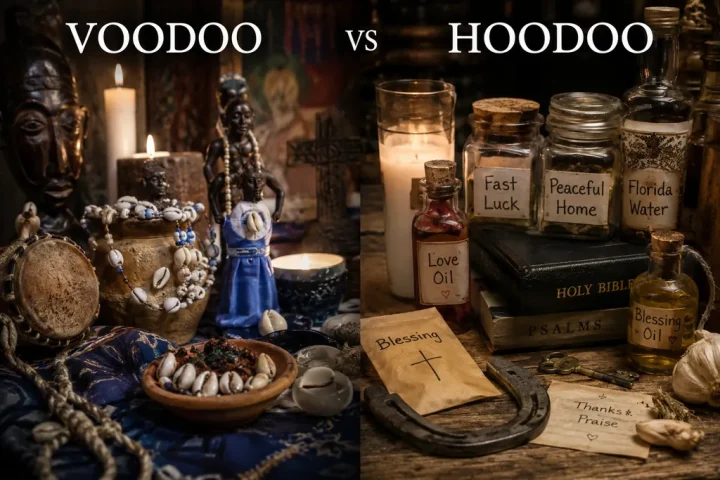
Inside the Academy, you can go deeper into African Diaspora spirituality, spirit veneration, magical traditions, and practical occult knowledge. We have both a Voodoo course and a Hoodoo course, giving you the opportunity to study powerful traditions connected to spirits, ancestors, ritual work, protection, magical practice, and the living relationship between the visible and invisible worlds.
The Occult World Mystery School is not just a place to read articles. It is a growing academy and community for occultists, witches, spiritual seekers, and practitioners who want to study seriously, ask questions, and connect with others walking the same path.
Join the Occult World Academy on Skool and continue your journey into Voodoo, Hoodoo, spirit work, African Diaspora traditions, witchcraft, divination, demonology, ancient grimoires, and the deeper mysteries of the occult world.
Ogun and Blood
Ogun has a complex relationship with blood. Iron is present in blood, and Ogun rules iron. He is associated with both birth and death, both the cutting of the umbilical cord and the blade that kills.
The knife that ends a life may also save a life in surgery. The hoe that opens the earth for planting may also open the earth for burial. Ogun is present at thresholds where blood, iron, life, and death meet.
Because of this, traditional cautions surround approaching him. One should not make offerings to Ogun while bleeding, whether from menstruation, a shaving cut, injury, or any other cause. In such a state, it is better not to approach him.
This rule reflects the seriousness of his power. Ogun is not a spirit to approach casually, carelessly, or without respect.
Ogun as Healer
Although Ogun is strongly associated with weapons and violent death, he is also a healer. His connection with iron, blood, surgery, and physical intervention makes him especially important in matters of health.
He may be invoked for diseases of the blood, including illnesses such as sickle-cell anaemia, leukaemia, and AIDS. He is also called upon for protection and success before surgery, since the surgeon’s scalpel belongs to him.
Ogun’s healing power is not soft or gentle. It is the healing of the blade that cuts in order to save. It is the healing of the tool, the operation, the hard intervention, the painful but necessary act that restores life.
He is also invoked for fertility, virility, and sexual strength. As a spirit of force, heat, iron, blood, and vitality, he radiates creative energy as well as destructive power.
Ogun and Work
Ogun is a tireless worker. He is active at the forge, on the road, in the workshop, on the battlefield, in the operating theatre, in the kitchen, and on behalf of his devotees.
He is especially invoked to help people find employment. This connection makes sense: Ogun is the spirit of labour, tools, skill, productivity, discipline, and applied force. He does not reward laziness. He respects effort, courage, stamina, and usefulness.
To work with Ogun is to honour work itself. Not vague dreaming, but action. Not empty words, but tools in the hand. Not passive hope, but the will to forge a path.
Offerings and Symbols of Ogun
Ogun is traditionally associated with iron, tools, weapons, machetes, knives, horseshoes, chains, railroad tracks, red palm oil, and the colour red.
One traditional way to summon his presence is to place two pieces of metal together and anoint them with red palm oil. Offerings may also be left near railroad tracks, which are powerful symbols of Ogun’s iron roads and unstoppable movement.
Some devotees tie a red ribbon around the base of a vehicle’s rear-view mirror to invoke Ogun’s protection while travelling. This reflects his connection with cars, buses, drivers, engines, roads, and accidents involving metal.
As always, such gestures should be made with reverence. Ogun is not merely a lucky charm. He is a powerful spirit of iron, discipline, and consequence.
Ogun the Creator and Destroyer
Ogun embodies one of the great paradoxes of spiritual power: the same force that builds can destroy. The same blade that protects can kill. The same machine that advances civilisation can cause disaster. The same iron that makes the plough also makes the sword.
He is an artist, a master craftsman, a healer, a warrior, and a workaholic. He radiates fertility and creative power, yet he also governs bloodshed, machines, weapons, and violent accidents.
This is why Ogun is approached with both love and caution. He is generous to his devotees, but he is not tame. He is protective, but never harmless. He opens roads, but he also punishes betrayal. He creates tools, but those tools can wound.
To understand Ogun is to understand that power itself is never neutral. It depends on how it is forged, directed, and honoured.
Ogun’s Enduring Power
Ogun remains one of the most important and dynamic spirits in West African and African Diaspora traditions. He is ancient enough to belong to the Iron Age, yet modern enough to rule computers, cars, machines, surgical tools, and weapons of the present age.
He is the machete cutting the path through the forest. He is the blacksmith shaping iron in the fire. He is the surgeon’s hand, the soldier’s weapon, the driver’s engine, the worker’s tool, and the magician’s blade.
Ogun teaches strength, labour, discipline, honesty, courage, protection, and transformation. He reminds us that obstacles can be cut away, that tools must be respected, and that creation and destruction often arise from the same source.
He is iron.
He is the path.
He is the force that cuts through.
Favoured people:
Ogun is patron of all those who work with metal, including miners, tattoo artists, circumcisers, construction workers, jewelers, smiths, steelworkers, butchers, surgeons, drivers, pilots, and railroad workers.
Also known as:
Ogou; Gu; Ogoun; Ogu; Ogum
Classification:
Lwa, Orisha
Manifestations:
A big, virile, powerful, handsome, charismatic man with fiery radiant eyes. Ogun is also present in metal. When you touch metal, you touch him. He may wear green or palm fronds or be accompanied by dogs.
Attributes:
A machete, a three-legged iron cauldron, traditionally wrapped in chains and filled with iron implements, including tools, spikes, nails, and knives
Emblem:
A sword driven into Earth
Spirit allies:
Eshu Elegbara, Ochossi, Erinle, Osain. Ogun adores Oshun. Relationships with Yemaya, Oya, and Ezili Dantor can be positive or tense. Some, although not all, traditions consider Ogun and Shango to be bitter rivals who should be kept far from each other.
COLOURS:
Red, black, sometimes green, sometimes red and white (the colours of heated iron), or blue and red (the colours of the Haitian flag)
Numbers:
3, 7
DAY:
Wednesday (sometimes Tuesday)
Planets:
Mars, Earth (because iron is mined from Earth)
CREATURES:
Dogs, snakes especially black mambas and black-necked cobras, snails (snails’ liquid is traditionally used to heal circumcision wounds), crocodiles, and red roosters
Mount:
He rides a spotted hyena (symbolically indicating his power over witchcraft, with which hyenas are closely associated in Africa) or a beautiful white stallion.
Trees:
Akoko (Newboldia laevis), palm, calabash, camwood, eucalyptus
Plant:
Cyperus esculentus called Espada de Ogum in Brazil and yellow nutsedge in English, among the earliest cultivated edible plants. Also garlic, roseMary, black pepper, chilé peppers, and many medicinal herbs.
Spice:
Grains of Paradise (Afromomum melegueta) which has culinary and magical uses
Festival:
25 July in Plaine du Nord, near Cap Haitien, Haiti
Altars:
Ogun’s altars are usually maintained with discretion in a cabinet or closet. An anvil or cauldron can serve as his altar or a repository for offerings. Make sure it’s a three-legged cauldron, not two. Think about it and you’ll know why.
OFFERINGS:
Red candles, cigars, rum, palm wine, whisky, aguardiente, or other alcoholic beverage—especially overproof rum—salt, dragon’s blood incense, metal, chains, metal tools, railroad spikes. Fill a cauldron with found pieces of metal, miniature ritual tools, full-size tools, toy cars, planes or other vehicles (make sure they’re metal, not plastic). If you cook for him, he likes his food spicy: add lots of hot peppers or hot sauce. Dress offerings with red palm oil. Offer roasted yams, red beans, red rice, mangos, and/or meat.
The various paths of Ogun may be understood as different aspects of one Ogun or as several closely related spirits. In Haitian Vodou, the Ogou family of spirits is known as the Nago nation and mediates between Rada and Petro.
The following are but a few of his many paths:
OGUN BALENDJO
ALSO KNOWN AS:
Balendyo
Ogun Balendjo, sacred physician, epitomizes the healing powers of iron, both in terms of tools but also in terms of the body’s iron content. Ogun Balendjo is patron of physicians as warriors against disease. He may also be invoked when battling against the medical industry. Invoke his aid if you are anemic.
Ogun Balendjo is the watery aspect of Ogun, spirit of the Ogun River. Forge steam and water are traditionally used to heal illness and impotence. Ogun Balendjo presides over water heated for healing purposes, like steam baths, especially if intensely heated because he is a very macho spirit even when kind and gentle. (See Also: Bahlindjo.)
Ogun Balendjo is syncretized to Saint Anthony or Saint George.
FAVOURED PEOPLE:
Surgeons, acupuncturists, military physicians, nurses, medics, those who treat veterans
OFFERINGS:
Iron tablets, surgical tools, acupuncture needles, hypodermic needles, War Water (a magical formula made by soaking iron nails in water)
OGUN FERRAILLE
ALSO KNOWN AS:
Ogoun Fer; Ogou Feray
Ogoun Ferraille, warrior lwa, is understood as the primary figure in the traditional chromolithograph of Saint James the Greater—the saint himself riding to battle on a white horse. He is the chief of all the warrior paths of Ogun.
Ogou Ferraille is the spirit who was invoked on 14 August 1791 at Bois Caiman initiating the Haitian Revolution. It is rumored that when Jean-Jacques Dessalines (circa 1758–1806) ripped the white fabric from the French tricolour flag, creating the blue and red Haitian flag, he was channeling Ogou Ferraille. (After he died, Dessalines joined the Ogou family becoming Ogou Dessalines.)
Ogun Ferraille is associated with the magical and healing power of magnets. Request that he gird your loins before entering battle, literally or metaphorically.
FAVOURED PEOPLE:
Soldiers, warriors in tanks or armoured fighting vehicles (AFVs), armourers
MANIFESTATION:
Ogoun Ferraille is a knight in shining armour, but he is also envisioned as a metal man or cyber man. Ferraille refers to scrap metal.
Offering:
Overproof rum, toy soldiers—especially old-fashioned metal ones—military medals, and regalia
Ogoun Ferraille is the name of a cocktail, a flaming rum punch:
1. Stir honey to taste into one part passion fruit juice; warm very gently on the stove.
2. Add to three parts dark rum and flambé.
3. Sprinkle with spices like ground cardamom, cinnamon, and coriander.
4. Serve a glass to Ogoun.
OGUN Gé ROUGE
ALSO KNOWN AS:
Ogou Jé Rouge
Ogou Gé Rouge is red-eyed Ogun, a fierce, wrathful lwa filled with rage, classified as a Petro or Bizango lwa. He is the patron of loupsgaroux. Shaman Ogou bestows the point of power enabling the soul to leave the body in the form of a flying werewolf and journey across the sky leaving a phosphorescent trail.
OGUN LA FLAMBO
ALSO KNOWN AS:
Ogou La Flambeau
Ogou la Flambo is an ecstatic warrior who exults in battle and bloodshed. He dances and whirls on the battlefield, killing to his left, and slaughtering to his right. He is aflame with passion, bloodlust, and the heat of battle. He is akin to rampaging Anat, Kali or Sekhmet or Odin’s shamanic berserk warriors.
Ogou la Flambo is scary Ogun—unless he is fighting for you! (He’s scary then too: stay out of his way until he’s done.) Nothing can stop him. He is the blind, inexorable force of destruction.
• At his best, Ogou la Flambo destroys injustice, oppression, and tyranny.
• At his worst, Ogou la Flambo is a bloodthirsty, violent force that must exhaust itself, as once activated, it cannot be stopped.
OFFERINGS:
Flambéed overproof rum, trail of gunpowder set ablaze (be careful!), bullets, weapons, iron
OGUN KRIMINEL
ALSO KNOWN AS:
Ogou Kriminel, Ogoun Kriminel
What’s that old joke about there being a very thin line between police and thieves? Ogou Kriminel crosses that line. Ogou Kriminel is thug or gangster Ogun invoked by criminals for protection, especially from law enforcement and incarceration. On the other hand, as the biggest, baddest criminal, Ogou Kriminel may be invoked to destroy or remove other criminals when other methods have failed. (Be careful: he’s dangerous.) He is identified with Saint Elias.
See Also:
- List of Lwa
- Baron Kriminel
- Bahlindjo
- Bizango Spirits
- Erinle
- Ezili Dantor
- Ezili Freda Dahomey
- Logunedé
- Loup-Garou
- Lwa
- Marinette
- Michael
- Ochossi
- Orisha
- Orisha Oko
- Oshun
- Oya
- Padilha, Maria
- Petro
- Rada
- Sarabanda
- Seven African Powers
- Shango
- Yemaya
- Anat
- Ezili Gé Rouge
- Ezili La Flambeau
- Kali
- Odin
- Sekhmet
- Bizango Spirits
- Ezili Gé Rouge
Source:
Encyclopedia of Spirits: The Ultimate Guide to the Magic of Fairies, Genies, Demons, Ghosts, Gods & Goddesses– Written by Judika Illes Copyright © 2009 by Judika Illes.






Follow